


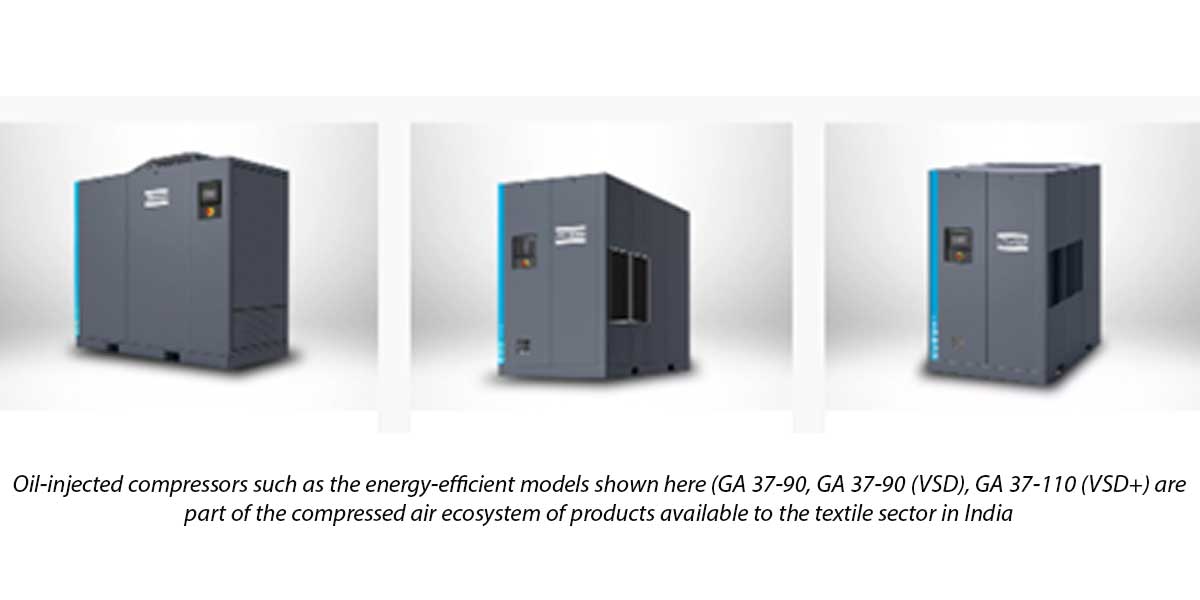
Modern textile manufacturing operates within a highly integrated ecosystem of machinery, process technologies, and utility systems. Among these, compressed air remains one of the most critical yet often overlooked enablers of production. Commonly referred to as the “fourth utility” alongside electricity, water, and gas, it supports a wide range of applications across textile operations. Its importance is further underscored by the fact that nearly 90 per cent of manufacturing facilities globally depend on compressed air systems, highlighting its foundational role across industrial sectors.
Role across core textile processes
Textile manufacturing involves multiple interconnected stages—from fibre preparation and spinning to weaving, dyeing, finishing, and packaging. Compressed air is embedded across each stage, ensuring process continuity, control, and consistency.
In spinning operations, it is used for fibre transport, machine cleaning, and maintaining yarn integrity. High-speed spinning technologies, including air-jet systems, rely on precisely regulated airflows to twist fibres, enabling higher productivity while maintaining uniformity. These processes demand stable pressure conditions and clean air to avoid irregularities in yarn formation.
Weaving operations further highlight the reliance on compressed air. Air-jet looms, now widely used in modern textile plants, depend on high-pressure air streams to insert weft yarn across warp threads at high speeds. This enables faster production cycles compared to traditional mechanical systems while reducing wear and tear. However, performance is directly linked to air stability—pressure fluctuations or contamination can lead to defects such as uneven fabric structure or yarn breakage.
Driving efficiency, precision, and automation
The increasing adoption of automation in textile manufacturing has elevated the importance of compressed air systems. Pneumatic components enable rapid and precise machine movements, supporting high-speed operations with repeatability and minimal mechanical complexity. This contributes to improved equipment uptime and reduced maintenance requirements.
Applications such as automated winding, inspection, and packaging depend heavily on pneumatic systems to deliver consistent performance. Additionally, compressed air enables real-time operational adjustments, supporting process stability even under demanding production conditions.
It also plays a key role in maintaining clean production environments. Textile processes generate significant lint and fibre dust, which can accumulate on machinery and affect both performance and product quality. Controlled airflows are widely used to remove such contaminants, helping maintain operational hygiene and reduce the risk of defects.
Energy considerations and system optimisation
Despite its operational advantages, compressed air remains one of the more energy-intensive utilities in textile manufacturing. In many textile facilities, compressors account for a significant share of total electricity consumption. At an industrial level, compressed air systems can consume around 10% of total electricity, with higher shares observed in continuous-process environments.
A critical factor is system efficiency. Losses due to air leaks, pressure drops, and suboptimal system design can significantly increase energy consumption. In many cases, a substantial portion of generated compressed air does not effectively reach end-use applications, which means extra operational costs which can be avoided.
Energy therefore becomes a central consideration in compressed air management, often representing the largest component of lifecycle costs. As a result, textile manufacturers are increasingly focusing on system-level optimisation rather than standalone equipment upgrades. Measures such as leak detection programmes, optimised system sizing, and advanced control technologies are being implemented to improve performance. Digital monitoring solutions are also enabling real-time insights, allowing operators to identify inefficiencies and take corrective action proactively.
Air quality and product integrity
Compressed air quality is a critical determinant of product outcomes in textile manufacturing, particularly in processes such as dyeing, finishing, and texturizing. The presence of contaminants—including oil, moisture, and particulates—can lead to defects such as staining, uneven dye absorption, or compromised fabric texture.
To mitigate these risks, textile facilities integrate air treatment solutions such as compressed air filtration systems, dryers, and moisture separators. The use of clean, contamination-free air is essential in ensuring product consistency and reducing rejection rates in high-sensitivity processes. Maintaining stable airflow and pressure conditions further supports uniformity across production runs, especially in large-scale operations.
Enhancing workplace conditions and reliability
Compressed air systems also contribute to improved workplace ergonomics and operational safety. Pneumatic tools are generally lighter and easier to handle, reducing operator fatigue in repetitive tasks. In addition, well-designed systems can minimise noise and improve overall working conditions within textile facilities.
From an operational standpoint, reliability is critical. Any disruption in compressed air supply can impact multiple processes simultaneously, leading to downtime and production losses. Preventive maintenance practices and system monitoring therefore play a key role in ensuring consistent performance and avoiding unexpected interruptions.
Emerging Trends and the Path Forward
As textile manufacturing continues to evolve, the role of compressed air systems is becoming more sophisticated. The integration of digital technologies, including Industrial Internet of Things (IIoT) platforms, is enabling predictive maintenance, automated control, and improved system visibility. These advancements allow manufacturers to transition from reactive to proactive system management.
Sustainability considerations are also shaping investment decisions. Energy-efficient system design, optimisation of compressed air networks, and the adoption of energy recovery solutions are gaining traction as manufacturers seek to reduce both operational costs and environmental impact. In energy-intensive textile processes, these measures can contribute significantly to overall plant efficiency.
Compressed air functions as an essential yet largely invisible backbone of textile manufacturing, supporting a wide spectrum of processes that define modern production. Its applications extend beyond powering equipment to enabling precision, automation, and quality assurance across the value chain.
While often overlooked, its impact is substantial—particularly in terms of energy consumption, process reliability, and product integrity. As the textile industry advances towards greater efficiency and sustainability, the role of optimised compressed air systems will continue to grow in importance, reinforcing their place at the core of industrial operations.
About the author:
Hardik Navaria is a Business Line Manager -Industrial Air, Compressor Technique at Atlas Copco (India). He is a dynamic and results-driven leader with over 16 years of experience in Sales, Marketing, and Business Development. He has experience in setting up and leading teams, developing, and executing ambitious business plans, and identifying opportunities with full potential. He has expertise strategic planning, marketing execution, customer relationship management (CRM), and cross-functional collaboration. Adept at mentoring teams, optimizing sales tools, and fostering strong customer relationships, he drives business growth and long-term performance. Operating with a growth mindset, Hardik is passionate about transforming something strong into something exceptional.