


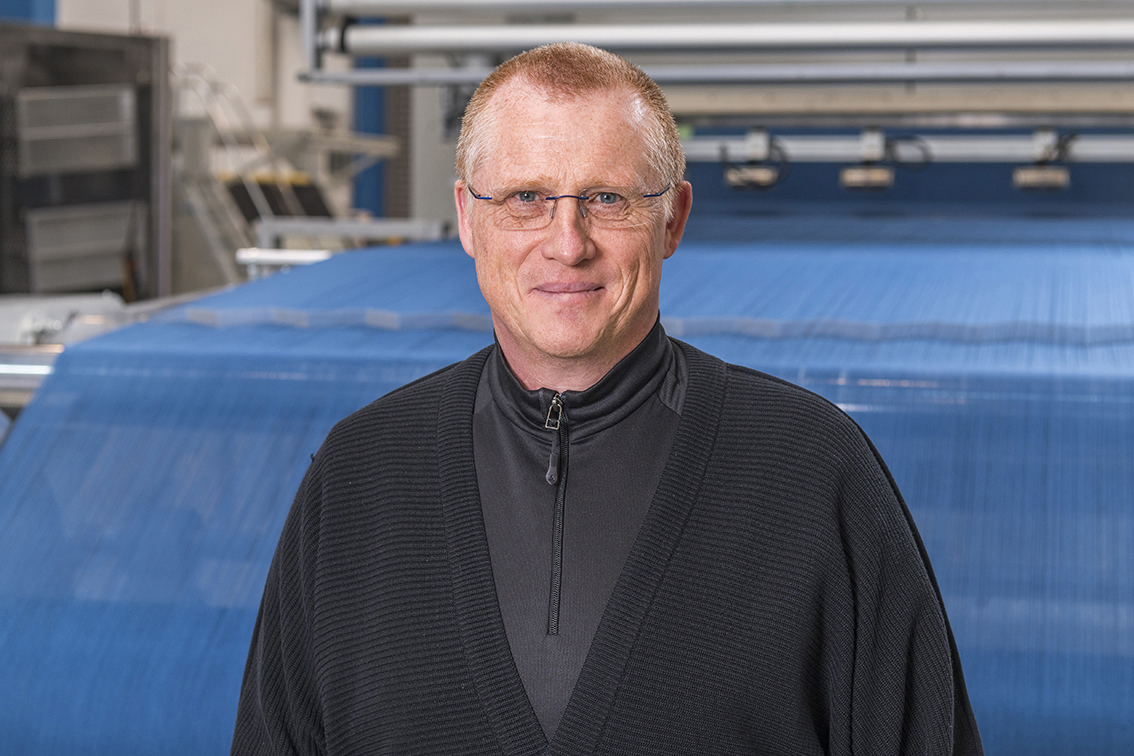
With a heritage of engineering excellence dating back to 1884, Monforts has been a pivotal partner in the global evolution of textile finishing and coating. As India shifts its focus from volume production to high-value, sophisticated textile applications, the demand for precision, energy efficiency, and digital innovation has never been more vital. Hans Wroblowski, Sales Director SEA, Monforts, in this interview with Divya Shetty, discuss how Monforts is combining long-term durability with cutting-edge technology to help Indian manufacturers optimise production, embrace sustainability, and secure a competitive edge in the global market.
Monforts has been associated with German textile machinery since 1884. How has the company contributed to the evolution of textile finishing and coating technologies globally?
Over many decades, the ‘Made in Germany’ label has become synonymous with engineering excellence and machinery innovation is a cornerstone of the country’s industrial strength. We are proud to have been a part of this sector since 1884 and successive waves of development.
Since we first entered the Indian market back in the 1960s, we have progressed through mechanical technologies to the first mass production lines, then to electronic drives and special machine construction and highly modular concepts. We are now truly in the digital age and committed to investing in the digitalisation of our technology, with concepts for further assuring precise quality control and energy monitoring.
Our role has always been to help customers produce better fabrics more efficiently. The technologies have changed enormously over the past 140 years, but that objective has remained remarkably consistent.
Textile finishing is becoming increasingly important for value addition in fabrics. How are Monforts’ technologies helping Indian textile manufacturers improve quality, consistency and production efficiency?
Finishing has become the point at which many textile manufacturers now differentiate themselves. Basic fabric production is increasingly commoditised, but finishing is where performance, appearance and value are created. Indian processors are under growing pressure to deliver higher quality with lower energy consumption and shorter production runs. This is exactly where MONTEX stenters and THERMEX dyeing and curing lines continue to demonstrate their strengths. We refine these systems continuously, improving productivity, process stability, energy efficiency and digital monitoring with every new generation.
Every new machine also benefits from lessons learned across decades of installations in mills around the world.
India has a strong presence in segments such as denim, home textiles, knitted fabrics and technical textiles. Which of these areas do you see as the biggest growth opportunities for Monforts in India?
In the next decade, volume alone will no longer define competitiveness. The winners will be the companies capable of producing increasingly specialised fabrics with consistently high quality and competitive optimised production costs.
India’s denim and home textiles markets are well established and although there is still room for growth, there are also many opportunities for expanding into niche technical textile fields. Over the past few years we have significantly advanced our technologies for coating, with the successive introductions of the MontexCoat, coaTTex, VertiDry and EcoLine systems combining flexibility, precision and energy efficiency for the basic and technical textiles market.
In outdoor and architectural textiles, for example, typical coated products include tents, awnings, sailcloth and blackout blinds, with coating providing the desired combinations of water resistance, dimensional stability, opacity or weather durability.
A second major field is in transport interiors, particularly automotive upholstery and interior fabrics, with coatings having a positive influence on parameters including abrasion resistance, tactile feel, stain behaviour and long-term durability. Automotive suppliers also demand absolute reproducibility across batches, which Monforts addresses through digitally-stored coating recipes that can be reloaded for identical results every time.
Beyond consumer-visible products, a large share of applications are in industrial applications, with Monforts coating ranges processing materials such as high-temperature filter media, flame-retardant barrier fabrics and heavy membranes for biogas storage systems. The technology is also used for carbon fibre prepregs and composite reinforcement fabrics, where coating precision is the key to mechanical performance.
German machinery is known for precision, durability and innovation. How does Monforts bring these strengths into solutions that are relevant for Indian textile mills and processors?
One of the reasons so many Monforts MONTEX stenters remain in production after more than three decades is that they were designed not just to be durable, but to evolve rather than becoming obsolete. In addition to supplying new machines, our services increasingly extend to the retrofitting of specific modules with new control and drive technology – going far beyond the basic replacement of spare parts – which can have a significant impact on the performance of an existing line. For many customers, the lowest lifetime production cost is ultimately far more important than the lowest purchase price.
Energy efficiency is a major concern in textile processing. How are Monforts’ stenters, heat-setting and finishing technologies helping manufacturers reduce energy use and operating costs?
Energy prices remain a key concern for Indian mills and our engineers are constantly looking for ways to reduce energy consumption. Heat recovery systems and dual heating options already provide the opportunity to achieve significant energy savings and we are currently exploring the use of green hydrogen as a future energy source, which could prove game changing. Ultimately, of course, the most economical unit of energy is always the one that never has to be consumed and here we are actually moving forward with our newest adaption of minimal application techniques for any kind of liquid, paste or foam.
With Indian textile companies focusing more on sustainability and responsible production, how is Monforts supporting cleaner, more resource-efficient textile finishing?
Sustainability is no longer an optional extra for textile manufacturers – it is increasingly becoming a commercial necessity. Our approach is to help customers reduce energy, water and chemical consumption while maintaining consistent fabric quality and productivity. Many of these improvements come through more efficient heat management, precise process control and the ability to monitor machine performance in real time. The result is lower operating costs alongside a reduced environmental footprint, which is becoming increasingly important for both domestic and export markets.
Looking ahead, how can stronger collaboration between German textile machinery companies and Indian textile manufacturers help India move towards higher-value and globally competitive textile production?
The shift towards man-made fibres (MMFs) and the expansion of dyeing and processing capacity signal a new growth chapter for India’s textile industry. For Monforts, this means evolving from a pure machine supplier into a consultative partner. We guide mills in transitioning to MMF production, while our state-of-the-art machinery and automation tools improve efficiency, cut water and energy use, and meet environmental standards. Training programmes help upskill workforces in handling MMF and modern dyeing techniques, while our sustainability expertise covers everything from water recycling to eco-friendly dyes. By integrating supply chains and embedding sustainable practices, we help Indian customers seize these opportunities on a global scale.
Having worked with Indian textile manufacturers since the 1960s, we’re continuing to see the industry evolve from volume production towards increasingly sophisticated, value-added textiles.
India already has the scale. The next opportunity lies in adding even more value through technology.