


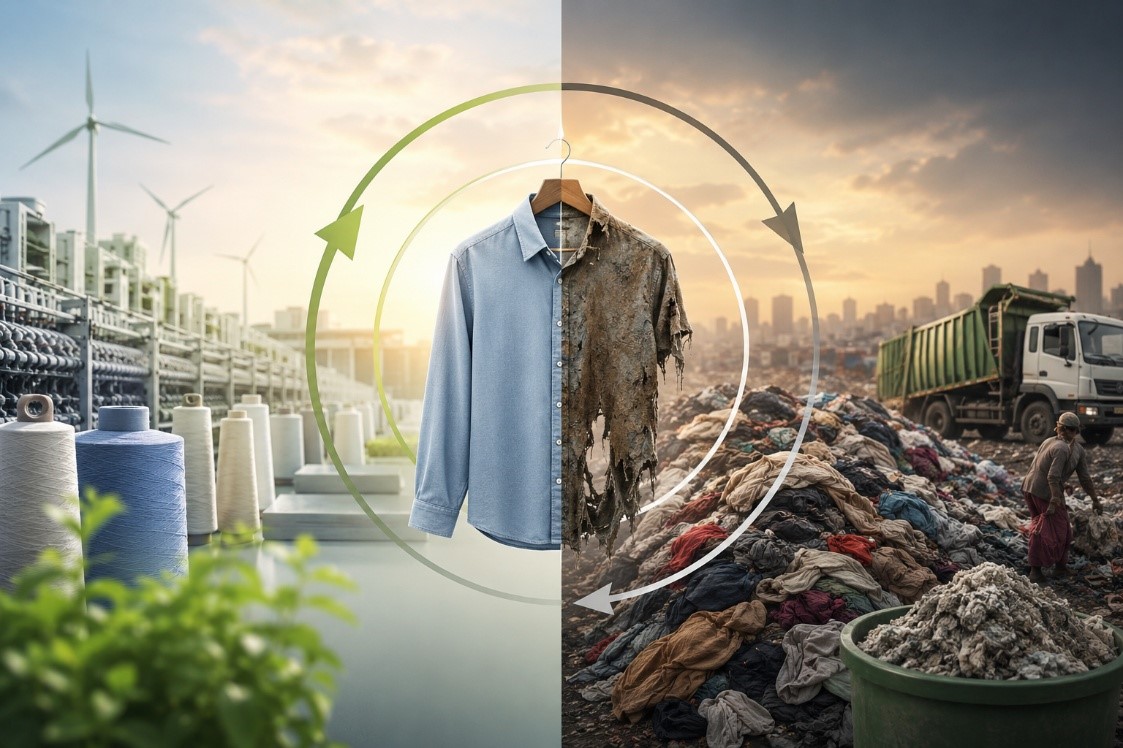
The exhibition celebrated the future of textiles. The next revolution may begin after we stop wearing them. India’s Next Textile Revolution Will Not Begin Inside a Mill. It Will Begin Inside Your Ward, Your Municipality and Your Dustbin, informs Rony Banerjee.
“I returned from Bharat Tex 2026 with optimism!”
The exhibition left little doubt that India’s textile industry stands at the threshold of its next transformation. Everywhere one looked there was talk of innovation, technical textiles, sustainability, AI-driven manufacturing, traceability, ESG compliance and the ambitious vision of taking India’s textile and apparel exports to $100 billion by 2030. The launch of the India Textiles & Apparel CXO Blueprint 2030 reinforced this confidence. The message was unmistakable: India’s next leap will come from building a smarter, more sustainable and technology-enabled textile value chain.
Yet, as I walked through the pavilions, one question refused to leave me.
“If India is preparing to manufacture the textiles of tomorrow, are we equally prepared to deal with the textiles of yesterday?”
India proudly celebrates its cotton heritage, handlooms, technical textiles, PM MITRA Parks, Production Linked Incentive schemes and sustainability initiatives. Every industry forum speaks of India’s rise as a global textile powerhouse. But amid this optimism, one uncomfortable question rarely finds space in the discussion.
What happens after India finishes wearing its clothes?
Not while garments are being donated, repaired or passed on. I mean after all of that, when a shirt has become a rag, the rag has become unusable and the fabric has no remaining value. Surprisingly, we still have no organised answer. That unanswered question is quietly becoming one of India’s biggest textile challenges.
The real blind spot lies beyond India’s metropolitan cities. Bihar, Jharkhand, Odisha, Madhya Pradesh, Chhattisgarh and West Bengal together account for more than 400 million people and are estimated to generate close to one million tonnes of post-consumer textile waste annually. Yet district-level textile recovery centres, municipal collection systems, fibre grading facilities and AI-assisted sorting units remain virtually absent. One of India’s oldest industries has become one of its least measured waste streams.
Panipat is rightly recognised as one of the world’s largest textile recycling clusters. But Panipat should be seen as a beginning, not the solution. A single recycling hub cannot serve a nation of 1.4 billion people. India needs a distributed network of regional recovery centres supported by digital traceability, decentralised material recovery facilities and efficient reverse logistics.
India has built one of the world’s strongest textile manufacturing ecosystems, yet has scarcely developed a corresponding recovery ecosystem. The sector contributes around 13 per cent of industrial production, 12 per cent of exports, 2.3 per cent of GDP and supports more than 45 million livelihoods. At the same time, the country generates nearly 7 million tonnes of textile waste every year. Unlike plastic, electronic or biomedical waste, however, discarded textiles remain largely invisible within urban governance. Municipal bodies seldom quantify them, dedicated collection infrastructure is almost non-existent, and there is little organised recovery once garments reach the end of their useful life.
Bharat Tex itself demonstrated what a circular future could look like. Plastic bottles generated during the exhibition were collected, converted into recycled yarn and transformed into fabrics. It was an impressive demonstration that circularity can be commercially viable. But it also exposed a larger contradiction. If we can recover every plastic bottle generated during a four-day exhibition, why have we still not created a nationwide system to recover millions of tonnes of discarded textiles generated every year?
India probably has one of the world’s most effective garment reuse cultures. A single shirt often passes through five or six lives, from the original owner to siblings, relatives, domestic workers, village households, second-hand markets, utensil exchange vendors and finally into a workshop as a wiping cloth. Few countries extract so much value from a garment.
Yet reuse is not the same as recycling. Every garment eventually reaches a point where it can no longer be worn, repaired or repurposed. That is precisely where India’s otherwise remarkable circular economy comes to an abrupt halt. Perhaps the industry is looking at the wrong end of the value chain. For decades, the focus has been on producing sustainable textiles. The next challenge is recovering fibres after consumers have finished using them.
Imagine every district operating a Textile Material Recovery Facility where discarded garments are collected, graded and sorted using artificial intelligence. Wearable clothing could be refurbished, damaged fabrics converted into industrial textiles, insulation materials, geotextiles or regenerated fibres, and only the irrecoverable fraction diverted for energy recovery. At that point, textile waste ceases to be a municipal liability and becomes an industrial resource.
India therefore needs more than another recycling campaign. It needs a National Circular Textile Recovery Missionbringing together the Ministry of Textiles, the Ministry of Housing and Urban Affairs, State Governments, Urban Local Bodies, recycling industries, technology companies and textile manufacturers within a single coordinated framework. This is no longer merely an environmental concern; it is an issue of industrial competitiveness, urban governance, investment and long-term resource security.
Every industrial revolution creates its own supply chain. The first textile revolution built spinning mills. The second created integrated textile parks. The third is being driven by technical textiles. The next may be built around urban fibre mining, recovering value not from cotton fields or petrochemical complexes, but from the wardrobes of ordinary households.
Bharat Tex 2026 repeatedly emphasised that India’s future will be shaped by sustainability, technology and circularity. The official Blueprint 2030 estimates that an optimised circular textile ecosystem alone could unlock nearly US$9.4 billion in economic value while creating new enterprises, employment and investment opportunities.
Perhaps the missing pavilion at Bharat Tex was not about another advanced fibre, smarter machine or innovative fabric. It was about the journey of a discarded garment after it leaves our homes. If Bharat Tex 2026 showcased India’s manufacturing strength, Bharat Tex 2027 should showcase India’s recovery strength. Because the country’s next competitive advantage may not come from producing more textiles, but from ensuring that every textile produced has a meaningful second life.
About the author:
Rony Banerjee is a strategy and policy advisor working at the intersection of textiles, MSMEs, sustainability and public policy. With over 25 years of experience across government, industry and development programmes, he focuses on industrial competitiveness, circular economy and institution building. He is a frequent commentator on emerging economic and governance issues and hails from Bihar.