


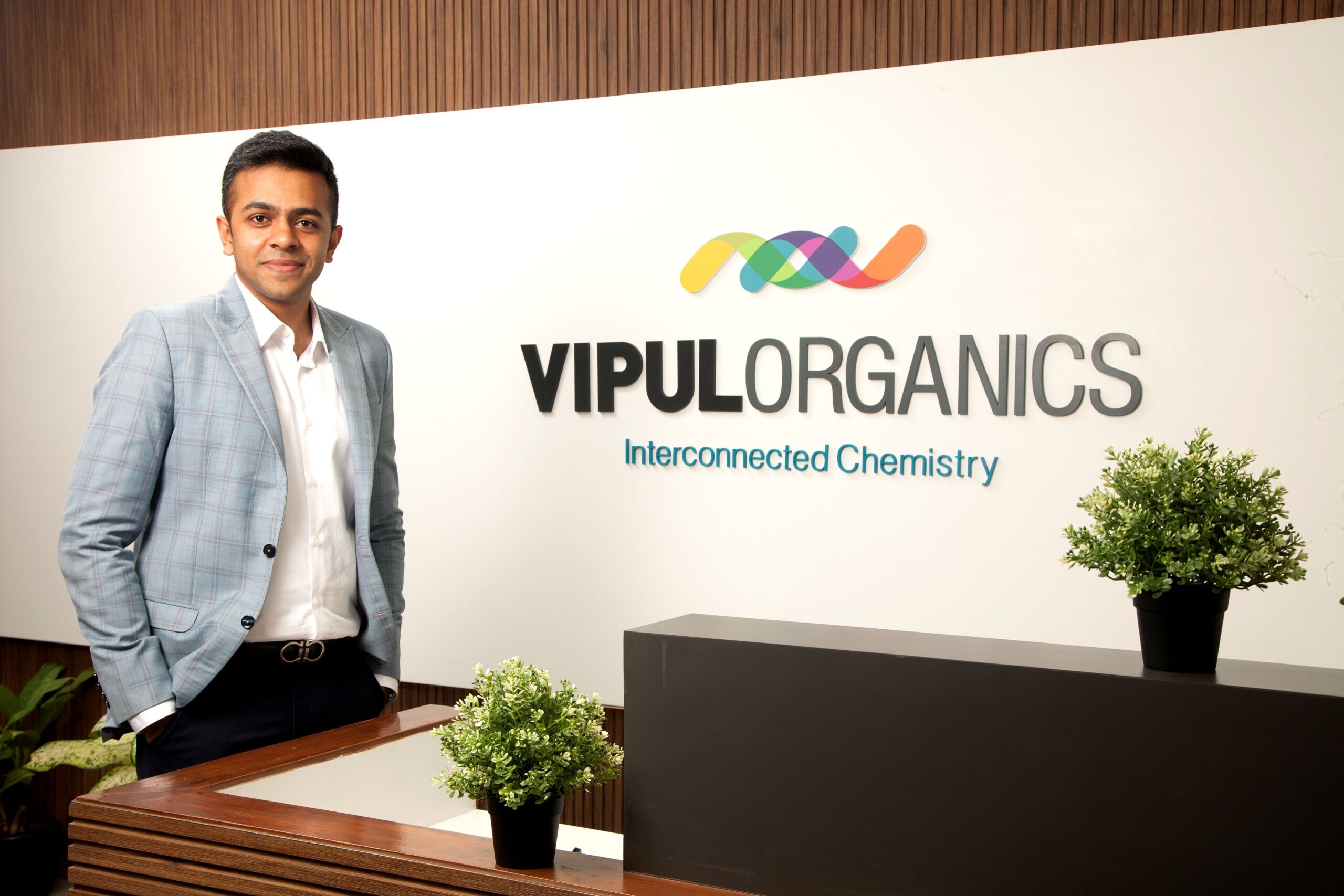
India’s textile processing industry is under growing pressure to deliver consistent colour, stronger performance and cleaner production while meeting global compliance standards. In this interview, Mihir V Shah, Executive Director, Vipul Organics, speaks with Divya Shetty about how the company is addressing these demands through advanced dyes, pigments and pigment dispersions. He discusses solutions that improve shade reproducibility, lightfastness, process stability and water efficiency, while supporting cotton, viscose, blended and technical textile applications.
How is Vipul Organics helping India’s dyeing, processing and finishing industry improve colour quality, consistency and performance?
At Vipul Organics, we have strategically strengthened our portfolio across dyes, pigments, and advanced pigment dispersions to address the evolving needs of the textile processing industry. Our pigment dispersion range, particularly SunPrint, offers a significant advantage in terms of consistent shade reproducibility, superior lightfastness, and process stability.
Unlike conventional dyeing, pigment dispersions enable cleaner processing with reduced effluent load, thereby easing the burden on ETP systems. Additionally, applications such as discharge printing traditionally complex can be effectively achieved using pigment dispersions, enhancing design flexibility without compromising environmental compliance. Overall, our solutions are engineered to deliver high colour strength, uniformity, and long-term performance across varied substrates.
How is Vipul Organics supporting textile processors in moving towards more sustainable operations?
Sustainability is no longer optional it is a business imperative. At Vipul Organics, we are actively supporting textile processors in reducing their environmental footprint through innovative product technologies.
Pigment-based coloration systems significantly reduce water consumption compared to traditional dyeing processes. In many cases, they enable near-clear water discharge, facilitating easier recycling and reuse within the plant. This not only lowers freshwater intake but also reduces chemical load and energy consumption associated with effluent treatment.
Our solutions are aligned with circular processing goals, helping customers achieve operational efficiency while meeting stringent sustainability benchmarks.
Your reactive dyes are used for dyeing and printing cellulose fibres. What makes these solutions relevant for Indian textile mills working with cotton, viscose and blended fabrics?
Our reactive dye portfolio is specifically developed to cater to the diverse fibre base of the Indian textile industry. Products like SunViscose are engineered to deliver excellent affinity and fixation on viscose and other regenerated fibres, ensuring high colour yield and uniform dyeing.
In addition, our SunVatdispersions and granules offer versatility for applications requiring superior fastness properties. For blended fabrics, we provide customised reactive dye solutions that ensure compatibility across fibre types, maintaining shade consistency and process efficiency.
This adaptability makes our solutions highly relevant for mills handling cotton, viscose, and blends, where performance, reproducibility, and cost optimisation are critical.
How important is product consistency in dyes and pigments for processors who operate high-speed dyeing, printing and finishing lines?
Product consistency is absolutely critical, especially for processors operating high-speed and automated lines. Any variation in shade strength, dispersion quality, or chemical behaviour can lead to batch rejections, downtime, and increased operational costs.
At Vipul Organics, we place strong emphasis on stringent quality control and batch-to-batch uniformity. Our manufacturing systems and process controls ensure that every lot delivers predictable and reproducible results. This reliability enables processors to run continuous operations with confidence, reducing rework and enhancing overall productivity.
With global brands demanding stricter chemical compliance, how are certifications such as ZDHC Level 3 and OEKO-TEX ECO PASSPORT helping Vipul Organics serve export-oriented textile processors?
Global compliance standards have become a key differentiator in the textile value chain. At Vipul Organics, we have achieved ZDHC Level 3 certification for over 186 pigment dispersions one of the largest certified product baskets offered by any company. Along with OEKO-TEX ECO PASSPORT, these certifications validate that our products meet the highest benchmarks for chemical safety and environmental responsibility.
For export-oriented textile processors, this provides strong assurance that the inputs used in their processes are aligned with international brand requirements. It simplifies compliance while enhancing their credibility with global buyers.
We view these certifications not just as regulatory requirements, but as a reflection of our commitment to responsible chemistry and sustainable manufacturing.
What role do pigment dispersions and reactive dyes play in improving value addition for segments such as apparel, home textiles, technical textiles and industrial fabrics?
Pigment dispersions and reactive dyes play a pivotal role in enhancing value across textile segments. Pigment dispersions enable innovative design capabilities, including special effects and surface applications, making them highly suitable for apparel and home textiles.
Reactive dyes provide deep penetration, vibrant shades, and excellent fastness properties, which are essential for high-quality garments and functional textiles.
In technical and industrial fabrics, where durability, lightfastness, and chemical resistance are critical, our solutions are tailored to meet these performance requirements. This enables customers to move up the value chain and cater to specialised and high-performance applications.
As the Indian textile industry modernises, what are Vipul Organics’ key priorities for supporting dyeing, processing and finishing units through innovation, sustainability and faster service support?
As the industry modernises, our focus is on delivering integrated solutions that combine innovation, sustainability, and operational efficiency. One of our key initiatives is Adimem a state-of-the-art membrane technology platform and a first-of-its-kind in India for 100 per cent membrane-based production. This novel technology supports advanced filtration, water recovery, and cleaner manufacturing processes.
We are also investing significantly in R&D to develop next-generation products that reduce resource consumption while enhancing performance. At the same time, we are strengthening our technical service capabilities to provide faster and more responsive on-ground support to our customers.
Our goal is to be a long-term solution partner to the textile industry helping processors adopt sustainable practices, improve efficiency, and remain competitive in both domestic and global markets.