Close Menu
Indian Textile Journal
  • Home
  • Textile Machinery
    • Allied Equipment and Accessories
    • Automation
    • Dyeing, Processing & Finishing
    • Knitting
    • Printing
    • Spinning
    • Weaving
  • Tech Textiles
  • Sustainability
  • Resources
    • Trade Fair
    • Events
    • Videos
  • Interview & Opinion
  • Subscribe Now
  • Advertise
  • Digital
  • Apparels & Garments
  • Fibres & Raw Materials
  • Home Textiles
  • Industry Update
Facebook X (Twitter) YouTube LinkedIn
Indian Textile Journal
Epson
  • Home
  • Textile Machinery
    • Allied Equipment and Accessories
    • Automation
    • Dyeing, Processing & Finishing
    • Knitting
    • Printing
    • Spinning
    • Weaving
  • Tech Textiles
  • Sustainability
  • Resources
    • Trade Fair
    • Events
    • Videos
  • Interview & Opinion
  • Subscribe Now
  • Advertise
  • Digital
  • Apparels & Garments
  • Fibres & Raw Materials
  • Home Textiles
  • Industry Update
Indian Textile Journal
Home » Unlocking the potential of man-made fibres with ring spinning
Spinning

Unlocking the potential of man-made fibres with ring spinning

By December 1, 20213 Mins Read
Share Facebook Twitter LinkedIn WhatsApp Copy Link

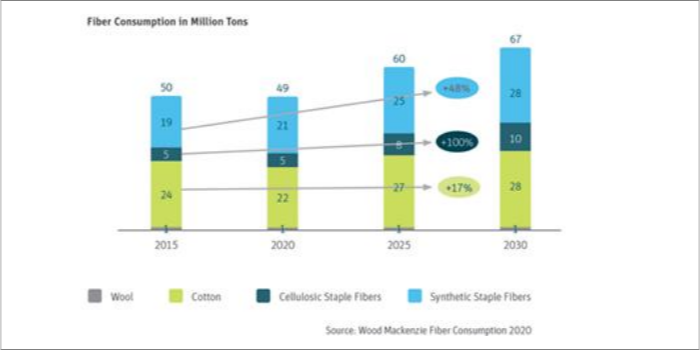
As population growth and prosperity increase, so does the consumption of fibres across the globe. While this holds true for all staple fibres, the use of man-made fibres such as cellulosic staple fibres and synthetic staple fibres is growing particularly quickly. The consumption of cellulosic staple fibres is expected to double to 10 million tons by 2030 while the consumption of synthetic staple fibres is expected to grow by 48% to 28 million tons compared to 2015 (Figure 1). Rieter addresses these market needs and continuously develops innovative technology components and solutions for MMF and blends for all end spinning processes.


MMF package for ring spinning
Synthetic fibres – usually polyester – and their blends with cotton are commonly processed on ring spinning machines. Different blends with cellulosic fibres are another popular application. In general, ring spinning is very flexible compared to other spinning processes and reacts less sensitively to fibre finish deposits which is a common challenge when processing MMF. Nevertheless, there are some technology elements on the ring spinning machine that have been specially developed for the characteristics of MMF and special settings that should be considered. One of these technology elements is the bottom roller with a diameter of 30 mm. It helps to reduce the build-up of fibre lapping for fine fibres like MMF.

Thanks to an additional drive unit for the middle bottom roller, positioned in the middle of the machine, Rieter can offer long ring spinning machines also for MMF: The G 37 machine with semi-electronic drafting system drive can be equipped with up to 1 632 spindles and the G 38 machine with a fully electronic drafting system drive with up to 1 824 spindles.


High tenacity requires special solutions
Due to their high tenacity, synthetic fibres cause higher part wear during processing. This can be mitigated by installing separators with reinforced front edges. These edges help to protect the separators from the fibre ends in the event of an ends down and increase the life cycle of the parts significantly. The high tenacity of synthetic fibres also poses challenges in terms of reliable detachment during the cop change procedure. If the detachment is unsuccessful, this can result in dragged yarn and a series of ends down, which affects yarn quality and efficiency. For this reason, a special SERVOgrip with a knife has been developed that reliably cuts off the yarn during the doffing process and prevents yarn breaks during start-up (Figure 2).

Previous ArticleThe doyen of silk testing
Next Article India is a key market for Biancalani Srl”

Related Posts

Recycling Powerhouse launches global franchise model to scale textile-to-textile recycling

July 20, 2026

Rieter transforms with major man-made fibre acquisition

July 17, 2026

Seven years of proven performance: Consistent effluent quality, stable flux & permeability, and exceptional operational reliability

June 25, 2026
Recent Posts
  • Bombay Dyeing curbs counterfeit sales in Hyderabad to safeguard consumers
  • ColorJet Group named official technology partner for Bharat Tex 2026
  • RSWM shines at Bharat Tex 2026, wins CITI Sustainability Awards for data-driven excellence 
  • BTRA, MIDC ink MoU for India’s First 120 TPA carbon fibre technology demonstration plant in Amravati
  • How advanced netting solutions are cutting aquaculture losses: 6 keyways
  • Benninger AG and Grupo NS form strategic partnership to empower Brazil’s textile industry
  • CITI and EURATEX initiate India-EU textile and apparel dialogue to aid FTA rollout
  • Spinning circular economy into India’s textile future
Facebook X (Twitter) YouTube LinkedIn
  • About us
  • Contact us
  • Privacy Policy
  • Terms and Conditions

SISTER PUBLICATIONS

Construction World Equipment India Industrial Product Finder Infrastructure Today

© 2026 Indian Textile Journal. All Rights Reserved.

Type above and press Enter to search. Press Esc to cancel.