


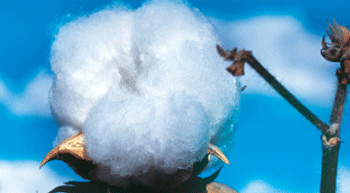
Cotton was the first fibre for mankind. Its history is replete with controversies.
Samuel Joseph attempts to delve into some of the recent contentious issues that have blurred the white gold´s image.
King Cotton, who ruled the textile kingdom without much challenges for many decades, is facing a few threats undermining its supremacy that already seemed to have partly wiped out some of its charm and shine. Vexing news recently outraged the complacency of this anointed King of Fibres: China, a big buyer of Indian cotton and yarn, dealt a deadly blow by reducing its dependence on imported cotton by digging into its mounting reserves only last year. The cotton world is suffering because of the Dragon´s failed policy. Another jolt followed: Garments made primarily of synthetic fibres overtook cotton in the US apparel imports during the first nine months of 2014 ´ the first time since 1991. To add to its woes, new fibres and materials, claimed to possess cotton-like virtues of eco-friendliness, comfort and adaptability are flooding the market.
On the home front, cotton production is estimated to be 405.50 lakh bales in 2014-15 season against 407.25 lakh bales last year due to slight decline in productivity in Gujarat. The projected balance sheet drawn by the CAI for the year 2014-15, estimated total cotton supply at 477.40 lakh bales while domestic consumption is estimated at 306.00 lakh bales, thus leaving an available surplus of 171.40 lakh bales. But what is worrying is the plummeting price and snail-speed in productivity rise in addition to farmers see-sawing wishes to shift to other cash crops.
The Indian Cotton Federation (formerly South India Cotton Association) has maintained the cotton crop at its earlier estimate of 406 lakh bales for the 2014-15 season. The federation, according to its President J Thulasidharan, reviewed the position recently after assessing the loss due to crop damage, water shortage and reports of low yield in certain pockets. The federation´s assessment shows that in the northern cotton belt comprising Punjab, Haryana and Rajasthan, the yield would sustain at 54 lakh bales, while in the central zone comprising Gujarat, Maharashtra and Madhya Pradesh, it would hover around 229 lakh bales and in the South at 115 lakh bales; Odisha and others would account for 8 lakh bales to take the total crop production estimate to 406 lakh bales.
A decline in cotton prices would most often impact the spinning industry adversely. This is because decline in cotton prices tends to pull down cotton yarn prices immediately and even more steeply and a subsequent price recovery in cotton would trickle down to cotton yarn only after a time lag, says DK Nair, Secretary General, Confederation of Indian Textile Industry.
T Rajkumar, present Chairman, Southern India Mills Association (SIMA), says ´urmoils are cyclic. Now there is a crisis for the cotton mills. But in the next two to three years, things will change, with a change in equations in various issues grappling the industry.´
(Read Rajkumar´s opinions in separate BOX)
Says Amit Mittal, Director of NKCM Spinners, Komarapalayam, Tamil Nadu: ´Cotton is down now. Inventories are only up. The Government should leave the industry to the market dynamics. The interference is harming the industry. The Government should not play a role in cotton business. A lot of cotton has come up in Andhra and Gujarat. But look at the transportation cost adding to mills burden. The production between state to state varies and finally with transportation costs going up, where is the competitive edge for mills in South? Only fine counts are doing well in sou