



The textile industry harms the environment with high water use, microplastic pollution, and 10 per cent of global carbon emissions. Meanwhile in India, burning 100 million tonne of agricultural waste worsens air pollution and smog.
Canvaloop transforms agricultural waste of hemp, flax, oilseed crops, pineapple, banana, and nettle into high-performance, breathable, and durable textile fibres. The 3-step patented process creates anti-microbial, anti-UV, and sustainable textile bio-materials, reducing dependence on cotton and synthetics. By repurposing waste and offering a plug-and-play solution for textile mills, Canvaloop drives towards mainstream sustainability in textiles. Shreyans Kokra, Founder & CEO of Canvaloop, shares valuable insights about the company and explains why natural fibre is the fibre of the future in an exclusive chat with Divya Shetty.
What inspired you to start Canvaloop, and how did the idea of converting agricultural waste into sustainable fibres come about?
Canvaloop actually began as a college project. My background is in finance—I’m a CFA, CFP—and I previously worked at Barclays in investment banking before pursuing a master’s in entrepreneurship from Babson. That was my first real exposure to concepts like sustainability and circularity. Coming from Surat, a major synthetic textile hub, we never really questioned the highly linear nature of fashion supply chains. Once I understood the environmental impact, I wanted to build something truly sustainable, not greenwashed.
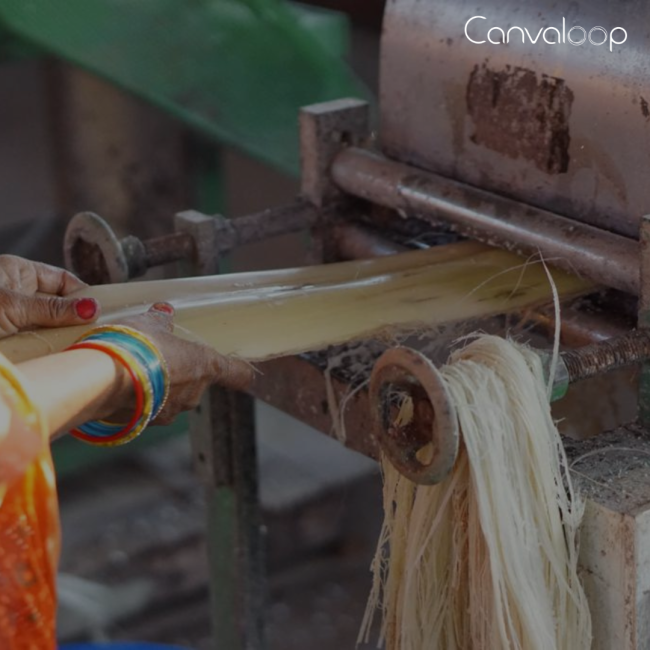
Initially, we worked with hemp, given its incredible sustainability characteristics both during cultivation and post-processing. Over time, our focus shifted to agricultural waste, which is abundant and offers a highly sustainable source of cellulose for natural fibre production. We developed a low-energy, low-chemical process to convert this biomass into textile-grade fibres, and the market has embraced our solution.
Can you elaborate more on the raw materials you use—where you source them from, and the overall sourcing mix?
Until last year, we primarily relied on imported raw materials due to ease of operations. However, from this year, we’ve started establishing collection centres across India. Our goal is to transition more than 80 per cent of sourcing to domestic biomass by the next season. We focus mainly on South Gujarat to minimize the carbon footprint of logistics, along with Maharashtra, Madhya Pradesh, Rajasthan, and some sourcing from the Northeast, especially for pineapple waste. Until last year, nearly 100 per cent of our materials were imported. This year, it’s a 50:50 mix. By next season, we aim for 80 per cent domestic sourcing.
Can you tell us more about your applications? Which industries and product categories do they currently cater to?
Our primary market is apparel, especially men’s shirting, women’s topwear, ethnic wear, and denim. As our production scales up, we plan to expand into home textiles and technical textiles. Our fibres offer higher strength and durability compared to other natural fibres, making them suitable for technical textile applications. We expect to enter the technical textiles segment in the next 12 to 18 months, starting with the domestic market.
Can you highlight some collaborations that has helped you in your journey?
A major collaboration was with the Marico Innovation Foundation, which helped us establish a domestic supply chain by connecting us to Marico Innovation Foundation’s agri network. We also work with the Circular Apparel Innovation Factory (CAIF), which promotes sustainable practices across fashion brands. Recently, we were awarded by the H&M Foundation for our urban waste initiative, where we are collaborating holistically on shop-floor-level sustainability.
Can you elaborate on your partnership with Marico Innovation Foundation and NAFPO?
Our association with Marico Innovation Foundation over the past 12–18 months has been instrumental. They helped us connect with NAFPO, which enabled us to engage directly with farmers and FPOs. As an urban-based company, this connection to the rural ecosystem was critical. Marico Innovation Foundation has also supported us with ideation, strategy, and operational challenges by providing expert resources whenever required.
Tell us about your manufacturing infrastructure and R&D process.
We currently operate one facility in Surat, Gujarat, and we’re expanding our capacity tenfold. Our R&D is very hands-on and industry-first. Instead of lab-scale trials, we work on commercial-scale development to ensure our products are both sustainable and widely usable. Every R&D initiative starts with the question: can this product reach every wardrobe in 5–10 years? We don’t focus on niche products that lack scalability.
You mentioned a venture into intimate wear. What developments can we expect in that category?
Currently, most of our products are designed for outerwear. Intimate wear demands more consistent fibres, which we’re developing. We aim to launch products in this space within a year, though our core focus remains on everyday apparel, followed by home and technical textiles. Product-market fit always comes first for us.
What are your expansion plans over the next 1–2 years in terms of product portfolio, production, or global markets?
We aim to grow our portfolio with more regionally available crops around South Gujarat. We’ve also forward integrated into yarns and fabrics to serve mid-sized brands that need finished products. Our R&D will continue launching new products and improving sustainability. Scaling these offerings is our near-term priority.
How do you plan to remain cost-competitive in a price-sensitive market like India?
Fashion is complex, with a wide price spectrum. We position ourselves in the mass-premium segment—above regular cotton but below linen or technical fabrics. We work with mainstream and fast fashion brands like H&M and Zara in their higher-end collections. We’re not competing with cotton or polyester directly but offering a distinct value proposition.
How did Canvaloop perform financially last year, and what are your projections?
We’ve consistently targeted 3x growth annually. Last year, we achieved about 2.5x growth. It’s been a challenging but rewarding journey.