


Divya Shetty explores how the world’s largest cotton cultivator can overcome structural bottlenecks, technology deficits, and climate vulnerabilities to close its massive global yield gap and secure the future of its textile industry.
India’s cotton sector presents one of the most compelling paradoxes in modern global agriculture. On one hand, the nation possesses the world’s largest area under cotton cultivation, spanning over 130 lakh hectares and accounting for nearly 40 per cent of global cotton acreage. On the other hand, this massive agricultural base fails to translate into proportionate global dominance in terms of output, as yields remain significantly below their true potential. The numbers reflect a sobering reality: national cotton production has steadily declined from a peak of around 39.8 million bales in the 2013-14 crop year to an estimated 29.5 million bales in 2024-25. Concurrently, average yields languish below 450 kilograms of lint per hectare, a figure that places India far behind its global peers. While leading cotton-producing nations like China and Australia record extraordinary productivity levels exceeding 2,000 kilograms per hectare, and countries like Brazil and the United States achieve yields multiples higher than India’s, the Indian subcontinent struggles to break past its historical ceilings.
This persistent productivity deficit sends shockwaves across the entire economic spectrum. As Dr Siddhartha Rajagopal, Executive Director, Cotton Textiles Export Promotion Council (TEXPROCIL), sharply observes, “The productivity gap is not merely a farm issue; it directly affects the competitiveness of India’s textile value chain.” Higher yields combined with optimised fibre parameters are essential to reinforce the cost structure and operational viability of India’s spinning, weaving, and apparel manufacturing sectors. For a country with deep-rooted textile ambitions, turning this agricultural stagnation around is not just a matter of rural development—it is an absolute industrial necessity.
Unpacking the structural bottlenecks
The challenges restricting Indian cotton are structural, deeply historical, and multi-layered. They cannot be blamed on a single bad season or localised weather anomalies. Instead, they are rooted in the very fabric of India’s agricultural ecosystem. At the forefront of these challenges is extreme land fragmentation. The average size of an Indian cotton farm is roughly 1.7 hectares, which stands in stark contrast to the massive, industrialised corporate farming operations found in the United States, Australia, and Brazil. This fragmentation restricts operational economies of scale, severely limits capital accumulation, and acts as a significant barrier to the adoption of advanced precision technologies, scientific agronomy, and mechanised harvesting equipment.
According to Chandandeep Singh, Principal Consultant, Gherzi Textil Organisation, the long-term data exposes an uncomfortable truth: “The persistent mismatch between domestic cotton production and consumption reflects these structural inefficiencies rather than a few weak agricultural seasons.” Singh highlights that when India initially approved Bt Cotton technology in 2002, lint yields stood at 302 kg/ha and expanded dynamically by 88 per cent to hit 566 kg/ha by 2013-14. However, since 2014, yields have consistently deteriorated to a current baseline of approximately 441 kg/ha. This downswing coincided directly with strict price control measures on seeds, which caused technology developers and international suppliers to pull back from the market as they were unable to charge a viable trait fee. Consequently, India has transitioned into a net importer of cotton, while global competitors like China and Brazil aggressively advanced their yields during the exact same timeframe.
Compounding the technology deficit is an overwhelming dependence on monsoon rainfall. As noted by Ramakrishnan M, Managing Director, Primus Partners, nearly two-thirds of India’s cotton cultivation area remains completely rainfed. This reality leaves millions of smallholder farmers highly vulnerable to monsoon variability and increasingly erratic, climate-driven weather anomalies. Evolving pest pressures further exacerbate this fragility. The rapid resurgence of the pink bollworm and the emergence of new secondary pests consistently erode crop yields, trapping farmers in a vicious circle of low productivity, diminishing incomes, and limited reinvestment capacity.
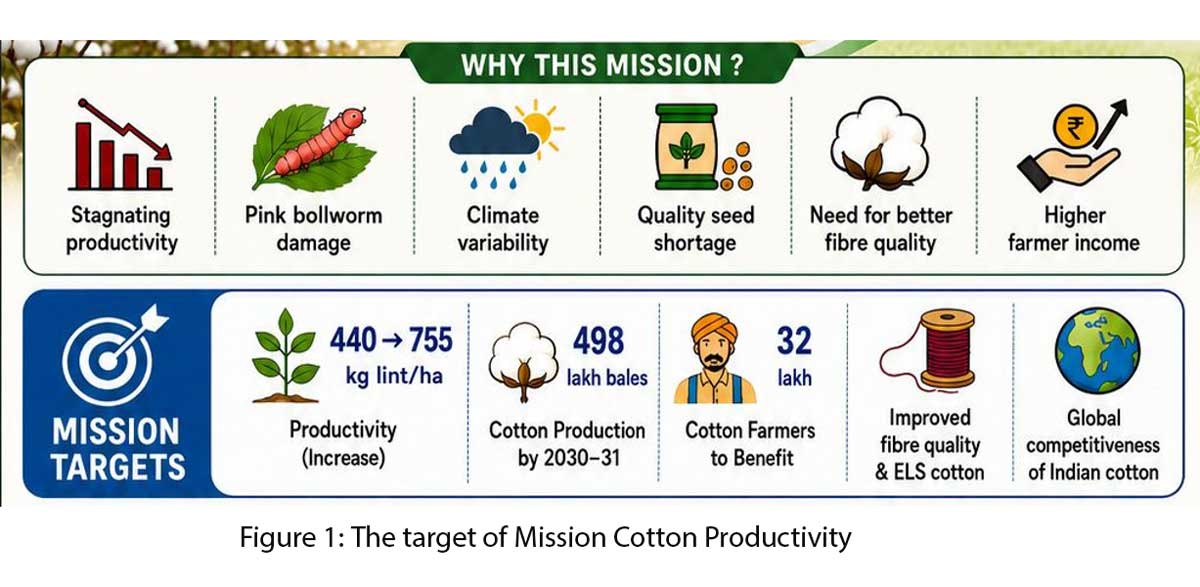
Reinforcing this diagnosis, Rajeev Gupta, Joint Managing Director, RSWM, notes that India’s lint productivity, which currently hovers around 440 kg/ha, suffers severely from this combination of fragmented holdings, monsoon dependence, uneven adoption of modern farming practices, and recurring pest cycles. Additionally, systemic vulnerabilities regarding post-harvest contamination, fibre quality inconsistency, and deficient ginning infrastructure heavily impact the global competitiveness of Indian cotton. To counter this, Gupta references the Government’s newly established Mission for Cotton Productivity, which targets a significant increase in lint productivity from 440 kg/ha to 755 kg/ha by 2031, a goal that demands a comprehensive overhaul of seed innovation, farmer outreach, and modernisation across the value chain.
The need for speed
To reverse these multi-year declines, the industry must differentiate between long-term infrastructural goals and immediate, high-impact interventions. While expanding nationwide irrigation networks and fully mechanising smallholder farms are vital objectives, they require substantial capital and years of execution. If India wants to lift yields within the next two to three cropping seasons, it must focus sharply on seed performance and advanced crop protection.
Varun Vaid, Business Director, Wazir Advisors, emphasises that accelerating the deployment of next-generation Bt hybrids featuring enhanced bollworm resistance and drought tolerance could significantly lift agricultural yields within two to three seasons. Vaid notes that while downstream initiatives like ginning modernisation are necessary, they require scale and time to justify investment. On the farm level, implementing quality-linked pricing mechanisms serves as a rapid behavioural catalyst. If farmers receive a transparent, measurable premium for superior quality parameters like optimal micronaire and staple length, their input and management behaviour will shift almost instantly.
Ramakrishnan points directly to Integrated Pest Management (IPM) and seed technologies as the absolute top priorities for immediate action, given that pest infestations routinely destroy harvests before any other farm-level measures can take effect. He highlights that demonstrations supported by the Indian Council of Agricultural Research (ICAR) have proven that IPM practices lead to drastic reductions in insecticide applications while yielding higher outputs and superior benefit-cost ratios. Commenting on these highly successful deployment models, Ramakrishnan stresses: “this is a proven method. There are the means to do it, and we should employ them on an urgent basis.” Among these proven solutions is the innovative SPLAT approach, which utilises a specialised waxy formulation of pheromones to disrupt mating cycles and prevent pink bollworm populations from multiplying.
This focus on immediate seed and market infrastructure is strongly mirrored by Vinay N Kotak, President, Cotton Association of India (CAI). Kotak points out that while declining seed performance and sub-optimal agronomic practices have severely constrained yields, immediate progress can be achieved by reforming market logistics and regulatory frameworks. “It is our suggestion that certified seeds should be sold in market yards,” Kotak asserts, emphasising that access to high-quality, verified inputs must be made seamless for the everyday grower. Furthermore, he argues for the removal of artificial caps on cotton seed prices to incentivise top-tier seed companies to re-introduce cutting-edge biotechnology into the Indian market, ensuring that advanced pest and disease management can be deployed at scale.
Sustainability and climate resilience
Historically, India’s national cotton strategy focused almost exclusively on expanding land acreage and pushing gross production volumes. However, under current climate realities and global supply chain shifts, this volume-first paradigm is no longer viable. The future demands a transition from land productivity to resource productivity—maximising the lint output achieved per unit of fertiliser, per unit of capital, and crucially, per litre of water utilised.
Ramakrishnan underlines this paradigm shift, stating that “The future lies in what may be called “productive efficiency” – producing more output with fewer resources.” He notes that cotton is a highly water-intensive crop in traditional systems, making water management the absolute core of long-term sector resilience. Expanding drip irrigation and fertigation to cover a larger target share of 25-30 per cent of India’s cotton acreage could drastically improve water-use efficiency while providing a stable foundation for higher yields. To truly gauge competitiveness, Ramakrishnan asserts that “The more meaningful metric for the future is higher lint output per litre of water, per kilogram of input and per unit of carbon emitted.”
The financial data heavily supports this push for resource efficiency. Chandandeep Singh references a comprehensive study by the Cotton India Textile Industry (CITI), with ICAC and Ghersi as knowledge partners, which reveals an eye-opening cost discrepancy. While India’s production cost per hectare sits at a modest $971—significantly lower than the per-hectare expenses incurred by growers in the United States, Australia, and Brazil—its severely depressed yields mean that its cost per unit of output is highly uncompetitive. India’s final production cost stands at approximately $0.98 per pound of cotton, compared to just $0.69 to $0.73 per pound in major competing countries. Improving farm productivity is therefore the single most effective tool to slash unit costs while naturally driving resource efficiency. Singh notes that emerging avenues in regenerative agriculture and soil carbon enhancement offer promising secondary income streams through carbon markets, though he warns that “such sustainability-linked revenues cannot substitute initiatives on productivity improvements.”
This dual mandate of environmental sustainability and commercial survival is echoed by Vaid, who observes that the two goals are entirely intertwined. As Vaid explicitly remarks, “The two are not in conflict – they are the same problem.” Precision agriculture, water-efficient drip setups, and climate-adapted seed varieties concurrently lower raw input costs and insulate farmers from weather-induced crop failures. Gupta reinforces this perspective, highlighting that resource efficiency has evolved into a strict commercial mandate. Because major global apparel brands are increasingly utilising sustainability and low carbon footprints as strict procurement criteria, transitioning to resource-efficient cultivation is no longer just an environmental ideal—it is an absolute business necessity to keep Indian textile products relevant in the international marketplace.
Learning from the leaders
To accelerate its modernisation, India can look to established frameworks implemented by successful cotton-exporting nations. Countries like Australia, the United States, and Brazil have structured their entire value chains around objective quality assurance, close public-private collaboration, and technological transparency.
In the United States and Australia, the entire trade operates on highly scientific, instrument-based quality assessment systems. By utilising High Volume Instrument (HVI) testing directly at the ginning stage, these nations eliminate subjectivity, ensuring absolute grading consistency. In contrast, India’s traditional cotton market still relies significantly on visual and subjective evaluations by local traders, which severely compromises transparency and weakens price incentives for small farmers. Moving to mandatory instrument-based testing at the gin level would be a major leap forward, allowing for fiber-based pricing structures that reward critical parameters like staple length, micronaire uniformity, and strength.
Furthermore, Australia’s CSIRO-led varietal development and grower-cooperative models offer a brilliant template for contamination control. Manual cotton picking in India frequently introduces foreign matter into the lint, leading to an average yarn realisation that is 3 per cent to 5 per cent lower than global benchmarks. Brazil also provides an exemplary model of robust value-chain governance, demonstrating how research institutions, producers, and processing industries can align their targets through synchronised investments. China’s targeted policy framework, which cleverly blends area, yield, and quality-focused subsidies under a single target price structure, shows how national policies can successfully incentivise growers to prioritise both volume and lint excellence simultaneously.
A blueprint for the future
To institutionalise these changes, the Government of India has approved the comprehensive Rs 56.59 billion Mission for Cotton Productivity (see Figure 1), scheduled to run from 2026-27 to 2030-31. As Rajagopal highlights, “The Mission for Cotton Productivity represents a significant structural reform because it links agriculture and industry through a common objective of producing more and better-quality cotton.” This targeted funding aims to elevate national production to 498 lakh bales, directly benefiting over 32 lakh farmers while securing raw material quality for downstream spinning mills and expanding export access through existing Free Trade Agreements (FTAs) with regions like Europe, the UK, and Australia.
Drawing from the collective strategic views of the industry’s top experts, a resilient 10-year roadmap for Indian cotton must be constructed around five distinct operational pillars:
- Accelerate next-generation seed pipelines: India must immediately establish a highly predictable, streamlined, and science-based regulatory pathway to validate and approve advanced biotechnology traits. Speeding up field trials and approval frameworks for advanced Bt iterations, RNAi-based crop protections, and drought-tolerant genes is vital to bridge the widening yield gap.
- Institutionalise integrated pest management (IPM): Eco-friendly crop protection practices—including pheromone traps, biological controls, refuge planting, and systematic crop rotation—must transition from isolated demonstration pilots into standard, mandated extension protocols delivered nationwide via Krishi Vigyan Kendras (KVKs).
- Overhaul quality architecture and incentives: The flagship Kasturi Cotton Bharat program must be aggressively scaled up across all cotton-growing states. Integrating audits, high-volume laboratory testing, QR-code verifications, and blockchain-enabled end-to-end traceability will give global buyers total visibility into origin and processing history, successfully driving brand equity.
- Expand targeted micro-irrigation: Utilising precision drip networks and smart fertigation, particularly across districts identified with severe groundwater depletion and large yield gaps, will decouple cotton cultivation from monsoon volatility, ensuring output stability and higher fiber uniformity.
- Develop premium long-staple and extra-long-staple (els) segments: India has immense potential to cultivate premium ELS varieties that command high premiums in international markets. Cultivating these segments through structured contract farming models, dedicated industry-farmer partnerships, and quality-linked procurement will substitute expensive imports and fulfill advanced spinning demands.
Kotak points out that executing this quality architecture requires immediate financial alignment at the procurement level. “Kasturi Cotton Bharat can play a pivotal role in enhancing the image of Indian cotton globally by establishing a credible framework for quality assurance, traceability, and branding,” Kotak outlines. To make this operational, he insists that farmers must be paid a distinct, special premium over and above the standard Minimum Support Price (MSP) for producing seed cotton that meets rigid Kasturi specifications, directly aligning the farmer’s financial incentives with the quality demands of global textile mills.
Furthermore, Gupta and Vaid emphasise that long-term success requires a secure policy environment. To drive seed innovation at scale, India needs a balanced framework that enables technology developers to recover their heavy research and development investments, while public-sector institutions receive expanded funding to complement private innovations and ensure advanced tools reach the smallest smallholder.
The future of India’s textile sector hinges entirely on a coordinated, well-executed transformation of its agricultural base. The historical approach of judging success by acreage or gross volume must be permanently retired. As Ramakrishnan masterfully summarises, “The future of Indian cotton will be determined not by the area under cultivation, but by consistency, traceability, fibre quality and buyer confidence.” India already has the necessary institutional frameworks, research excellence, and massive market scale in place. By executing the multi-billion rupee Mission for Cotton Productivity with strict discipline and fostering genuine, deep collaboration among policymakers, research bodies, textile manufacturers, and farmers, India can finally close its productivity gap. In doing so, it will protect the livelihoods of millions of rural households and secure its rightful position as a reliable global powerhouse for premium, sustainable, and high-quality cotton.
QUOTES TO HIGHLIGHT:
- “The introduction of Bt cotton delivered substantial productivity gains in the past and helped farmers manage key pest challenges.”
- Ramakrishnan M, Managing Director, Primus Partners
- “Integrating climate resilience with productivity enhancement will strengthen India’s position as a reliable supplier of responsible and high-quality cotton.”
- Rajeev Gupta, Joint Managing Director, RSWM
- “If farmers receive a measurable premium for higher micronaire and staple length, the input behaviour can shift quickly.”
- Varun Vaid, Business Director, Wazir Advisors
- “Presently, India’s cotton productivity is significantly lower than the global average productivity mark and far behind leading cotton producing countries like Brazil, Australia and China.”
- Vinay N Kotak, President, Cotton Association of India
- “India’s challenges in cotton quality and value chain efficiency are closely linked to issues of contamination and inconsistent fibre characteristics.”
- Chandandeep Singh, Principal Consultant, Gherzi Textil Organisation
- “A shift from volume-based procurement towards quality-based procurement can create powerful incentives for farmers.”
- Dr Siddhartha Rajagopal, Executive Director, TEXPROCIL
| Crop Year | Area Under Cultivation (Lakh Hectares) | Total Production (Lakh Bales) | Average Yield (kg lint per Hectare) |
| 2021-22 | 123.72 | 311.18 | 428 |
| 2022-23 | 129.27 | 336.60 | 443 |
| 2023-24 | 126.88 | 325.22 | 436 |
| 2024-25 (P) | 114.47 | 312.40 | 444 |
| 2025-26 (E) | 110.86s | 309.50 | 448 |
Table 1: Cotton production in the last five years.
Source: Directorate of Economics and Statistics (Ministry of Agriculture) and CAI