


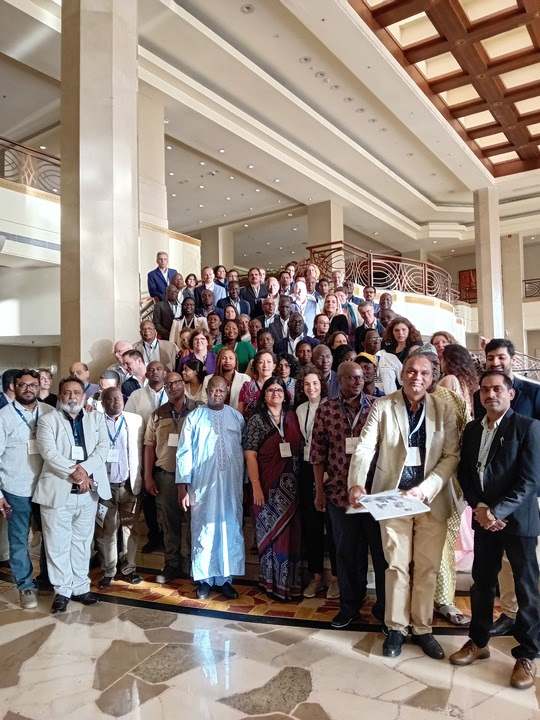
Industry leaders and experts from across the global cotton and textile industry, discussed challenges and innovations for the sustainable future of cotton.
From March 11-13, the Aid by Trade Foundation (AbTF) successfully held its cotton conference in Mumbai. The conference brought together a global network of industry leaders, experts, and stakeholders from the cotton and textile industry. The conference emphasised the urgency of finding solutions to mitigate the effects of climate change on the cultivation of cotton and the lives of smallholder farmers. Another important topic was the increasing demand for transparency, traceability and responsibility in supply chains. The conference in Mumbai delivered a clear message; valuable approaches can be offered through a combination of regenerative cultivation methods, innovative technologies, and the preservation of indigenous knowledge. Simultaneously, the conference clearly showed that there can be no data, no impact, no traceability, and no transparency without the people in the fields and in the supply chains.
“We rely on innovation as an effective tool to make cotton production ecologically and socially sustainable,†said Tina Stridde, Managing Director, AbTF, at the opening ceremony. She continued, “Together with our partners, we want to work collaboratively to create a cotton sector that not only generates benefits and opportunities for every stakeholder but also ensures that nature is not harmed or exploited in the process.â€
Throughout the conference, participants had the opportunity to delve into the latest developments in sustainable cotton production. The highlight of the first day was the introduction of the new Regenerative Cotton Standard (RCS) by the Aid by Trade Foundation. Set up by the Aid by Trade Foundation in 2023 RCS is the first standard for sustainable cotton that the foundation will introduce in other countries outside Africa such as India. Presentations by experts including Dr Keshav Kranthi, ICAC, and Dr Adam Cobb, Soil Food Web School, highlighted the vital role of microbes in restoring soils stressed by overuse and climatic change. The approach by African People & Wildlife (APW) presented by Alais Ole-Morindat, a Maasai elder from Tanzania, provided inspiring insights into their approach to restoring the balance between nature and people by combining a thoughtful community engagement programme with a data-driven approach to monitoring and assessing impact and feeding all data back to the community. In various formats, experts presented innovative new approaches that enable the industry to use new technologies to meet the challenges small-scale farmers face. Dr Daniela Castro Herrera, sustainable AG, presented the approach of monetising carbon sequestration for farmers so that they get an additional monetary benefit from cultivating sustainable cotton; an initial feasibility study for carbon sequestration has already been conducted for AbTF in Mozambique. Stefan Scherer, from Geocledian GmbH, gave the audience a guided tour of the world of remote sensing, which is already being applied to the CmiA standard in a pilot project in Tanzania.
Another key topic at the conference was the increasing demand for traceability of cotton in textile supply chains due to different legal requirements. With its Hard Identity Preserved (HIP) system, which was established five years ago, CmiA delivers a valuable solution to meet the requirements for companies to conduct due diligence within their supply chains. In this context, Torsten Stau, Executive Buying Director Non Food / Indirect Spend REWE Group, reported on their successful path to 100 per cent traceable CmiA cotton in their products thanks to the HIP system. A variety of experts from throughout the textile supply chain discussed on a panel why and how traceability can be achieved, particularly by means of artificial intelligence and physical monitoring. They agreed that AI can become a real game changer in fulfilling due diligence requirements; however, they also agreed that human beings are irreplaceable when setting up new technologies, adapting them to the local context, and successfully implementing them in close co-operation with the people on the ground.
The conference concluded with a visit to the Cotton Association of India (CAI) in the historic Cotton Exchange Building. Attendees had the opportunity to gain insights into the cotton trading business in India and engage in a lively exchange with representatives of the Cotton Association of India.