


The main advantages of White Filter Cleaning are cost-saving and clean factors, and it also ensures gentle treatment of filter elements.
Current techniques of polymer filters cleaning involve the use of chemical solvents, which come with a lot of disadvantages. TEG and similar chemicals are not only costly, toxic and highly flammable, but also harmful to the environment; therefore they have to be disposed of extensively. The machine construction company, BB Engineering GmbH (subsidiary of Oerlikon Barmag and Brueckner Maschinenbau) in Remscheid, Germany has developed an alternative filter cleaning solution for polymer filters without toxic solvents but just as effective. It is marketed under the trade name WFC – White Filter Cleaning. WFC is designed to clean filter elements – candles or discs – from production lines processing polymers like PETP, PA6.
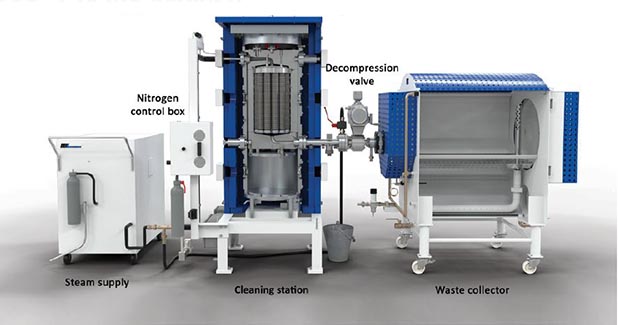
The cleaning effect is based on a combination of both hydrolysis and gas flow dynamics. Super-heated steam flows through the polluted filter elements in reverse direction (compared to regular polymer flow). After draining out the melt with the support of gravity and nitrogen pressure as much as possible, the remaining melt inside the filter insert is pushed out by super-heated steam. The steam is injected via ports into the cleaning vessel until a pre-set pressure (up to 8 bar) is reached. During this fill-up time the steam reduces the viscosity of the melt inside the filter insert by means of hydrolysis degradation. After that, the pressure is released by means of a sudden opening of a decompression valve (gas flow dynamics effect). This cycle of hydrolysis and decompression is repeated multiple times, each cycle removing some polymer from the filter into a waste collector. The decompression process is derived from the proven deecom process owned by B&M Longworth, UK with which BB Engineering GmbH is collaborating.
This cleaning method is as effective as to substitute any other main cleaning methods, such as cleaning using solvents. After having removed the polymer using WFC, the filter elements can be transferred to regular subsequent final cleaning steps.
The main advantages of WFC are:
- Cost-saving and clean: no solvents required. This saves purchase and disposal costs and avoids environmental and fire hazard problems.
- Gentle treatment of filter elements: the cleaning of filter inserts using WFC starts immediately after having taken them out of service without any cooling and reheating period. Therefore, not only is the energy consumption lower, so too is damage to the filter elements due to the shrinking effect of freezing polymer being avoided.