


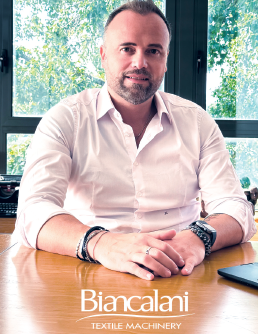
As textile manufacturers around the world work to improve product quality while meeting environmental standards, the choice of finishing machinery becomes increasingly important. In this interview, Fabio Cecconi, Area Manager, Biancalani Textile Machinery, discusses the company’s approach to fabric finishing. Founded in Prato in 1957, Biancalani Textile Machinery develops solutions for textile manufacturers across international markets.
Could you provide an overview of your company?
Biancalani Textile Machinery is an Italian manufacturer of textile finishing machinery, founded in Prato in 1957. We develop and manufacture 100 per cent Made-in-Italy solutions for fabric preparation, washing, drying and finishing. Our machines include AIRO® for versatile wet processing, tumble drying and mechanical softening; AIRO®24, the continuous open-width dryer for tumbling treatments; AQUARIA® for continuous open-width washing; AIRBOX® compact dryers; and specialised machinery for washing and milling
woollen fabrics.
With more than 2,500 machines installed in over 100 countries, we work with manufacturers across apparel, home textiles and technical textiles, processing fibres such as lyocell, cupro and modal. Research and development remain central to our work, with more than 50 international patents developed over the years.
How has the company performed during 2025-26?
During 2025-26, we continued to develop our technology, with particular attention to international markets and processes that improve fabric quality and production efficiency.
We also worked on further applications for AIRO®24 and AQUARIA®, particularly where manufacturers are looking to reduce water, energy and chemical consumption. At the same time, we strengthened our presence in markets seeking flexible, sustainable and reliable finishing processes.
What differentiates your solutions in the global market?
Our strength comes from combining process knowledge, fabric quality and flexibility.
We have worked with air as an active element in fabric treatment for many years. That experience helps us understand what a fabric needs and adapt the process accordingly.
We work closely with customers to develop solutions for their fabrics and production requirements. This includes testing on customers’ own materials, so we can assess the results together before defining the process. Our aim is to achieve measurable improvements in handle, appearance, shrinkage control and overall fabric quality.
India is positioning itself as a major textile manufacturing hub. What are the key hurdles, and what role can machinery providers play?
India has enormous potential, but competitiveness increasingly depends on productivity, consistent quality and responsible use of resources. One challenge is moving towards textile production with higher
added value.
Machinery manufacturers can contribute technologies that improve productivity and process repeatability while reducing water, energy and chemical consumption. Technical support and process knowledge are equally important: they help Indian manufacturers achieve consistent results that meet international standards.
What are the major technology trends transforming the industry?
Automation, digitalisation and data management are becoming more important. Modern textile machinery needs to provide mechanical performance, reliable process control and access to useful production data.
AI and IoT can contribute to predictive maintenance, process optimisation and real-time monitoring. For Biancalani Textile Machinery, the starting point is always the result the customer needs: the right fabric quality, efficient production and a lower environmental impact..
How are your solutions helping manufacturers achieve sustainability goals?
For Biancalani Textile Machinery, sustainability is closely connected to process efficiency. We design our technologies to achieve the required fabric result while reducing the resources needed to obtain it.
For example, AQUARIA® enables continuous open-width washing with adjustable dwell times and effective mechanical action, maintaining liquor ratios as low as 1:6, depending on the process. AIRO®24 combines efficient drying with mechanical softening and finishing in a continuous open-width process. In some applications, this can reduce or eliminate the need for chemical softeners.
We also develop processes for fibres such as lyocell, cupro and modal, helping manufacturers meet both quality requirements and environmental objectives.
What role do exports play in your business strategy?
Exports are fundamental to Biancalani Textile Machinery’s business. Our machines are used in more than 100 countries, and international markets have always been an essential part of our growth.
We continue to build our presence in established textile markets and explore opportunities in growing manufacturing hubs, particularly where companies are investing in fabric quality, efficient processes and more responsible production. India is certainly one of the markets with significant long-term potential for Biancalani Textile Machinery.
What are your growth plans for 2026-27?
Our priority for 2026-27 is to continue investing in research and development and to find new applications for our core technologies. We will focus particularly on solutions that bring together fabric quality, process control and lower consumption of water, energy and chemicals.
We also intend to strengthen our international presence, develop new technology partnerships and continue working closely with customers in markets such as India. That means understanding their production needs and developing processes that deliver results they can measure.
For further information: www.biancalani.com