


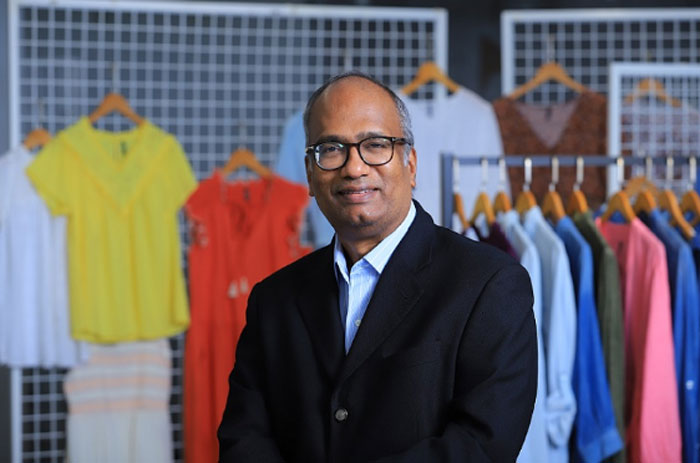
As global apparel supply chains undergo seismic shifts and trade dynamics evolve, industry leaders are under immense pressure to combine scale with agility. In this insightful interview, Sivaramakrishnan Ganapathi, Vice-Chairman & Managing Director, Gokaldas Exports, speaks with Divya Shetty about the strategic blueprint driving the company’s rapid momentum.
Your company has built significant scale and business momentum. What will be the key growth drivers that help you sustain this trajectory over the next three to five years?
Our growth trajectory over the next three to five years will be driven by capacity expansion, an international manufacturing footprint, vertical integration, and geographic market diversification. First, we are scaling our manufacturing operations organically in India through strategic expansions in low-cost rural locations such as Madhya Pradesh and Jharkhand, which will enhance production capacity while maintaining competitive cost structures. Second, our international manufacturing presence in Kenya offers distinct tariff advantages and operational flexibility, serving as a key growth engine for our major export markets. Third, strategic vertical integration through our investment in knit fabric processing in Perundurai, Tamil Nadu, and the BTPL fabric processing unit will significantly enhance supply chain control, enabling faster turnaround times, superior quality, and improved operating margins. Fourth, we are actively rebalancing our market mix by expanding our footprint in the UK and European Union. The recently signed UK FTA provides a 12 per cent duty advantage over China and brings us to parity with Bangladesh and Vietnam. The upcoming European trade agreement presents a similar long-term opportunity. Overall, the combination of these strategic initiatives positions us to deliver sustained annual top-line growth of 15 per cent to 20 per cent over the foreseeable future.
As global textile and apparel supply chains diversify, what opportunities do you see for Indian manufacturers to capture a larger share of international sourcing, and what must the industry do to capitalise on them?
Global apparel supply chains are actively diversifying under ‘China Plus One’ strategies, driven by rising labour costs in traditional hubs and geopolitical realignments. India is positioned as a primary beneficiary due to its vast labour pool, robust raw material base, and comprehensive manufacturing infrastructure. FTA’s would only accelerate this shift, as it bring a level playing field, granting Indian manufacturers zero-duty market access and removing historic tariff disadvantages relative to competing nations like Bangladesh and Vietnam.
To capitalise on these structural opportunities, the Indian industry must focus on expanding the manufacturing base into low-cost rural and hinterland regions to establish competitive cost structures capable of delivering near Bangladesh-like operational costs. Second, India must build a scale-driven synthetic (polyester and MMF) fabric ecosystem, bridging the critical gap where China and Vietnam currently dominate global trade. Third, the industry must maintain world-class ESG, environmental, and social compliance standards to capture volume allocations as global brands consolidate orders among larger, highly compliant suppliers.
How are investments in automation, digitalisation, AI and advanced manufacturing technologies changing productivity, quality and cost competitiveness across your operations?
Investments in advanced manufacturing technologies, automation, and operational digitalisation are fundamental to sustaining our operational excellence and cost competitiveness. Across our facilities, continuous process improvements and targeted automation deliver a baseline 3 per cent to 4 per cent annual productivity increase in existing operations. This systematic efficiency gain enables us to extract incremental capacity without proportional capital deployment while insulating our margins against wage inflation and minimum wage increases.
Modernisation is equally central to our capital allocation, with consistent annual investments directed toward upgrading machinery, sewing infrastructure, and digital process controls. Digitally integrated workflows also streamline order tracking, material consumption, and throughput times, which are critical when executing complex fashion programs for top global brands. Our philosophy in terms of technology remains strictly ROI-driven. Every digital and automation initiative should demonstrate improvements in product consistency, turnaround speed, and commercial competitiveness for our global partners.
With sustainability increasingly influencing both customer and investor decisions, what major investments are you making in areas such as renewable energy, water management, circularity, sustainable materials and decarbonisation?
Sustainability and environmental stewardship are embedded within Gokaldas Exports’ long-term business strategy. They represent a decisive competitive advantage in driving resource efficiency. Our focus spans energy, water, waste, responsible sourcing, and resource efficiency, supported by clearly defined long-term ambitions.
We have reduced water intensity per garment by 36 per cent and expanded our renewable energy mix by 85 per cent. Our roadmap is guided by definitive operational targets, including achieving Carbon Neutrality and Water Positivity by 2030, Net Zero by 2045, a 42 per cent reduction in GHG emissions under MCAP, Zero Solid Waste-to-Landfill by 2030, and sourcing 75 per cent of input materials from certified sustainable sources.
Circularity is equally integral to our operations. We have significantly increased the use of recycled fibres in our fabrics since 2021 and continue to work towards increasing the share of recycled inputs. We adhere to sustainable chemical and waste management practices and responsible sourcing standards across our value chain. Our objective is to build a manufacturing ecosystem that is environmentally responsible, commercially competitive, and fully aligned with global brand expectations.
What are your major capacity expansion, product diversification or value-added manufacturing plans, and which markets or product segments do you expect to contribute most strongly to the next phase of growth?
Our upcoming phase of growth is anchored by targeted capacity expansion, strategic product diversification, and deeper vertical integration.
On capacity expansion, our major projects include unit additions in Madhya Pradesh, Karnataka, and Jharkhand. Overseas, we are scaling our brownfield operations in Kenya, including testing second-shift operations to augment capacity without significant incremental capital expenditure.
In product diversification, we remain focused on our core offerings across outerwear, fashionwear, sportswear, and bottomwear. While our portfolio is currently weighted towards woven products, over time, we aim to build a more balanced portfolio by increasing our presence in knitwear. The integration of fabric processing into our operations will further strengthen our value chain, enabling us to capture greater economic value through improved supply chain control, efficiency, and margins.
Geographically, while the US remains a cornerstone market, we expect the UK and European Union to contribute more significantly to incremental growth, with their combined revenue share targeted to increase to 20 per cent+, supported by favourable trade agreements and FTAs.
Looking towards 2030, what do you believe will differentiate India’s leading textile companies from the rest — scale, technology, innovation, sustainability, brand building or global market presence — and where is your company placing its biggest bets?
Looking toward 2030, leadership in the global textile industry will no longer depend solely on low-cost labour or domestic scale. The true differentiators will be a multi-country operational footprint, deep vertical integration, ESG excellence, and structural agility in navigating global trade dynamics. Global retailers increasingly demand partners who can insulate them from geopolitical shocks, tariff volatility, and supply chain disruptions while delivering speed to market and compliance.
Gokaldas Exports is placing its bets across the following key areas:
- Global Multi-Geography Footprint: Building a balanced manufacturing presence across India and Africa to offer clients duty advantages and supply chain resilience.
- Vertical Integration: Scaling fabric processing through knits fabric processing unit at Perundurai, Tamil Nadu, and BTPL to control raw material quality, speed turnarounds, and capture value across the chain.
- Rural Manufacturing Scale: Expanding large-scale facilities in rural Indian hubs (Madhya Pradesh, Jharkhand) to achieve Bangladesh-like manufacturing cost structures.
- Value-Added Product Capabilities: Scaling complex outerwear, knits, and synthetic sportswear while expanding into UK and European markets, taking advantage of Free Trade Agreements.