


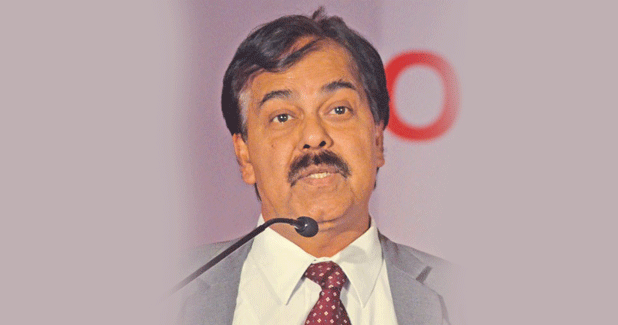
Dr Chandan Chatterjee, Advisor (Project & Technology), iNDEXTb and Director, Centre for Entrepreneurship Development, in an interaction with the Indian Textile Journal.
ITJ: What according to you is the total market potential for the textile & clothing industry in your State? How has it grown over the years?
Gujarat is the largest producer of cotton and also the largest producer of art silk manmade textile. Cotton-based textile industry is mainly targeted at both domestic and export market whereas art silk synthetic textiles is mainly focused on the domestic market, which is growing at 15 per cent. Indian textile industry is expected to reach the market size of $141 billion by 2021 from $108 billion. In this, Gujarat has got an estimated market size of $25 billion and expected to reach $35 billion in the next five years.
ITJ: What are the investments in the last few years? Can you give a few projects ongoing & completed?
Most of the investment in Gujarat in the recent past is focused mainly on cotton spinning. At least 15 lakh of spindle capacity are in various stages of implementation. Cotton spinning has also made a driving force for investment in cotton-based weaving mainly in and around Ahmedabad, Rajkot and Saurashtra region. A few textile parks are also in the process of implementation. This has already made an investment to the tune of Rs 6,000 crore during last 2-3 years.
ITJ: What are the special incentives and assistance offered to new projects proposed by industries in your State? Give some details.
Besides various incentives in terms of interest subsidy, VAT concession, etc., first time the State Government has announced power tariff concession to spinning and weaving activities. In addition, the Government has special provision to extend support in various skill development activities for textile and apparel sector.
ITJ: What are the major segments in textile & clothing industry, which have shown the potential for investment in the State?
Future growth in Gujarat is expected to be mainly in the area of technical textiles and high valued ready-made garments mainly for exports.
ITJ: Technical textiles are getting focus nowadays. What the special schemes to boost this segment in the State. How far has it been successful?
Special incentives of 6 per cent interest subsidy has been extended for promotion of technical textile in Gujarat, in addition to the benefits given by Ministry of Textiles, Govt of India in terms of 5 per cent interest subsidy and 10 per cent capital subsidy. State Government has also extended support for establishing Centres of Excellence on technical textiles mainly to address on newer product and market development for this scheme. A special support on start-up projects in Gujarat Industrial Policy 2015 is also expected to promote technical textile as a new investment opportunity for the younger generation entrepreneurs as a start-up project.
ITJ: Apart from domestic consumption and pan-India distribution , what the efforts on the export front to boost textile exports from the State?
Looking to the enormous export potential, various state government bodies are providing specific entrepreneurship development on export.
ITJ: Please give us some details about the infrastructure, logistics support and other facilities that will favour the growth of textile industry in the State.
As a part of infrastructure development required for promoting MSMEs, the Government of Gujarat has come out with a separate policy (Gujar