


As INDEX 23 in Geneva approaches, all the indications are that international business is now fully bouncing back for the nonwovens industry, which is highly globalised and well-balanced, with integrated supply chains on every continent.
After the turmoil of the past few years, PALEXPO is pleased to be welcoming no less than 74 new companies from China representing all sectors of the supply chain. Most Chinese companies were unable to be at the last INDEX in 2021 as China continued to struggle to contain the Covid-19 pandemic.
Progress
The last major report on the progress of China’s industry was made by Li Guimei, president of the China Nonwovens and Industrial Textiles Association (CNITA), in March 2022.
At that time, she observed that nonwovens production in China climbed to 8.8 million tonne in 2020 from 6.2 million tons in 2019 – annual growth of approaching 36 per cent.
Production in 2021, however, fell 10.1 per cent to 7.9 million tonne and figures for 2022, once available, are likely to have been further depressed.
Spunmelt products represented 50.6 per cent of the total of Chinese nonwovens output in 2021, with a notable increase in spunbonded/needlepunched polyester products, to around 600,000 tonne.
Spunlace was the fastest growing nonwovens process and amounted to around 1.6 million tons or 17.7 per cent of the total in 2021 in China, and needlepunched materials accounted for 18.4 per cent of the total at 1.45 million tonne.
In response to Covid-19, more than 2,000 new production or converting lines of various specifications for facemasks and PPE were announced in China, but many subsequently failed to start production or were withdrawn as global demand fell.
Three quarters of all Chinese nonwovens production is in the eastern coastal areas and central Hubei province of the country, with Zhejiang accounting for 22.1 per cent of the total.
Producers
China’s top nonwovens producers – Zhejiang Kingsafe, Foshan Nanhai Beautiful, CHTC Jiahua, Xingtai Ruiguang, Huahao Nonwovens, Tiandingfeng Holdings, Jofo Nonwovens, Anhui Jinchin and Shandong Taipeng – account for around 10 per cent of the country’s total output and will all be well represented at INDEX 23, either directly, or via subsidiaries and local representatives. As such, the show will provide the opportunity to come fully up to date with all that is happening in the country and re-establish contacts, or make valuable new ones.
In addition to the substantial delegation of companies from China, INDEX 23 will also welcome many more companies from the major expanding manufacturing centres, including India.
Sparkle
Underlining the reality that nonwovens innovation also refuses to recognise boundaries, one Indian company has been nominated for no less than three separate categories in this year’s INDEX 23 Innovation Awards.
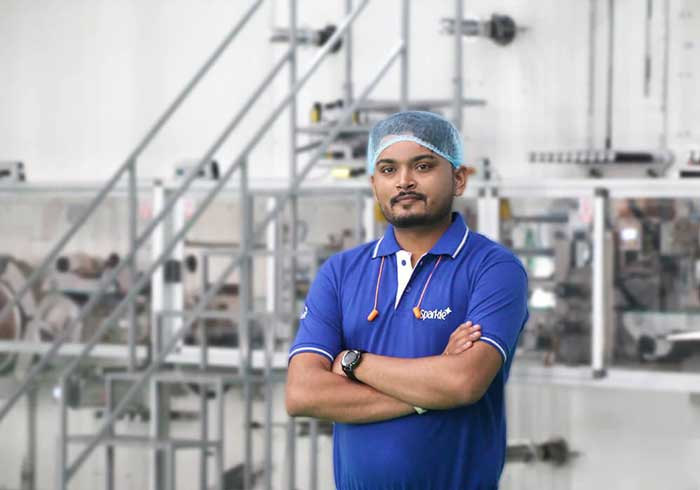
Sparkle Innovations is operating a state-of-the art converting plant in Kamrej, Gujurat, with the capacity to manufacture over one million sanitary pads per day and has established a sustainable and in part fully closed loop system for its products by working with local partners in India.
Sparkle sanitary pads are made from renewable resources designed to biodegrade in warm and humid conditions, with their top sheets, absorbent cores, release papers, pad wrapping papers and outer packaging all made of cellulose-based fibres.
One Sparkle innovation is the use of sugarcane bagasse in the company’s SugaFluff absorbent cores.
Sugarcane bagasse is one of the world’s most abundantly available lignocellulose agricultural residues and in India alone, over 100 million tons of it is produced each year. Unlike planting softwood or hardwood trees, no extra land is required to grow bagasse fibres as it is a widely available by-product of the sugar industry.
Composting
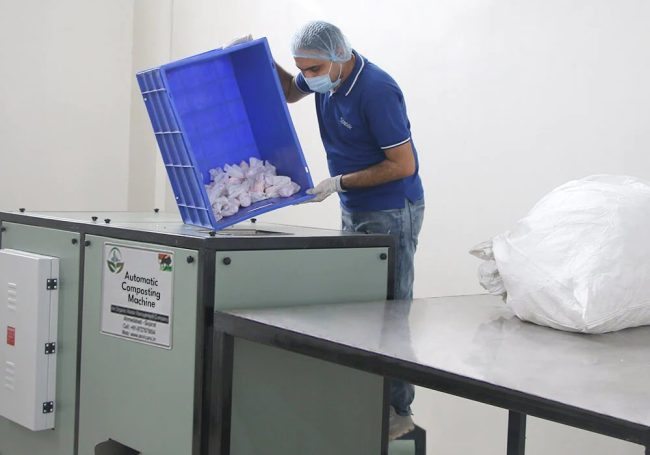
In considering the entire life cycle of its products, Sparkle is also piloting its GreenCycle project in Surat, Gujarat, as a first step for making the large-scale composting of absorbent hygiene products a reality.
Consumers signing up to the scheme are supplied with leak and odour-proof compostable bags for their used products, with a waste-management partner carrying out monthly doorstep collections.
“Many of our customers want to do their part to protect our planet by composting their used period products,†says Sparkle co-founder Hetal Virani. “However, for someone living on the 20th floor of an apartment building in an urban area without access to a backyard for composting, this is difficult. With the GreenCycle programme, we aim to make it easy for our customers to live a sustainable life by offering them a service to pick up their used products every month and turning them into compost.â€
Momentum
“India’s nonwovens and absorbent hygiene products industries are currently seeing great momentum,†said Samir Gupta, Managing Director of Business Coordination House (BCH). “New players are entering the market and existing participants are in expansion mode. Raw material supply is gradually becoming localised and import substitution is on the rise. As India gears up for the next hygiene revolution, it is witnessing new market trends coupled with a change in production dynamics. A never seen before user awareness is making the business very exciting.â€
“It’s extremely satisfying that the INDEX show in Geneva this year is poised to more than just return to its post-Covid status, but to be bigger and better than ever before,†said Murat Dogru, General Manager of EDANA, the INDEX owner. “Making the international contacts this exhibition enables is vital to the industry’s global progress going forward.â€