It is an input control certification aimed at introducing transparency and traceability into the textile supply chain involving organic cotton.
Oeko-Tex – the International Association for Research and Testing in the Field of Textile and Leather Ecologyas both official testing & certification institute, at India, Sri Lanka, Nepal and several countries in the Middle East. The subsidiary of Hohenstein Institute recently introduced certification Oeko-Tex Organic Cotton. It is an input control certification aimed at introducing transparency and traceability into the textile supply chain involving organic cotton.
Oeko-Tex Organic Cotton is a globally uniform, independent testing and certification system for textile raw, intermediate and end products of all processing stages, as well as accessory materials.
The testing includes
- Supply chain traceability to the field
- Genetically modified cotton (qualitative and quantitative) and numerous pesticides to prevent mixing with conventional cotton
- Legally prohibited and regulated substances
- Chemicals whose harmful effects are known but not legally regulated
- Substances for which a harmful effect is likely
What do you get?
- A detailed report and a certificate (valid for one year) as proof of the successful inspection of your textile products for harmful substances and their origin in organic farming
- Transaction certificates to maintain supply chain traceability
- A label to communicate the safety of your product to your consumers and business partners and to set yourself apart from the competition
- Cost savings through the Oeko-Tex modular system – certificates for input materials can be recognised at subsequent production stages, limiting the need for re-testing
- Free listing of your certified product range and company in the Oeko-Tex Buying Guide (www.oeko-tex.com/en/buying-guide)
What are different aspects of Oeko-Tex Organic Cotton certification?
- Supply chain traceability to the field (cultivation)
- Genetically modified cotton (qualitative and quantitative) and numerous pesticides to prevent mixing with conventional cotton
- Testing for harmful substances:
- Legally prohibited and regulated substances
- Chemicals whose harmful effects are known but not legally regulated
- Substances for which a harmful effect is likely
- Certification of your products in line with Oeko-Tex Organic Cotton provides a number of useful aspects that facilitate your operational quality assurance as well as communication towards stakeholders along your supply chain and consumers.
Compelling benefits
- A detailed report and a certificate as proof of the successful inspection of your textile products for harmful substances and their origin in organic farming.
- Transaction certificates to maintain supply chain traceability.
- A label to communicate the safety of your product to consumers and your business partners and to set yourself apart from the competition at the point of sale.
- Cost savings through the OEKO-TEX® modular system – certificates for input materials are recognized at subsequent production stages, limiting the need for re-testing.
- Free listing of your certified product range and company in the Oeko-Tex Buying Guide
Who can apply for Oeko-Tex Organic Cotton?
- Producers of raw cotton
- Any manufacturer or reseller of textile materials, finished goods or accessories – from any stage of processing – throughout the textile chain
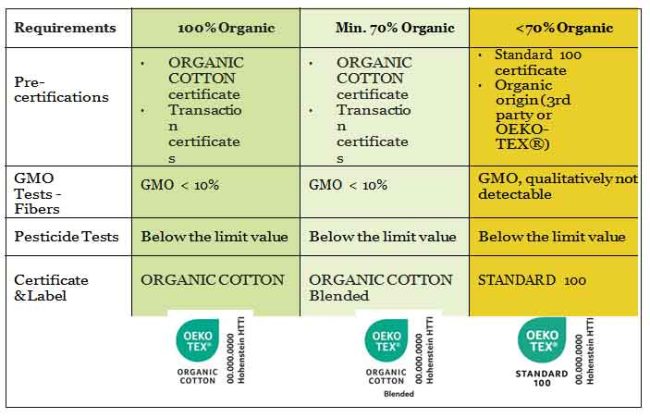
The requirements and levels