


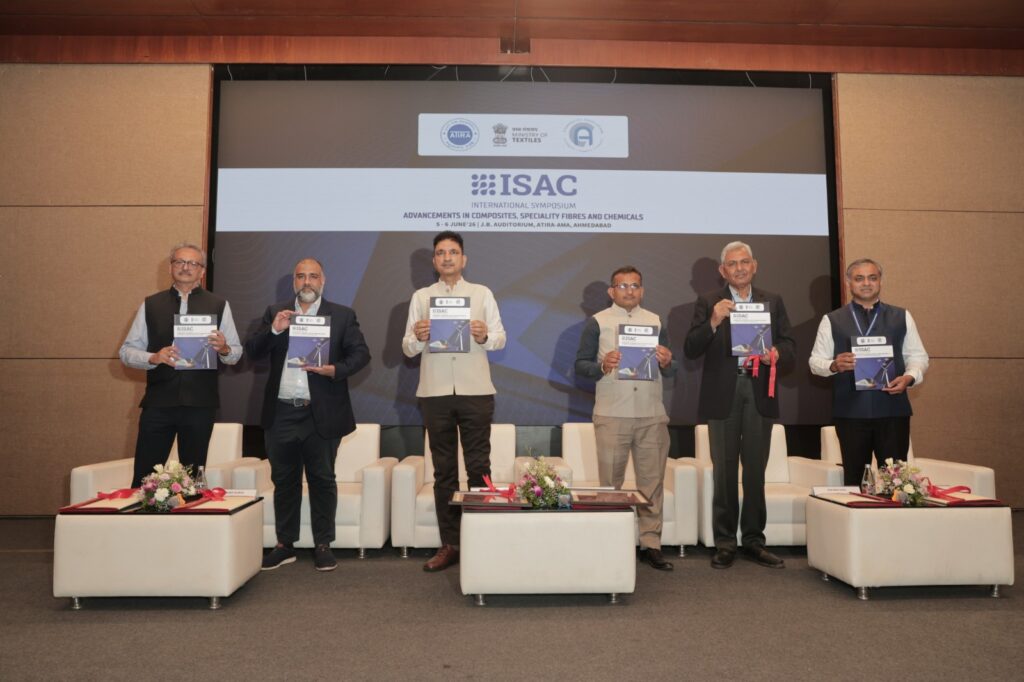
Ahmedabad Textile Industry’s’ Research Association (ATIRA) in association with Ministry of Textiles (MoT) and Composites Association of India (CAI) organized International Symposium on ‘Advancements in Composite, Special Fibres and Chemicals’ on 6th June 2026 at Ahmedabad.
India’s composite materials industry must strengthen domestic manufacturing, develop independent testing and qualification capabilities, address raw-material dependence and accelerate collaboration between industry, research institutions and government agencies to support the country’s long-term growth ambitions.
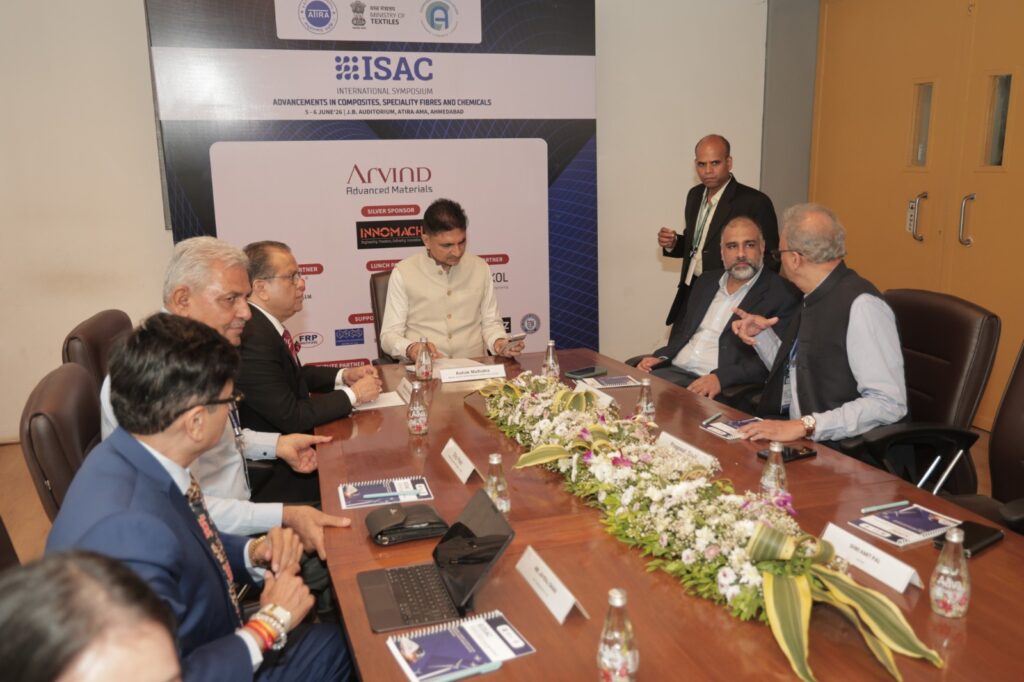
These priorities emerged during a CEO Meet held on June 6, 2026. The meeting was chaired by Ashok Malhotra, Mission Director, National Technical Textiles Mission, Ministry of Textiles, Government of India.
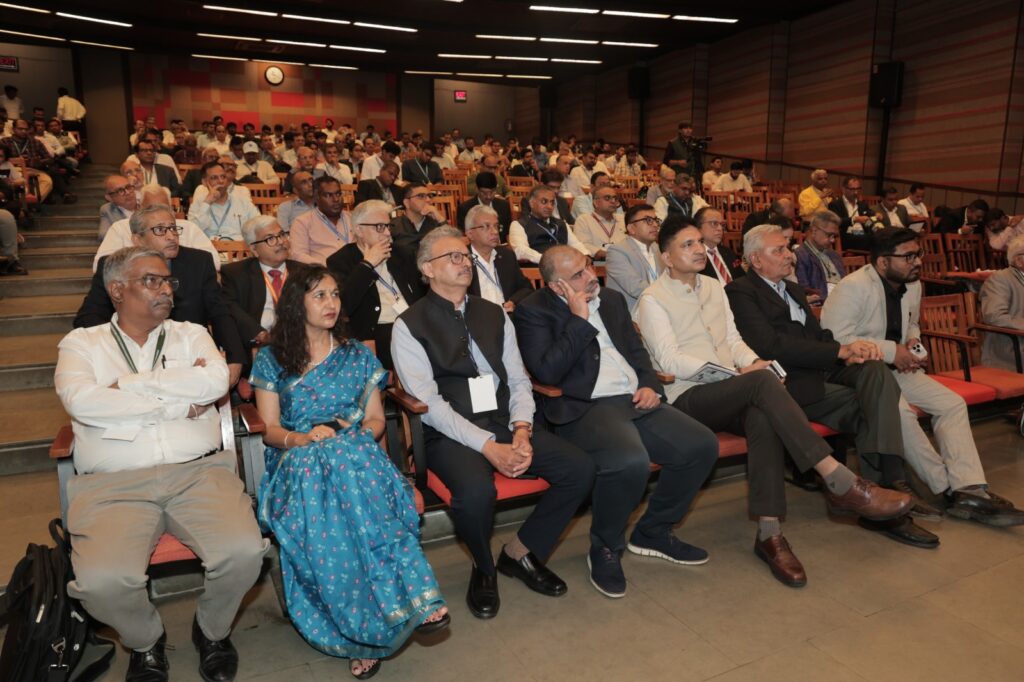
Around 30 senior industry leaders, along with representatives from the Ahmedabad Textile Industry’s Research Association, participated in the focused strategic dialogue. The discussions examined the present status of India’s composite industry, its immediate requirements and the support needed to contribute effectively to the India Growth Mission 2027 and the broader vision for a developed India.
The deliberations were centred around the “Three S” agenda for India’s composite sector: strategic role, material sovereignty and sustainability.
Opening the meeting, Pragnesh Shah, Director, ATIRA, outlined the objective of bringing industry stakeholders together for a constructive dialogue. This was followed by a presentation from Jayraj Shah of EPP, representing the composites association, which provided the context for the subsequent discussions.
Participants acknowledged that the Central Government and various ministries have introduced several encouraging policies and initiatives to support the composite industry. These measures have helped the sector evolve from conventional manufacturing and products towards advanced technologies and specialised applications.
Composite materials are now being used across infrastructure, mobility, aerospace, defence, renewable energy, water distribution, electrical systems and several other mission-critical applications. Their combination of low weight, durability, corrosion resistance and design flexibility makes them increasingly relevant for industries seeking improved performance and lifecycle efficiency.
However, participants observed that the sector continues to face structural and policy-related challenges that could restrict its ability to scale.
Need for a clear policy framework
Government departments and public-sector undertakings are among the largest potential customers for composite products. Punit Lalbhai, Vice Vice-Chairman & Executive Director, Arvind, emphasised the need for a clear and practical policy framework developed through consultation between government agencies, manufacturers and end-users.
Such a framework should provide clarity on product approval, procurement, qualification and implementation. While Indian manufacturers possess the technology to serve several demanding applications, they often lack a defined pathway for introducing these products to government departments and infrastructure agencies.
Participants noted that composite materials have already become significant contributors to sectors of national importance. However, stronger direction from the government would help manufacturers identify opportunities, obtain approvals and commercialise solutions more efficiently.
A related concern is the absence of government specifications and the limited inclusion of composite products in Schedules of Rates and other procurement documents. In many instances, technically suitable products are unable to qualify because the applicable standards, specifications or approval requirements have not been clearly defined.
This creates uncertainty for both manufacturers and end-users. Companies may invest in product development but remain unsure about the specifications they must meet, while procurement agencies may hesitate to approve newer materials without recognised guidelines.
Industry representatives called for composite products to be incorporated into relevant government specifications and procurement schedules wherever their performance has been established.
Building industry-ready skills
The composite sector remains highly dependent on skilled manpower, even as manufacturers gradually adopt automation and advanced production technologies. Participants highlighted the shortage of institutes offering specialised training in composite materials, processing and manufacturing.
Existing academic and training programmes are often unable to produce personnel who are immediately ready for industrial operations. The challenge is likely to become more serious as experienced employees retire and companies struggle to replace ageing manpower.
Shekar Sardesai, Chairman & Managing Director, Kineco, suggested introducing composites as a formal subject in engineering education. As composite materials are used across mechanical engineering, civil construction, aerospace, automotive, electrical systems and other multidisciplinary sectors, greater academic exposure could help create a stronger pipeline of engineers and technicians.
Participants also recommended closer engagement between companies, technical institutes and skill-development organisations to design training programmes aligned with actual manufacturing requirements.
Converting research into commercial products
India has undertaken several research and development initiatives in composite materials. However, industry mem
bers said that many research projects struggle to move beyond the laboratory stage.
The sector requires stronger collaboration between academic institutions, research centres and manufacturers to ensure that research is directed towards commercially relevant applications. Companies should be involved at an early stage so that product development reflects market requirements, manufacturing feasibility and user expectations.
The discussion also highlighted the importance of creating awareness among end-users. Even when a technically strong product is available, adoption may remain limited if customers are unaware of its benefits, performance or possible applications.
Demonstration projects, industry trials and structured engagement with potential users could help increase application areas while encouraging further research, innovation and new product development.
Participants also discussed the need to bring research institutions together through collaborative programmes. Instead of working independently on similar challenges, laboratories and technology centres could pool expertise, infrastructure and resources to develop commercially viable solutions.
Addressing recycling and circularity
Recycling and the circular economy remain among the most significant challenges facing the composite industry. Unlike metals and certain thermoplastics, many composite products are difficult to separate and recycle at the end of their useful life.
Some initiatives currently involve pulverising composite waste and using it as a filler material. Another common route is the use of composite waste as fuel in co-generation or cement manufacturing. However, this primarily represents an end-of-life disposal solution rather than true material circularity.
Participants called for a structured approach supported by the government to develop sustainable recycling technologies, collection systems and viable secondary applications.
Greater policy support could encourage research into recyclable resin systems, design for disassembly, reuse of composite components and recovery of fibres or other valuable materials. Sustainability considerations must increasingly be integrated into product design and manufacturing rather than addressed only at the disposal stage.
Developing Indian standards and testing facilities
The lack of Indian standards and complete domestic testing facilities was repeatedly raised during the meeting.
In the absence of locally defined standards, manufacturers are frequently required to follow international specifications. While global standards may provide useful benchmarks, excessive dependence on them can create challenges because they may not fully reflect Indian operating conditions, climatic environments or application requirements.
India also has limited facilities capable of conducting the complete range of tests needed for composite products. ATIRA offers several testing capabilities, but many specialised tests still have to be carried out overseas. This increases the cost and time required for product qualification.
Industry representatives recommended that manufacturers, end-users, testing centres and the Bureau of Indian Standards work together to develop relevant standards and qualification procedures. These standards should consider Indian environmental conditions, safety requirements, performance expectations and intended applications.
The requirement is particularly important for advanced and critical
applications in automotive, aerospace, defence, mobility and energy. Products used in these sectors must undergo extensive performance, fatigue, impact, pressure, fire, environmental and lifecycle testing.
Without domestic facilities, companies remain dependent on international laboratories, making development cycles more expensive and delaying market entry.
Responding to this concern, Malhotra advised ATIRA to explore the establishment of a testing facility for hydrogen cylinders. He suggested that ATIRA, industry associations and manufacturers jointly approach the Ministry for support in creating the facility.
Improving coordination across ministries
Participants noted that composite materials should not be viewed only through the lens of the textile industry. Their applications extend across defence, railways, aerospace, electric mobility, electrical equipment, marine transport, waterways, infrastructure and several other sectors governed by different ministries.
This creates a coordination challenge. Industry stakeholders often lack clarity about which department should collect sectoral data, assess industry requirements and recommend policy actions.
Malhotra said the composite industry could initially approach the Ministry of Textiles to seek recognition and support. The Ministry could subsequently advise or engage other relevant ministries depending on the application area.
He added that associations can represent industry requirements after consulting their members and developing a clear implementation proposal.
The creation or modification of standards must similarly be undertaken through collaboration between BIS, industry representatives and end-users.
Participants stressed that associations must present clear recommendations rather than only identifying gaps. To influence policy decisions effectively, industry bodies should depute representative teams, develop consensus among members and communicate precisely what the sector requires from the government.
Strengthening material sovereignty
The discussion also addressed the composite industry’s contribution to Viksit Bharat and the need to strengthen material sovereignty.
India remains dependent on imports for several raw materials used in composite manufacturing. Participants called for greater attention to domestic raw-material production, import substitution and the development of indigenous supply chains.
Government support may be needed to balance import duties, improve manufacturing economics and encourage investments in local capacity.
Industry members also urged a considered approach towards anti-dumping measures, particularly for glass fibre. India’s demand for certain reinforcing materials is currently higher than domestic production. Trade measures should therefore account for the demand-supply gap and avoid disrupting industries dependent on these inputs.
At the same time, domestic manufacturing capabilities must be upgraded through new technologies, international partnerships and technology transfer. Technologies from established overseas markets, including China and other countries, could help Indian manufacturers increase capacity, reduce costs and bridge the supply-demand gap.
Participants said that specialised fibres, including natural fibres, carbon fibres and other advanced reinforcing materials, should be recognised as strategically important. Specialty composite materials should receive greater attention in national policies, research programmes and manufacturing incentives.
NTTM could also support the sector by bringing major public-sector undertakings, which are significant users of composite products, onto a common platform with manufacturers and technology providers.
A collaborative path forward
The meeting witnessed active participation from industry leaders, who shared practical concerns and recommendations on policy, skills, raw materials, testing, research, sustainability and market adoption.
The discussions reflected a growing recognition that composites can play an important role in India’s industrial development, infrastructure modernisation and strategic self-reliance. However, unlocking this potential will require coordinated action across ministries, industry associations, research institutions, testing centres, standards bodies and end-users.
Malhotra listened to the recommendations and responded positively to the issues raised. He assured participants of support from NTTM in taking the industry’s priorities forward.
The meeting concluded with a shared commitment to strengthen collaboration and position the composite industry as an important contributor to India’s Vision 2030 and Growth Mission 2047.