


For nearly two years, face masks have been a much-debated product, while they have played important role in curtailing the spread of variants of SARS-CoV-2, says Prof Seshadri Ramkumar of Texas Tech University, USA.
Lubbock, USA
With the COVID-19 wave wanning and many States in the United States easing their face mask recommendations, it is important to understand the role played by face coverings offering varied levels of protection during the pandemic.
For nearly two years, face masks have been a much-debated product, while they have played important role in curtailing the spread of variants of SARS-CoV-2.
Since March 2020, when the pandemic was recognised and vaccinations were just beginning to happen, face masks have played critical role in saving lives. Face masks are one of the critical tools in the toolbox to fight infections caused by airborne microbes.
The use of different versions of face coverings has genuinely spotlighted the use of cotton and its blends. While in public domain, technical details may not have been much discussed, certainly, among stakeholders, from producers to fashion designers, technical advantages of cellulose-based materials for medical and personnel protection has gained support and interest.
Haripriya Ramesh, doctoral student in the Department of Environmental Toxicology, Texas Tech University, who wears face coverings in indoor public settings such as classrooms stated that cotton-based face coverings are comfortable and makes her safe and comfortable in wearing.
As the Omicron wave was peaking in late Fall 2021, medical community emphasized the need for high quality face masks such as N95s. N95s and other filtering facepiece respirators offer highest level of protection, which are needed where higher level of transmissions is experienced.
In communities other than highly vulnerable settings such as hospitals, health care facilities, etc., other making strategies that involve nonwoven face masks in combination with multilayered cotton-based face coverings may be helpful. In all these scenarios, fit is important. The use of cotton-based face coverings as a combo may provide next-to skin comfort, provided the combo structure provides good fit.
This alternate masking strategy considers, filtration, fit and comfort into consideration and has evolved out of two years of class discussions and research in the Nonwovens & Advanced Materials Laboratory at Texas Tech University. Cotton-based multilayered face coverings with more than two layers are needed when used in combination with 3-ply nonwoven surgical masks to offer good protection.
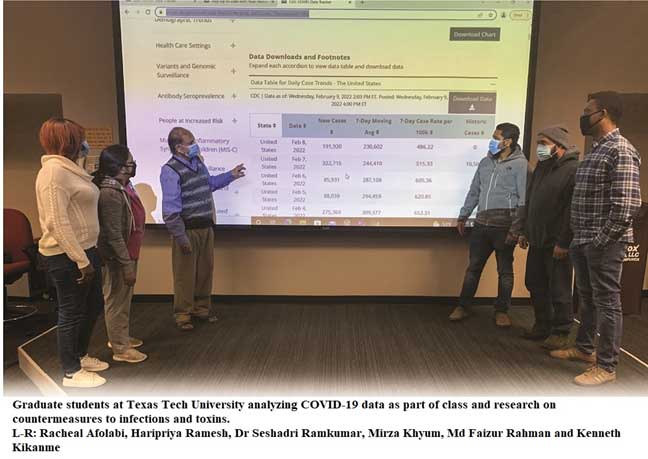
Graduate students involve both in research on PPE and analyzing the infection and vaccination rates as part of “Countermeasures to Toxins,†graduate level course at Texas Tech University. It has become evident that courses that deal with ongoing crisis result in timely and valuable deliverables. Such activities also strengthen the course information based on relevance and ongoing research, adding value to courses.
COVID-19 has strengthened our understanding that textile materials, which have functional capabilities play vital roles in medical, hygiene and personnel protection applications.
Stakeholders in the textile and material sectors must focus on non-commodity applications and provide support for much needed R & D in the advanced materials sector.
About the Author:
Dr Seshadri Ramkumar is the Professor, Nonwovens & Advanced Materials Laboratory, at Texas Tech University, Texas, USA. He can be reached on email: s.ramkumar@ttu.edu