Close Menu
Indian Textile Journal
  • Home
  • Textile Machinery
    • Allied Equipment and Accessories
    • Automation
    • Dyeing, Processing & Finishing
    • Knitting
    • Printing
    • Spinning
    • Weaving
  • Tech Textiles
  • Sustainability
  • Resources
    • Trade Fair
    • Events
    • Videos
  • Interview & Opinion
  • Subscribe Now
  • Advertise
  • Digital
  • Apparels & Garments
  • Fibres & Raw Materials
  • Home Textiles
  • Industry Update
Facebook X (Twitter) YouTube LinkedIn
Indian Textile Journal
Epson
  • Home
  • Textile Machinery
    • Allied Equipment and Accessories
    • Automation
    • Dyeing, Processing & Finishing
    • Knitting
    • Printing
    • Spinning
    • Weaving
  • Tech Textiles
  • Sustainability
  • Resources
    • Trade Fair
    • Events
    • Videos
  • Interview & Opinion
  • Subscribe Now
  • Advertise
  • Digital
  • Apparels & Garments
  • Fibres & Raw Materials
  • Home Textiles
  • Industry Update
Indian Textile Journal
Home » Electricity from yarns!
Industry Update

Electricity from yarns!

By September 15, 20172 Mins Read
Share Facebook Twitter LinkedIn WhatsApp Copy Link

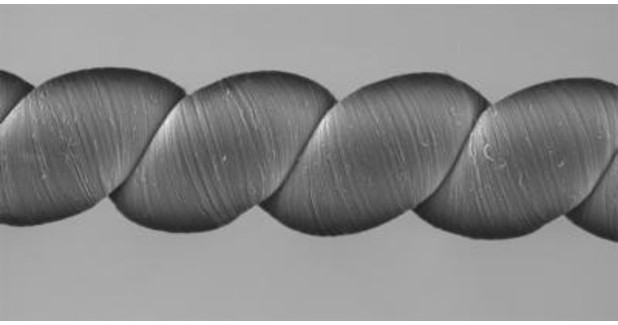
Highly twisted coiled carbon nanotube yarns termed “twistron,” generate electricity efficiently. A team of international scientists from the United States, South Korea and China led by researchers at The University of Texas-Dallas (UT Dallas) and Hanyang University, South Korea have reported in a recent Science magazine that these harvester yarns in electrochemical environment can transform mechanical energy to electricity without any external voltage source, in other words without the need of external batteries.

According to Na Li, at Alan G MacDiarmid NanoTech Institute at UT Dallas, who has been involved in the study, yarns charge with the help of electrolyte, without external batteries. Mechanical activities on the highly twisted yarn assembles the charge closer to the yarns, thereby increasing the voltage, helping with harvesting of electricity.

The strength of the new development is that the yarns result in high energy output per cycle. Stretching the yarn 30 timers per second generated 250 watts per kilogram of electric power, stated Professor Ray Baughman of UT Dallas, lead researcher in the study.

Shi Hyeong Kim, a postdoctoral researcher at UT Dallas and with Hanyang University did a bold study to prove the efficiency of the yarns, by experimenting the yarns in the cold waters off the east coast of South Korea. A 10-cm twistron yarn was attached between a balloon and a sinker on the seabed. With ocean waves, the yarn would stretch 25 percent, thereby generating electricity.

The task is to make these high-tech yarns economical and scale-up the production method. May be one day, such high performance textile yarns can harvest energy from ocean waves.

Previous ArticleGreens to fore at October’s Yarn Expo
Next Article Applied DNA system for US gin

Related Posts

Birla Cellulose handloom initiative opens new avenues for traditional weavers

August 11, 2026

NABARD celebrates National Handloom Day with Mumbai Exhibition and Sales

August 11, 2026

PDS Q1 FY27 revenue rises 15%, PAT jumps 43%

August 10, 2026
Recent Posts
  • CAI raises India cotton pressing estimate to 339 lakh bales
  • Birla Cellulose handloom initiative opens new avenues for traditional weavers
  • NABARD celebrates National Handloom Day with Mumbai Exhibition and Sales
  • Global textile sector responds enthusiastically to ITMA 2027
  • Peter England enters Gen Z fashion with new sub-brand VYBE
  • PDS Q1 FY27 revenue rises 15%, PAT jumps 43%
  • Gartex Texprocess India in Delhi showcases cutting-edge garment tech
  • KKCL Q1 FY27 revenue rises 19%, PAT grows 29%
Facebook X (Twitter) YouTube LinkedIn
  • About us
  • Contact us
  • Privacy Policy
  • Terms and Conditions

SISTER PUBLICATIONS

Construction World Equipment India Industrial Product Finder Infrastructure Today

© 2026 Indian Textile Journal. All Rights Reserved.

Type above and press Enter to search. Press Esc to cancel.