


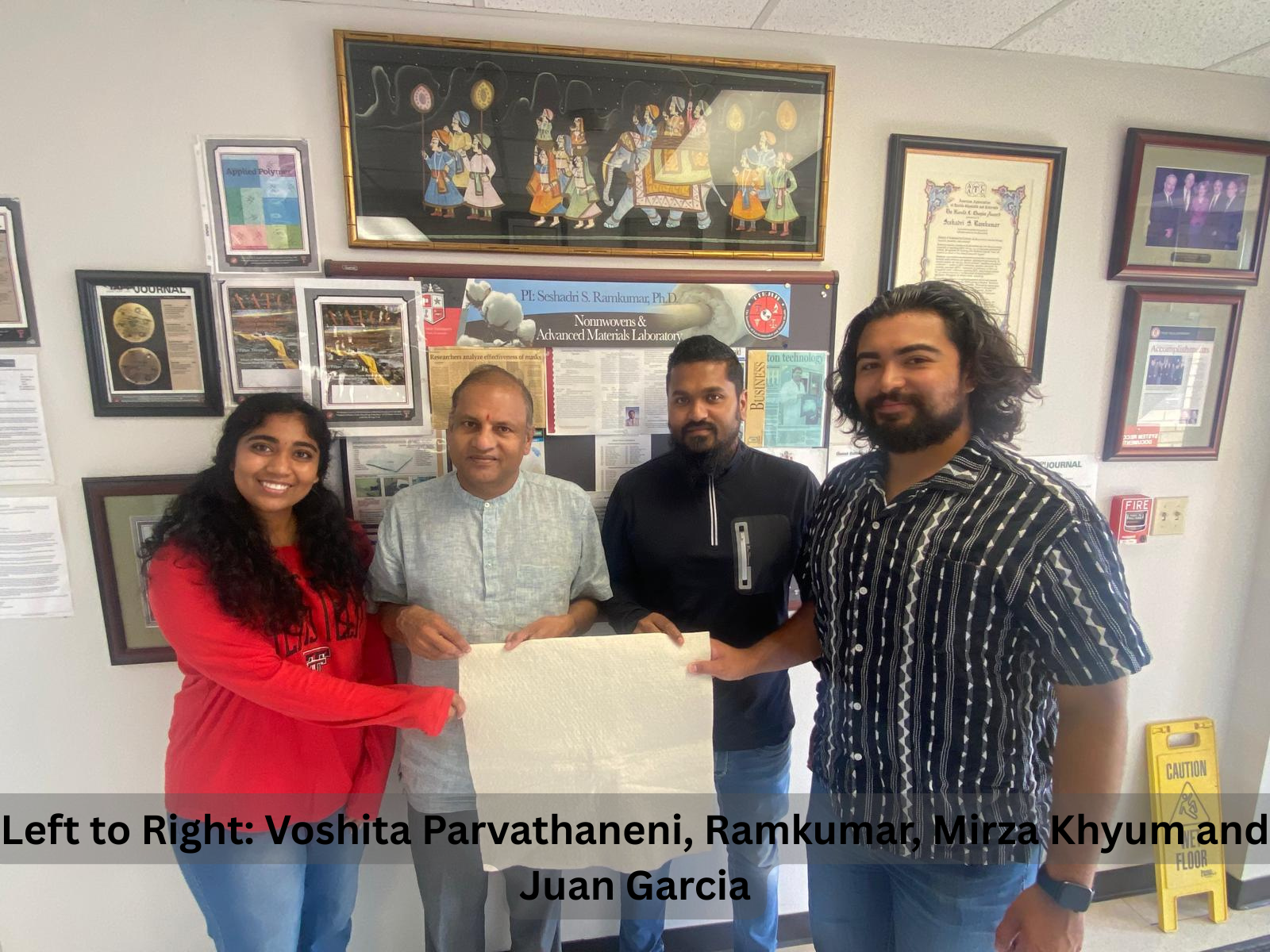
At the university level, Transformative Research Undergraduate Experience [TrUE] program supports undergraduates from first year in research and providing financial support as an encouragement to undertake research in laboratories, informs Dr Seshadri Ramkumar.
Investing in science and next generation talent is vital for economy and defense of nations.
There is a general sentiment that next generation talents in developed nations are not interested in demanding fields science as science, while this is not the case in China. Recent experience at Texas Tech University has shown that the above may not be true provided the system supports attracting and encouraging high school students and undergraduates in research.
This summer, our laboratory welcomed two TrUE scholars to undertake research on cotton for advanced applications such as environmental protection.
Juan Garcia, who will major in Physics and Math and Voshita Parvathaneni, Pre-Med are enthusiastic in conducting experiments, and contribute to writing journal papers. The ecosystem such as the welcoming aspect of Nonwovens & Advanced Materials Laboratory, incentive mechanisms like TrUE scholarships and interest by students, has enabled this positive research story.
The College of Arts and Sciences at Texas Tech University has established Undergraduate Research Academy to foster multidisciplinary collaboration among students who are conducting their undergraduate studies. At the university level, Transformative Research Undergraduate Experience [TrUE] program supports undergraduates from first year in research and providing financial support as an encouragement to undertake research in laboratories.
Juan Garcia, having grown up in Plainview, Texas, which is a cotton growing area, has been amazed with new applications of cotton. Voshita Parvathaneni is from Dallas and is a University-Medical School Initiative scholar, a highly competitive medical school program, although not aware of production agriculture, was thrilled to bring her research experience to cotton. These high achievers engage in research with the help of graduate student Mirza Khyum whose research is focused on using sustainable processes to find new cotton products. Engagement with undergraduates also helps graduate researchers like Mirza Khyum to develop their tutoring abilities which is needed for their career in academia or research laboratories.
“I had known of the many uses of cotton but had not realized the full extent of its utility,” stated Juan Garcia. On cotton research Voshita added, “Research experience in cotton has made me to understand how versatile it is. This is the beauty of research.”
On research encouragement at undergraduate level, Juan Garcia stated, “It opens up windows into the world of ideas, which undergraduates may not find on their own.”
Voshita is thankful for the research support, and stated, “By encouraging creativity and providing a welcoming atmosphere, students will be encouraged to take their curiosity to next level.”
Research needs support, but it need not be just funding alone. Active engagement with society, solving problems that are relevant, outreach to high school students and undergraduates through undergraduate research academy and financial and in-kind support by the end-user community all will develop a welcoming and supportive R & D ecosystem. Importantly, science communication to the public is needed to buy-in support from society and policy makers.
While in majority of countries, research is supported by government programs, in the United States, stakeholders like industry and commodity groups support research. United States’ cotton producers support research in laboratories like Nonwovens & Advanced Materials Laboratory through Cotton Incorporated and Texas State Support Programs.
Recent experience with high school and undergraduate students in our laboratory has shown that an engaging and supportive system will enthuse students towards science and technology.
Economic might of nations depends on talented next generation workforce which is interested in science and technology.
About the author:
Dr Seshadri Ramkumar is a Professor, Nonwovens & Advanced Materials Laboratory in Texas Tech University, Lubbock, TX, USA. You can contact him on Email: s.ramkumar@ttu.edu