


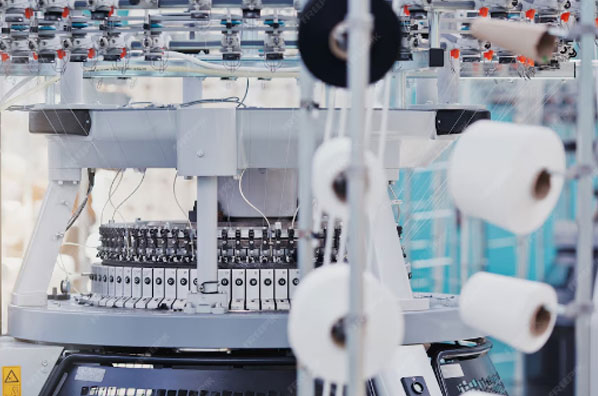
FEM, particularly through software like Abaqus, allows for precise simulations, significantly reducing the need for extensive physical prototyping in textile engineering.
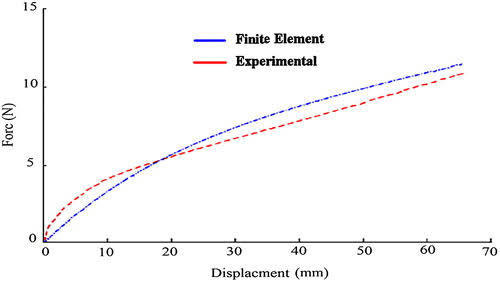
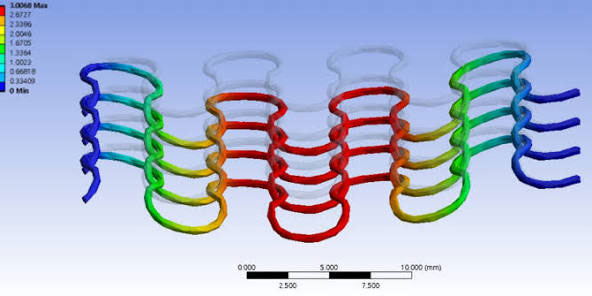
Finite element methods (FEM) in knitting involve numerical simulations that discretise complex, yarn-level structures into smaller, manageable elements to analyse mechanical, thermal, and deformation properties. This approach enables accurate modeling of warp/weft fabrics, including stitch geometry, contact interactions, and non-linear behaviors, which are crucial for simulating draping, buckling, and compression in engineered textiles.
Key aspects of FEM in knitting:
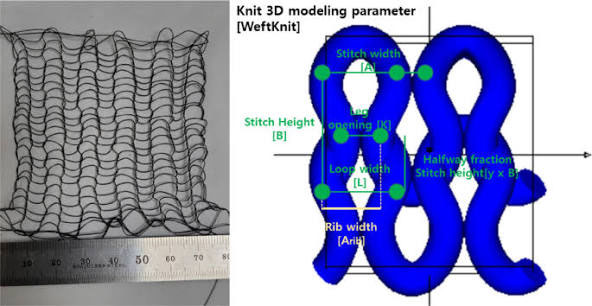
Researchers develop 3D representations of knitted microstructures, using unit cells to define geometry (e.g., Catmull-Rom splines for yarn centerlines) and applying contact algorithms for accurate mechanical behavior simulation.
Applications
- Mechanical behaviour: Analysis of compression, stress, and strain in knitted composites and fabrics.
- Thermal comfort: Simulation of heat transfer, air permeability, and thermal conductivity in weft-knitted fabrics.
- Garment design: Optimisation of functional textiles, such as compression sleeves, by simulating fabric-level responses.
- Multiscale approach: Techniques transfer properties from the fiber level (microscale) to the yarn level (mesoscale) and finally to the complete fabric/composite level (macroscale).
- Integration with AI: Machine learning is increasingly used alongside FEM to predict the mechanical properties of complex, large-scale knitted materials.
FEM, particularly through software like Abaqus, allows for precise simulations, significantly reducing the need for extensive physical prototyping in textile engineering.
Finite Element Method (FEM) is a cornerstone of modern textile engineering, used to simulate the complex mechanical and thermal behavior of knitted structures at various scales—from individual yarns to complete garments. By discretising the intricate geometry of knit loops into smaller, solvable elements, researchers can predict performance without expensive physical prototyping.
Applications of FEM in knitting
- Mechanical performance: FEM predicts the tensile, flexural, and compression properties of knitted fabrics and their composites. It is particularly effective for analysing stress distribution in complex structures like auxetic warp-knits or weft-knitted spacers.
- Thermal comfort: Models analyse heat transfer and thermal conductivity, helping designers optimise fabrics for sportswear and insulation.
- Deformation and aesthetics: Simulations capture “bagging” behavior, draping, and the natural curling of fabric edges based on internal bending and torsional forces.
- Electronic textiles (E-yarns): FEM evaluates mechanical stresses on soldered joints within electronic yarns to ensure reliability under axial loading.
Modeling scales
Micro-scale: Focuses on the internal structure of individual yarns, often treating them as bundles of fiber filaments.
Meso-scale: Models the 3D geometry of the unit cell (the individual loop). Software like Catia or Rhino is used to generate the loop paths based on mathematical models like the Pierce model. Macro-scale: Treats the entire fabric as a homogeneous continuous material, which is less computationally expensive for simulating large components.
Modern advancements: FEM + Machine Learning
Traditional FEM for knitting is computationally intensive because of the complex yarn contacts and non-linear deformations. Recent frameworks combine FEM with Machine Learning (ML) to accelerate design:
- Predictive databases: FEM is used to generate large databases of “engineering constants” (stiffness, Poisson’s ratio) for different loop geometries.
- Rapid inference: Once trained on FEM data, ML models (like Artificial Neural Networks) can predict fabric properties in milliseconds, whereas traditional FEM might take hours.
- Sensitivity analysis: Techniques like SHAP analysis are used to identify which geometric parameters (e.g., stitch width, yarn diameter) most significantly impact final performance.
About the authors:
Karthika is from the Department of Mathematics and Dr N Gokarneshan is from the Department of Textile Chemistry, SSM College of Engineering, Komarapalayam, Tamil Nadu.