


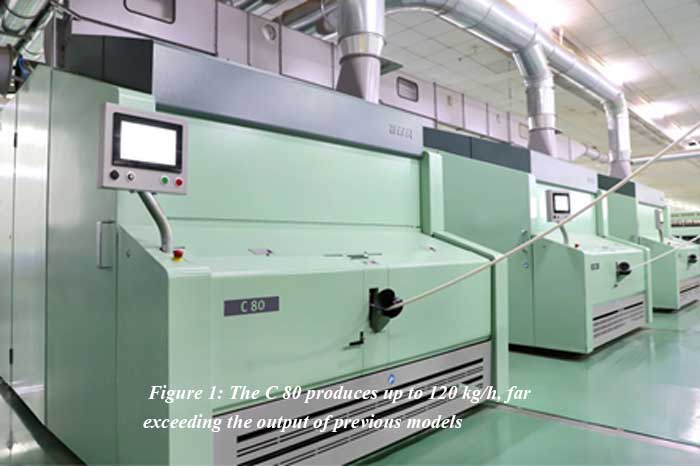
After installing three Rieter cards C 80, Chuzhou Jinshangjia Yarn Industry Co, saw its cost-performance ratio improve. The Chinese spinning mill, which is based in Anhui Province, values the C 80 for its high stability, remarkable production efficiency and long service life. The superior sliver quality with up to 82 per cent fewer neps ensures excellent end spinning performance and delivers a yarn quality that their downstream customers appreciate greatly.
Jinshangjia pursues the twin goals of increasing production while keeping sliver quality high. With around 100 000 spindles the company produces 55 tons of Ne 16 to 26 carded compact yarn per day. Previously, the company used the Rieter cards
C 72 with a production rate of 80 kg/h. To achieve higher capacity without using more space, Jinshangjia tested different solutions and finally chose the C 80. Today they produce up to 120 kg/h sliver per card. Neps were reduced by up to 82 per cent during the carding process. The C 80 helps handle higher order volumes and supports the company’s goal of improving both yarn quality and cost efficiency.
Features for better performance
The card C 80 has the largest active carding area, which improves fiber opening and cleaning. It has 40 active flats and precise carding gap settings, leading to high sliver quality and finally to more efficient spinning. Energy efficiency is another advantage. The improved drive system and suction technology lower energy consumption while keeping output high. The modular design reduces maintenance and machine downtime.
Long-term partnership with Rieter pays off
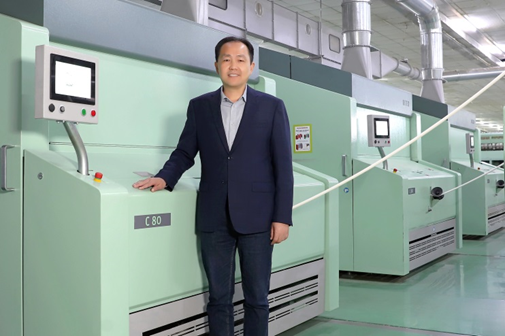
Figure 2: Gu Jinguo, General Manager of Chuzhou Jinshangjia, appreciates the superior sliver quality that ensures excellent spinning performance.
Jinshangjia has used Rieter’s technology since 2013. Gu Jingguo, General Manager of Chuzhou Jinshangjia Yarn Industry Co, emphasizes, “Our cooperation with Rieter dates back to 2013. For more than a decade, we have relied on Rieter’s equipment, advanced technology and professional service. The card C 80 is characterized by high stability, remarkable production efficiency and a long service life. The sliver is of superior quality, with fewer neps, ensuring excellent yarn quality. This is highly appreciated by our customers.â€
By investing in the C 80, Jinshangjia strengthens its position as an innovative company. With the advanced carding technology, it continues to improve production, ensuring growth and high-quality yarn for the global textile market.
About Rieter
Rieter is the world’s leading supplier of systems for manufacturing yarn from staple fibers in spinning mills. Based in Winterthur (Switzerland), the company develops and manufactures machinery, systems and components used to convert natural and
man-made fibers and their blends into yarns in the most cost-efficient manner. Cutting-edge spinning technology from Rieter contributes to sustainability in the textile value chain by minimizing the use of resources. Rieter has been in business for 230 years, has 18 production locations in ten countries and employs a global workforce of around 4 790, about 16 per cent of whom are based in Switzerland.