


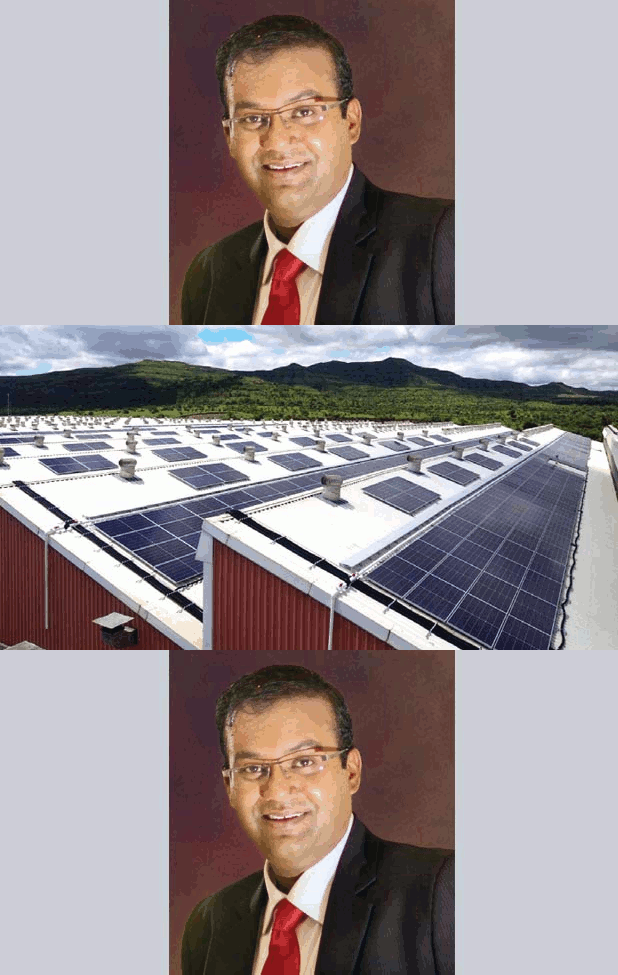
Sunshot Technologies is an on-site solar power solutions company that provides comprehensive rooftop solar power plant solutions for commercial and industrial customers like airports, manufacturing facilities, special economic zones, resorts and hotels, educational institutes, etc. Adhering to world-class standards in the industry, they foresee to reinforce people’s trust in solar energy through the empowerment of businesses to grow more sustainable. With quality, safety, performance and reliability being the main priorities, they are willing to embrace the challenge of helping the society fight climate change.
Rahul Dasari, CEO, Sunshot Technologies, talks on the company’s contribution to the sustainability of textile industry, and on rooftop solar power plant solutions. Excerpts…
Your comments on Sunshot’s contribution to the sustainability of textile industry.
At Sunshot, we started out with a vision of providing long-term sustainable energy benefits to our consumers. While most of us passively glance through the future of non-renewable sources of energy, Sunshot has actively worked towards providing the renewable energy solutions to the commercial and industrial sector.
One of our key installations in the textile sector include the rooftop solar power plant set-up at the Rieter, which is world’s leading Swiss textile machinery manufacturing brand, and has taken a step towards sustainability at their manufacturing unit located near Pune, Maharashtra by installing 2 MWp capacity rooftop solar power plant. This power plant is expected to generate around 29 lakh units of electricity annually and will contribute to the environment by reducing 2,500 tonnes of CO2 every year, which is equivalent to reducing carbon emission from 1,500 cars annually and planting around 2,00,000 trees.
Rooftop solar power plant solutions: How they can be a boon to the textile industry in India?
In simplest words, rooftop solar power plant solutions have not only proven to be cost effective, but also efficient and highly viable. There is no denying that the energy requirement in the textile industry is enormous. Adopting solar energy will offer textile sector control over one of the most critical element that is operational cost.
If we do the calculations, a commercial property, which pays around Rs 10 per unit, having a rooftop solar power plant can generate Rs 150 per sq ft of revenue, which is almost 20 per cent of the rental yield most of the commercial spaces get annually, this can be achieved using a vacant space, which otherwise has no commercial use. When it comes to the industrial customers who pay approximately Rs 7-8 per unit tariff; can generate around Rs 105-120 per sq ft through a rooftop solar power plant.
In India, the grid power costs are expected to escalate at 5 per cent YoY, moreover, accessibility of grid power is also challenging at some places, resulting in higher usage of diesel generators, which leads to increased energy costs.
The textile is India’s one of the highest energy consuming sectors. Textile business runs throughout the year, and energy demand always remains in excess. Textile industry in India pays around Rs 7-8 per unit power tariff. On an average textile industry in India has enough space to accommodate 1-5 MW capacity of the rooftop solar plant with a payback time of 2.5 to 3.5 years where the life of solar power plant is around 25 years. The operation and maintenance of the solar plant can cost around Rs 40 paise per kWh with 4 per cent escalation YoY. Sensing the economic outlook of solar energy, large textile industries in India can be assertive towards the use of solar energy.
Lastly, through this initiative, the sector can immensely contribute towards the sustainability quotient of the country.
Which of the industry has shown good response for your company? How has been the response from the textile industry?
At Sunshot, we have extended clean energy solutions towards various industries, such as airports, food processing, malls, hospitality, auto, amongst many others. However, our biggest consumer base comes from the manufacturing industry. This is mainly because this industry is power intensive and runs nearly all the days of the year making it a contender in dire need of cost-effective solutions and uninterrupted sources of energy.
Textile industry, too, has started to realise the benefits of adopting renewable energy. After having a successful installation at Rieter, we are in conversation with various other big brands in the Indian textile industry.
What is the potential of solar power utilisation in textile industry?
To understand the potential of solar utilisation in the textile industry, let’s take into consideration a report by Technopak Advisors. This report states that the textile industry in India accounts for approximately 24 per cent of the spindle capacity of the world. It also reflects that 8 per cent of the global rotor capacity is in our nation. As per the report, we can estimate that by the year 2021, the potential size of the Indian textile industry, as well as the apparel industry is going to reach $223 billion.
Abundance of raw materials such as wool, silk, cotton, and jute have given India the power of not only being a top-notch sourcing hub, but also the potential to being one of the largest producers of textiles globally. Since, the textile sector contributes to about 14 per cent of the total industrial production, and 4 per cent of India’s GDP – it does not come as a surprise; that an industry this large should switch to solar.
As per Dr Ashvini Kumar, Senior Director, Renewable Energy, The Energy Resources Institute (TERI), the proper application of solar energy in the textile industry holds a potential of saving nearly Rs 770 crore per annum.
TERI says this with experience since they have solar plant installed for producing Benarasi sarees. This solar plant do not only help the units in accessing a better form of energy for running their machines but keeps them ready for power cuts. They have installed nearly 100 such systems which support 400 different power looms in Lohta, Jalalipura, and even Kotwa, which are remote areas in Uttar Pradesh. As per data produced by TERI, these solar power systems have reflected an earning of nearly 20 per cent in total and the total hours of productivity have also gone up due to fewer power cuts in total.
The potential is definitely huge; it is a matter of quick realisation and adaptability amongst all concerned.
What are your suggestions for the government to promote this renewable source of energy further?
We have noticed that discoms are not in favour of net metering, group captive and open access permissions. This is largely because, somewhere, rooftop solar players are taking away their business by approaching their top paying consumers.
The reality is, in industrial states, over 30-40 per cent electricity is offered free of cost to lower strata of the society; 15-20 per cent goes to residential at a subsidised cost; and hence the balance is offered to commercial and industrial consumers at a premium price.
To restraint this issue, government can introduce some capitalisation and financing schemes that can incentivise discoms in order to promote distributed solar.