


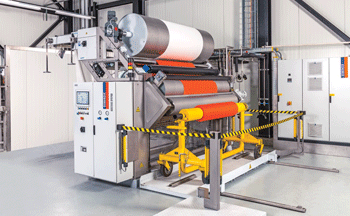
The new Küsters/Benninger S-roller technology ensures even liquor application over the entire fabric width as well as deliberately different liquor application in the ´edge-centre-edge´ areas.
The Küsters S-roller technology is now a recognised brand and stands for a safe, reproducible dyeing method, the CPB cold, pad, batch process. The CPB process is becoming increasingly important, as it can be used to dye both short and long yardages of woven and knitted fabric very economically. The initial scepticism towards a new technology is becoming overcome with time due to the positive experiences made in industrial practice with an established technology. The new Küsters S-roller technology with the very latest technical features combined with modern control equipment and electronics supplied by the BENNINGER AG mechanical engineering division provides the technical process conditions that are expected of such a process today.
Dyeing is a very complex process and influenced by a number of parameters. Dyeing results are now not only gauged by visual assessment, and technical measuring instruments that can determine these results accurately and precisely have also become established in customer circles. In addition, correction of dyeing faults is time-consuming and expensive. Furthermore, ecological sustainability demands are constantly rising, especially with regard to the consumption of natural resources, and are increasingly becoming a cost factor that affects decisions. CPB dyeing with reactive dyes is a cost-effective process with a very high level of reproducibility.
Impregnation in the padder is the most important part of CPB dyeing. This is where the foundation stone for the dyeing results is laid. There are naturally also a number of other factors affecting the process that also require consideration but cannot be directly influenced by a plant engineer. On the surface the demand for an application system for forced application is relatively simple. It must be ensured that the dye can be equally and constantly applied across the entire width of the fabric after a short period of contact with the dye liquor. This is only possible if the squeezing pressure and the squeezing nip can be kept constant. This task becomes complicated when the properties of the material to be dyed have to be included in calculations. From a purely technical viewpoint, conditions are affected by different fibre and yarn thicknesses, absorbency, fabric tension, weft distortion, admission moisture content and liquor temperature, dye properties and errors such as dye migration at the selvedges during drying. For this reason the requirements to be met by an application system are complicated and can only be satisfied by the use of state-of-the-art control and instrumentation equipment. It is therefore necessary to deliberately control regular liquor application over the entire fabric width to correct the different influencing factors.
The new Küsters / Benninger S-roller technology ensures even liquor application over the entire fabric width as well as deliberately different liquor application in the ´edge-centre-edge´ areas. With the integration of modern instrumentation and control this can be adjusted simply and in a reproducible manner or controlled and regulated as required. The new Küsters S-roller technology now offers new and extended correction potential.
The reproducibility is maximised by an electronic pressure system (patented) that ensures controllable line forces over the entire roller width. In addition, dyers have a higher level of flexibility that offers decisive advantages, especially when dyeing knitwear and stretch woven fabric. With the further development of a specific roller coating, the ´Blue Nip´, it can be ensured that the necessary application conditions can be transferred to the dyed goods optimally and durably.
Higher-level technol