


Rony Banerjee explains why municipalities measure plastic and e-waste but rarely textiles and how a textile-waste baseline could be created.
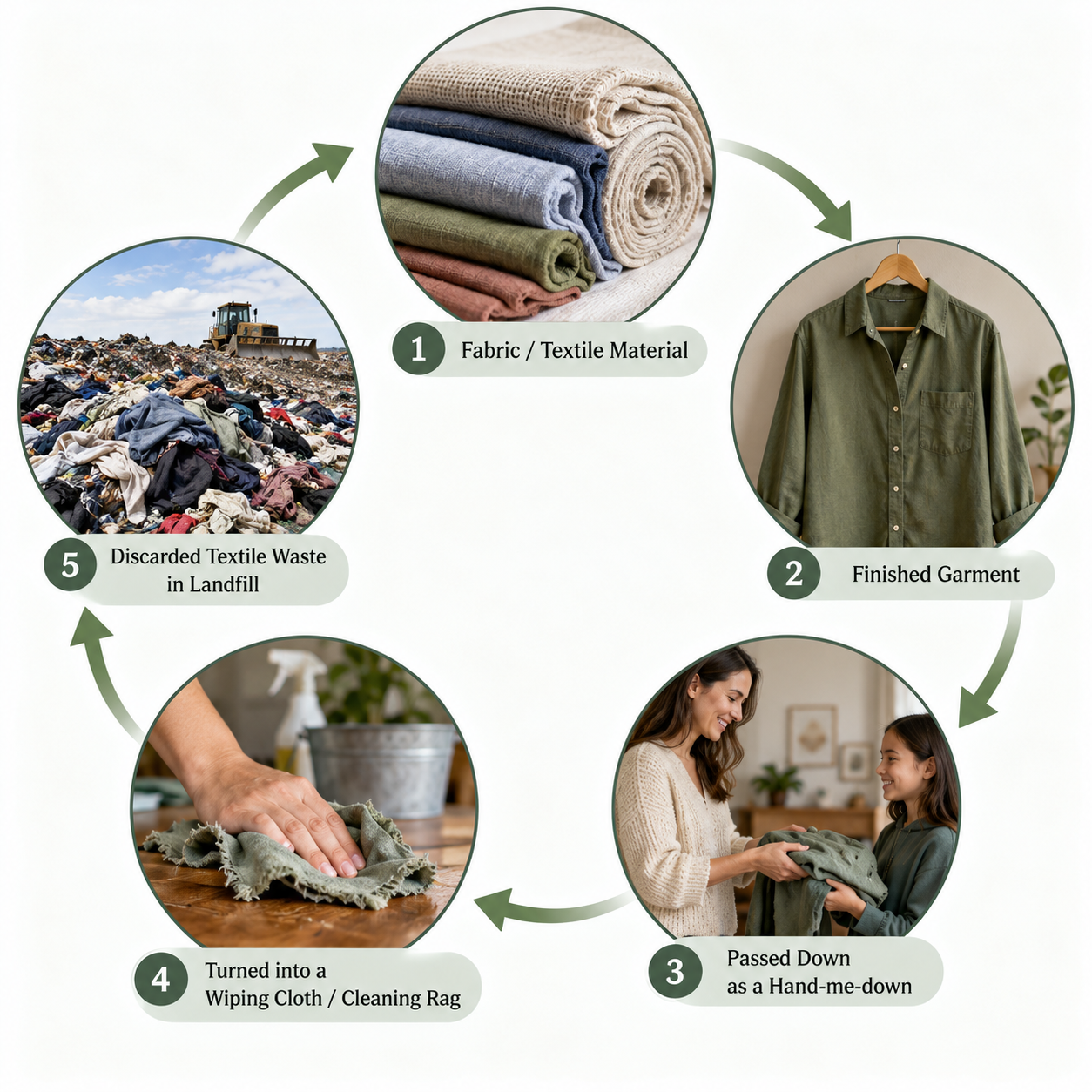
In the first article of this series, we followed the journey of an old shirt. It moved from the regular wardrobe to home wear, perhaps to a younger member of the family, then to a household worker, an NGO, a second-hand market or the neighbourhood kabadiwala, untii it became a wiping cloth. After that, its journey became uncertain. The shirt did not disappear. It merely disappeared from the data.
This is where our second discussion begins.
Indian cities are becoming increasingly conscious about waste. Plastic, electronic, biomedical and construction waste are now recognised as different categories. Collection systems may still be imperfect, but these materials have at least acquired a separate identity. Textiles have not received the same attention.
A discarded plastic bottle is immediately identified as plastic. An old mobile phone is e-waste. A newspaper is paper and has a known resale value. But an old shirt, sari, bedsheet or curtain does not carry such a clear identity. It may be cotton, polyester, viscose, wool, acrylic or a blend of several fibres. It may also contain elastane, dyes, coatings, buttons, zips, hooks and other materials.
To the household, it is simply old cloth. To the municipality, it usually becomes part of mixed dry waste. To a recycler or enterprise, however, it could have been raw material, provided somebody had collected, identified and graded it properly.
Textile waste is difficult to measure because it does not leave the household in one clear movement. A plastic bottle is normally discarded soon after use. A shirt may remain in a cupboard for years. A bedsheet may become a curtain, then a furniture cover and finally a floor cloth. Clothes may be donated, exchanged for utensils, sold, handed down or carried from cities to villages. Some enter weekly markets and second-hand trading networks. Others move through charitable organisations, waste collectors and small traders. Only the final and least valuable portion may reach the municipal waste bin.
Therefore, what reaches a landfill cannot tell us how much textile waste a city actually generates.
The problem becomes larger because textile waste is not limited to old clothes. It includes household linen, curtains, upholstery, uniforms, hotel and hospital linen, tailoring waste, damaged stock, returned products, footwear, bags and many other fabric-based items. Each comes from a different source and follows a different route.
My work experience with Urban Local Bodies have repeatedly shown one simple thing: a municipality can manage something better when it can identify, locate and measure it. A property can be mapped. Its built-up area, use and ownership can be recorded. A unique number can be assigned. Municipal demand can be calculated and collection monitored. GIS can show exactly where the property is located.
But the same city may not be able to tell us how many kilograms of discarded textiles leave that property in a year.
The issue is not necessarily that municipalities are unwilling to measure textiles. The material has simply not been recognised as a separate and economically useful waste stream. The waste vehicle collects whatever has been placed before it. At the sorting point, textiles may be separated if somebody finds an immediate buyer. Otherwise, they remain part of mixed waste and gradually lose their value.
Interestingly, the first level of knowledge already exists outside the formal system. The kabadiwala, waste picker, barter collector, second-hand trader and textile sorter can often judge the value of an old garment within seconds. They know what can be worn again, what can be sold in another market, what can become wiping cloth and what has no immediate value.
Their assessment may not involve laboratory equipment or formal grading standards, but it is based on long experience and actual demand. They are already collecting, inspecting, sorting and matching material with markets. Yet their knowledge remains personal and local. It is rarely documented or connected with municipal planning, processing technology and industrial buyers. Any textile-waste baseline must, therefore, include these people as working partners, not merely as survey respondents.
Why is such a baseline important? Because without it, almost every subsequent decision becomes an assumption. A municipality cannot design a separate collection system. A recycler cannot estimate whether sufficient material will be available. A technology supplier cannot recommend the right capacity. An MSME cannot prepare a credible investment plan. A bank cannot assess the proposal confidently. A buyer cannot be assured of consistent quantity and quality.
A machine cannot solve a problem that has not been properly measured.
The baseline, however, cannot merely state that a city generates a certain tonnage of textile waste. One tonne of clean cotton bedsheets is very different from one tonne of mixed household clothing. Polyester uniforms, cotton rags, woollen garments and stretch fabrics containing elastane require different processing methods and lead to different products.
The exercise must measure both quantity and recoverable value. It should record where the material comes from, its condition, fibre composition, contamination, present use, current price and possible future application. It should distinguish between what can still be worn, repaired, repurposed, opened into fibre or presently cannot be recovered economically.
Not every old garment needs to return as another garment. Depending upon its quality, recovered textile material may become wiping cloth, filling, felt, nonwoven material, insulation, acoustic products, packaging or other utility products. The objective should be to find the most practical and valuable route for each grade.
We do not need to wait for a perfect national study. A practical beginning can be made with few cities and a few representative wards. Residential areas, markets, hostels, hospitals, hotels, tailoring units, second-hand markets, charitable collection centres, waste aggregators and disposal points can be mapped. Selected materials can then be collected, weighed and classified over a fixed period.
GIS can show where textile waste originates, who collects it, where sorting takes place, how far the material travels and where a recovery facility could be located. The outcome should not be another bulky report resting on a municipal shelf. It should become a working material map that connects waste, collectors, processors, enterprises and possible buyers.
A focused pilot involving few cities, a few wards, selected bulk generators and existing informal collectors can answer the basic questions. How much textile material is being discarded? Where does it come from? Who handles it? What portion can be reused or recovered? What can be manufactured from it? And, finally, who will buy the resulting product?
India does not need to begin by constructing large textile-recycling plants in every city. It needs to begin by knowing what material exists, where it is generated, who currently handles it and what value can realistically be recovered.
Textile waste is not invisible because it does not exist. It is invisible because it moves through households, informal transactions and mixed municipal systems without acquiring a separate identity. The first infrastructure required for a circular textile economy may, therefore, not be an expensive machine. It may simply be a credible baseline.
Once the old shirt becomes visible in the data, the next question becomes unavoidable: what value remains in it, and who presently captures that value?
About the author:

Rony Banerjee is an independent MSME development professional with over 25 years of experience across design, clusters, livelihoods, investment facilitation and public policy. He has been associated with institutions including NIFT, IL&FS, HCL, Invest India and EY. He writes on textiles, circularity, enterprise development and the changing economic landscape, especially of Eastern India.