


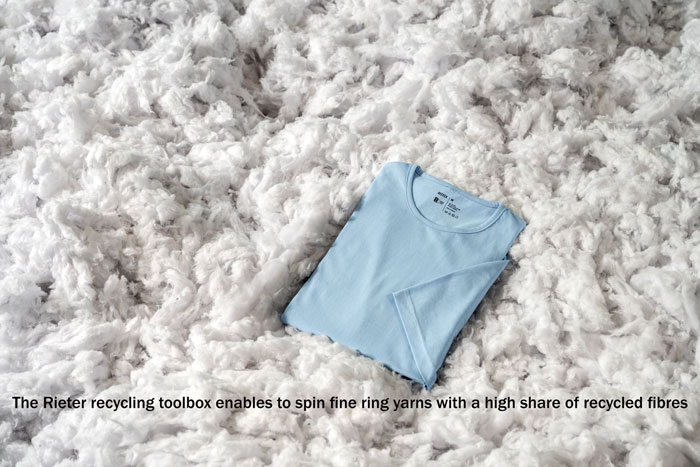
For spinning mills, the path to high-quality ring yarns made of mechanically recycled fibres starts with Rieter’s recycling toolbox. By combining pre-carding, combing and compacting, the coordinated solutions improve yarn quality, increase process stability and support reliable downstream processing, helping mills use recycled fibres more effectively.
The quality of mechanically recycled fibres has improved noticeably in recent years. Nevertheless, unopened yarn and fabric pieces, high short-fibre content and neps continue to affect spinning performance and yarn quality.
Rieter has conducted several trials to show how the three tools address these challenges: pre-carding cleans the recycled fibres perfectly before they enter the spinning process, combing reduces the number of short fibres and compacting adds the finishing touch to the yarn. To show the impact of the different tools, Rieter conducted a trial with a blend of 50 per cent mechanically recycled fibres and 50 per cent virgin cotton, spun into a ring yarn with yarn count Ne 30 (Figure 1). A conventional carded ring yarn made from virgin cotton serves as a reference, with the aim of achieving a comparable quality using Rieter’s recycling toolbox.
Pre-carding for full cleaning
The main limitation for spinners is the occurrence of unopened yarn pieces. Pre-carding is an additional fibre refinement step used exclusively with recycled fibres. Before the material enters the spinning process, unopened yarn pieces are removed and the yarn imperfections can be reduced by around 50 per cent, mainly by lowering thick places and neps. Instead of producing a sliver, the recycled fibres are either fed back into a bale press or can be blended directly in the blowroom. Pre-carded recycled fibres normalize waste levels and reduce cleaning efforts during spinning process.
Combing to improve yarn quality
The second tool is the comber. Combing is a process step that is widely recognized for its ability to improve the quality of the raw material as it removes the most disturbing short fibres, neps and impurities. As mechanically recycled cotton is particularly challenging due to its high short-fibre content, combing these fibres proves to be beneficial. In combination with the pre-carding process, it can reduce imperfections by more than 90 per cent compared with an untreated recycled fibre blend.
Compacting to add the finishing touch
The first two tools have already reached productivity levels and yarn quality comparable to carded virgin cotton. However, they still lack in yarn strength. This is where compacting comes into play. Compacting is especially beneficial for integrating the fibre ends into the yarn body. Trials show fewer imperfections and higher tenacity (Figure 2). This improvement leads to good running performance in downstream processes and also increases the lifetime of the end products.
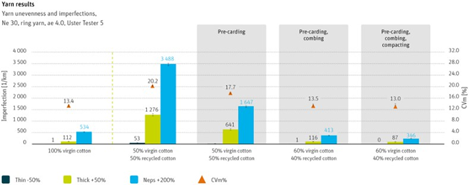
Figure 2: Using the toolbox, yarn imperfections and unevenness of the recycled yarns are comparable to those of 100% virgin cotton carded ring yarns.
The technology for producing high-quality ring yarn from mechanically recycled fibres already exists. Rieter’s recycling toolbox combines the solutions and process know-how needed to turn this potential into reliable industrial production. The complete technology report “Rieter Recycling Toolbox” provides in-depth information on the Rieter trials, explains how each tool works individually and in combination, and offers useful recommendations for mills (Figure 3).

Figure 3: Scan the QR code to get all the details with the technology report “Rieter Recycling Toolbox”.
About Rieter
Rieter is the world’s leading system supplier for processing natural and man-made fibres into short-staple and long-staple yarn, as well as for the production of filament yarns, man-made fibres and nonwovens. With its comprehensive technology portfolio, Rieter covers the entire textile value chain – from fibre to yarn, and from polymer melt to texturized filament, synthetic staple fibres and nonwoven.
Headquartered in Winterthur, Switzerland, the company designs and engineers complex spinning plants, machines, systems, and components that enable an
efficient and economical production. Rieter’s leading technologies ensure minimal resource consumption, making a significant contribution to sustainability across the global textile value chain. Rieter has a history spanning more than 230 years, operates 22 production sites in nine countries, and employs around 6 400 people worldwide, approximately 9 per cent of them in Switzerland.