

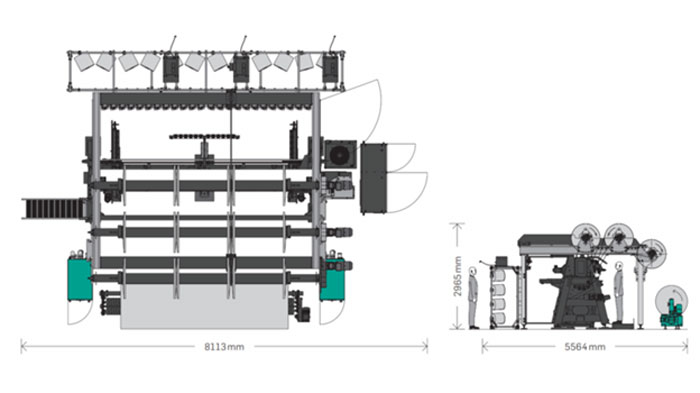
Use of Co-mingled Yarns in Composites
Commingled yarn for composites is a hybrid material that intimately combines reinforcing fibres (like carbon or glass) and thermoplastic matrix fibres within a single yarn.
Commingled yarn for composites combines reinforcing fibres (like carbon or glass) with thermoplastic matrix fibres into a single yarn. This preform is flexible and can be woven or knitted to create fabrics that are then heated under pressure to form composite parts. This method simplifies manufacturing, allowing for rapid production of complex shapes with reduced processing time and cost compared to traditional prepregs.
How it works
- Yarn creation: Thermoplastic fibres and reinforcing fibres are combined into a single yarn. The matrix material is essentially integrated with the reinforcement at a fine level.
- Fabrication: These commingled yarns can be used to form textile preforms like fabrics through weaving, knitting, or braiding. These fabrics are flexible and drapeable, making them suitable for complex shapes without the wrinkling often seen with pre-impregnated materials.
- Consolidation: The fabric is then heated under pressure to melt the thermoplastic matrix fibres, which flow to impregnate the reinforcing fibres and form a solid composite part.
- Advantages:
- Reduced manufacturing time and cost: The pre-integrated nature of the yarn shortens the distance the polymer needs to flow for impregnation, reducing processing time and the need for high pressure.
- Flexibility: The resulting textile fabrics are highly flexible, which is ideal for forming complex shapes.
- Storage: The yarns can be stored in their flexible, “dry” form, similar to conventional textiles.
- Ease of use: Compared to powder-coated or film-coated prepregs, commingled yarns are easier to handle.
- Applications: This technique is used to produce lightweight, high-strength components for industries such as automotive, aerospace, and sporting goods.
Commingled yarn for composites is a hybrid material that intimately combines reinforcing fibres (like carbon or glass) and thermoplastic matrix fibres within a single yarn. This structure allows for easier processing and results in lightweight, high-performance composites, primarily by reducing the distance the molten polymer needs to flow during manufacturing.
Key benefits
- Reduced processing time and pressure: The intimate mixture of fibres shortens the polymer flow distance during consolidation, allowing for rapid manufacturing cycles using lower pressures compared to other methods.
- Enhanced material handling and formability: The inherent flexibility of commingled yarns makes them easy to store, manipulate, and convert into highly drapable textile preforms (woven, knitted, or braided fabrics), which can be formed into complex shapes without creating wrinkles.
- Improved mechanical properties: The homogeneous distribution of reinforcement and matrix filaments across the yarn cross-section leads to better fibre impregnation, lower void content, and, consequently, improved mechanical properties of the final composite part.
- Cost-effective manufacturing: The use of commingled yarns allows for more efficient, high-volume production processes, such as stamp forming and bladder inflation molding, which can reduce overall manufacturing costs.
- Recyclability: Composites made with thermoplastic matrices can be recycled, which is a significant environmental advantage over thermoset composites.
Common material combinations
Commingled yarns can be produced using various combinations of reinforcing and matrix fibres to tailor properties for specific applications.
- Carbon fibre (CF) / Polypropylene (PP): A balance of high strength, ease of processing, and low cost, often used in automotive applications.
- Glass fibre (GF) / Polypropylene (PP): Offers high impact strength and cost-effectiveness, suitable for various industrial and civil engineering applications.
- Carbon fibre (CF) / Polyether ether ketone (PEEK): Provides superior mechanical properties, high temperature resistance, and is used in demanding aerospace and high-performance applications.
- Carbon fibre (CF) / Polyamide (PA/Nylon): Used for creating high-strength, lightweight carbon fibre reinforced thermoplastics (CFRTP) with fast impregnation speeds.
- Glass fibre (GF) / Polylactic acid (PLA): A combination for developing more sustainable, biodegradable composites for specialised applications.
Typical applications
- Aerospace and automotive: Used for structural components, chassis, body panels, and engine parts due to their high strength-to-weight ratio and ability to withstand static and fatigue loads.
- Sporting goods: Utilised in equipment like tennis racquets and bicycle frames, where light weight and high performance are crucial.
- Civil engineering: Employed for concrete reinforcement and other structural applications due to their durability and high performance.
- Pressure vessels: Filament wound components like lightweight LPG cylinders are manufactured using commingled yarns.
- Medical applications: Biodegradable PLA-based commingled composites are being researched for non-load-bearing biomedical applications like bone fixation.
About the authors:
- S Karthikeyan is from the Department of Petrochemical Technology, SSM College of Engineering, Komarapalayam, Tamil Nadu
- Dr N Gokarneshan is theAcademic Consultant, Coimbatore, Tamil Nadu
- KK Hema is from the Department of Mechanical Engineering, SSM College of Engineering, Komarapalayam, Tamil Nadu.
News snippet
CAI urges removal of 11% cotton import duty to aid textile sector
The Cotton Association of India (CAI) has called on the government to abolish the 11 per cent customs duty on raw cotton imports, warning that the textile sector is facing one of its most challenging phases. The industry, a major contributor to exports, rural employment and manufacturing activity, is under pressure due to high domestic prices driven by lower productivity and a steep minimum support price. According to CAI, the duty is further distorting prices and hurting the competitiveness of Indian mills.
The association noted that cotton traders and ginners, who act as unsecured creditors within the textile value chain, are also feeling the strain as mills struggle with elevated input costs. CAI said the removal of import duty is essential to ensure steady and competitively priced raw material, especially when farmers are already protected under MSP operations.
The industry is additionally grappling with uncertainties around US tariffs and recessionary conditions in Europe. CAI warned that without timely intervention, the sector could face job losses, loan defaults and rising bad debts. “These fruits can be reaped only and only if 11% duty on import of raw cotton into India is removed and thereby making available raw material at competitive rates,†the association stated.
CAI believes that ongoing trade negotiations led by Commerce Minister Piyush Goyal, under the guidance of Prime Minister Narendra Modi, along with global sourcing shifts under the China Plus One trend, create a strong export opportunity for India—provided mills have access to competitively priced cotton.
The association added that unseasonal rains this year have damaged domestic crop quality, forcing mills to depend on imports. Without duty relief, buyers may shift to Vietnam, Bangladesh, Pakistan and others, posing long-term risks to India’s market share.
CAI has urged the government to act swiftly to support the survival and growth of the entire cotton-to-textile ecosystem.
