


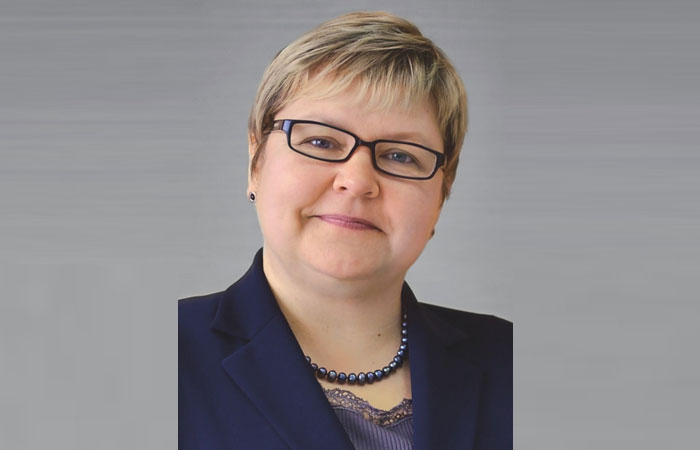
The Saurer Group is a globally active technology company for spinning, twisting, and cabling machines and components for yarn production in the textile and technical sectors. We offer our customers a wide range of system solutions and services that support them on their path towards sustainability, digitalisation, and automation. Pia Terasa, VP of Marketing and Communications at Saurer Group, highlights the company’s smart initiatives and key innovations currently underway.
What smart automation initiatives has your company implemented to enhance production efficiency?
We have been offering automation solutions to the textile industry for decades. In 1967, the Zinser 317 ring-spinning machine was already equipped with the automated cops changer CoWeMat. In 1975, we introduced the first automated yarn connection device for ring-spinning machines, the FIL-A-MAT, followed in 1978 by the world’s first fully automated rotor spinning machine, the Autocoro.
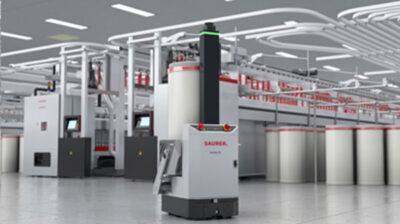
One of our latest automation innovations is the Hunter S1 Can-Transport AGV, which was unveiled at ITMA Asia 2025. Designed to intelligently transport sliver cans throughout the spinning mill, the Hunter S1 boosts productivity, reduces the manual workload, and ensures high operational uptime. With its versatile configuration options, the Hunter Series AGV can adapt seamlessly to any mill layout and production requirement. From drawing to roving and rotor spinning, it ensures precise, consistent, and reliable handling at every stage.
Today, we offer all major spinning and twisting technologies. Each machine features built-in automation to reduce labour dependency, improve quality and increase efficiency. Our consistent automation philosophy covers integrated quality monitoring, centralised machine control, and extensive data usage.
The Senses Mill monitoring system enables customers to digitally connect all Saurer machines, collect relevant data and gain instant transparency across the mill. Central dashboards support predictive maintenance, energy monitoring per lot and tracking of production efficiency and quality. Graphical visualisations help users analyse data and react quickly to deviations.
Autocoro rotor spinning machines are fully automated for piecing, doffing, and yarn clearing, and can easily be connected to palletisers or further automated package transport systems. Even for semi-automated BD rotor spinning machines automation has become relevant and selected automation functions like doffers are available as optional extras.
In ring spinning Saurer connects roving frames, including automated doffing with ring spinning frames through the bobbin transport system (BTS) significantly reducing workload and improving quality through careful handling of delicate bobbins. The Saurer ring-spinning frames offer autodoffing, thus enabling a cops change in around two minutes across the entire machine. The Optispeed function automatically regulates the spinning speed to keep yarn breaks within given limits, enabling higher productivity.
When it comes to twisting and cabling technical yarns, collaborative robots on autonomous driving systems can handle large and heavy packages for machine loading, collecting finished packages and connecting to central palletisers. Specialised automation solutions are also available for glass filament processing.
All Saurer automation solutions consist of specially designed elements that are combined by a project engineering team into bespoke system solutions that are tailored to customers’ buildings and processes. This enables Saurer to meet the growing demand for cost-effective automation in staple fibre spinning and twisting mills, as well as in filament yarn processing.
What key innovations is your company currently focusing on or developing?
We want all spinning mills to experience the future of automated logistics. With Hunter S1, mills can take their first step towards automated, digital, and effortless transport. Real-time monitoring, data-driven optimisation, and seamless connectivity allow mills to achieve unprecedented levels of productivity and operational transparency. Spinning mills can therefore assess their readiness for further automation.
Saurer is committed to developing new processes for the industry, creating new possibilities for producing yarns and addressing new challenges. In the future, more recycled fibres will be processed, and production lots will be smaller and inconsistent over time. It will be necessary to adapt quickly to changing fibre quality – directly at the spinning machine rather than by adapting the spinning preparation process.
What major challenges and opportunities do you foresee for the Indian textile machinery industry in the coming years?
An opportunity is increasing quality and productivity, with reduced manual intervention, thanks to more automation and digitalisation. Resource saving and circular economy will be a challenge for the entire world. However, a significant challenge is to find suitable workforce for smart manufacturing. Despite growing investments in smart technologies, skill gaps persist. Additionally, a secure level of power and internet connectivity is required for automation, digitalisation, and IoT manufacturing.
What support or policy measures do you expect from the government to help the textile machinery industry become globally competitive?
More training in regard to circular economy and recycling initiatives would be very much appreciated. Also support in form of green energy for the production sites will be essential for managing the shift, not just for spinning mills but for machinery manufacturers as well.