


Budget-driven initiatives such as challenge-mode development of mega textile parks and the proposed Rs 100 billion SME Growth Fund are expected to accelerate adoption, particularly in the MSME sector, says Suketu Shah.
India’s textile industry is moving into a phase where scale is being strengthened by innovation and efficiency. The sector supports over 45 million livelihoods and is expected to see the domestic textile and apparel market reach nearly $225 billion by 2025, growing at a healthy 10–12 per cent annually, with exports rising alongside.
The industry itself is realising that “the challenge today is no longer capacity; it is capability.” The customers are demanding speed, traceability, sustainability, and consistency simultaneously. This is putting the existing manufacturing model to the test and making smart manufacturing a necessity for the global competitiveness of India.
Reshaping manufacturing via technology
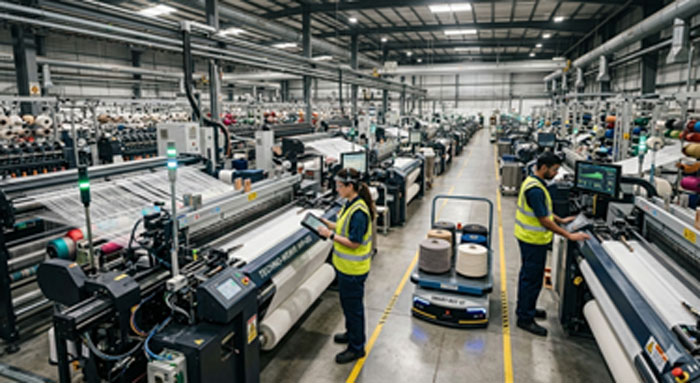
‘Smart manufacturing’ integrates automation, data, and digital intelligence throughout the textile value chain, from fibre to finished products. This is not just another form of mechanisation, but a complete switch that digitally links machines, processes, and people to optimise performance.
Major technologies that are leading this shift consist of the Industrial Internet of Things (IIoT), AI, automation and robotics, digital twins, and advanced analytics. Sensors embedded into the machinery are providing real-time information on speed, tension, energy consumption, and quality variations. When analysed, this information provided predictive maintenance, reduced downtime, and improved equipment effectiveness.
Automation is also extending beyond repetitive tasks, and quality inspection systems powered by AI are ensuring consistency at scale while detecting defects that are not visible to the human eye.
Productivity, efficiency, and sustainability gains
The first area where the impact of smart manufacturing is apparent is in ‘productivity’ and ‘efficiency.’ Digitally enabled factories report higher output stability, faster changeovers, and better utilisation of assets. Rather than pushing machines harder, smart systems focus on running them smarter, closer to optimal operating conditions.
‘Sustainability’ is one of the most important results of smart manufacturing. With the textile industry under the spotlight for its use of water, energy, and chemicals, AI-managed energy solutions optimise energy use, and digitally controlled dyeing and finishing reduce water and chemical emissions. Waste reduction is now quantifiable and achievable due to smart factories that promote traceability, accurate reporting, and supply chain visibility.
Sustainability has moved from being a mere compliance requirement to becoming a major determinant of consumer choice, and Indian manufacturers can now align with global ESG standards.
Workforce evolution, not elimination
One of the myths surrounding smart manufacturing is that it leads to job displacement. The truth is that it leads to job transformation. Although automation reduces reliance on human labor for repetitive tasks, it also generates a need for technicians, data analysts, system supervisors, and digital operators.
Indian textile industry has a massive workforce and a rare opportunity to shift from labor-intensive to skill-intensive manufacturing. Skill development programs related to digital tools, machine interfaces, and data interpretation are becoming increasingly mandatory. With proper training, smart manufacturing can help develop shop-floor safety, minimise fatigue, and help workers transition to more skilled jobs.
The shift towards ‘Samarth 2.0’ under Budget 2026 is in sync with the requirements of smart manufacturing, focusing on developing a workforce that is industry-ready and suitable for automation. This will additionally assist in a smooth transition to digitally enabled shop-floor and supervisory roles.[1]
Adoption challenges and structural realities
Inspite of its clear advantages, implementing smart manufacturing is not very convenient in an industry dominated by MSMEs and fragmented units. The reasons could be high capital expenditure, lack of clarity on returns, limited access to qualified personnel, and outdated equipment, especially in brownfield sites. In addition, there could be a certain degree of resistance to change, where experience is still given more importance than data.
However, these challenges also offer numerous opportunities. Government initiatives like PLI schemes, integrated textile parks, and technology upgradation assistance programs are reducing entry barriers and promoting scale. Modular automation, cloud-based platforms, and staged digital adoption plans are making smart manufacturing more viable, even for mid-sized manufacturers.
Adding to this momentum, the Union Budget makes a clear policy statement with its integrated approach to the National Fibre Scheme, Textile Expansion and Employment Scheme, and cluster development approach, realising that competitiveness advances when the entire value chain is developed. Its focus on fibre security in natural, man-made, and emerging fibres also supports this strategy. [2]
The journey ahead
Smart manufacturing in the Indian textile industry is no longer about being efficient; it is becoming a way to stand out. Digital twins, AI-driven demand forecasting, and more efficient inventory management are enabling manufacturers to react more quickly to market requirements while preventing overproduction. Sustainability and circular thinking are also being incorporated into manufacturing strategies. Looking ahead, the key to India’s success will not only depend on scale but also its reliability, flexibility, and transparency in global supply chains.
Budget-driven initiatives such as challenge-mode development of mega textile parks and the proposed Rs 100 billion SME Growth Fund are expected to accelerate adoption, particularly in the MSME sector. With technology upgradation support, joint testing facilities, and certification support, these endeavors are helping manufacturers bridge the gap with the evolving global standards. In this scenario, smart manufacturing is no longer an option but the “building block” of the sector’s future.
About the author:

Suketu Shah has been appointed as the Chief Executive Officer (CEO) of Vishal Fabrics. Shah holds a Bachelor of Science (BSc) degree and a Diploma in Textile Chemistry (DTC) from M.S. University, Vadodara, where he was awarded the prestigious Gold Medal for academic excellence.With over 40 years of experience in the textile industry, Shah has been instrumental in driving growth and innovation across several leading companies. His extensive career includes leadership roles at LNJ Denim – RSWM Group, Mafatlal Industries, Aarvee Denims C Exports, APAC Inti Corpora Bawen (Indonesia), Raymond UCO Denim, Modern Denim, and Arvind.