


As erratic monsoon patterns and severe water deficits strain manufacturing hubs across the subcontinent, Divya Shetty investigate whether textile mills are genuinely transforming their wastewater management or merely hiding behind corporate greenwashing.
Across the sun-baked plains of Gujarat, the industrial clusters of Tamil Nadu, and the bustling manufacturing belt of Maharashtra, an ominous quiet hangs over the borewells. India’s textile industry—a colossal engine of employment, export revenue, and cultural heritage—is facing an existential reckoning. With the arrival of the monsoon delayed and erratic across major subcontinental basins, severe water scarcity has transformed from an environmental projection into an immediate operational crisis. Textile manufacturing is inherently water-intensive. From wet processing sectors like bleaching, dyeing, printing, and finishing to cotton cultivation and yarn sizing, millions of liters of fresh water are funneled daily through industrial machinery before emerging as complex, toxic effluent.
Yet, as public reservoirs dwindle and local municipalities restrict groundwater extraction, a pressing question echoes through corporate boardrooms and shop floors alike: Is the textile industry genuinely implementing wastewater management, or is sustainability merely a glossy marketing facade designed to appease international buyers while business continues as usual? It is critical to recognise which specific industrial sectors must mindfully use and treat wastewater. The wet processing sector—comprising denim finishing units, cotton dyeing mills, synthetic fabric processing houses, and Common Effluent Treatment Plants (CETPs)—stands at ground zero. These facilities consume the highest volumes of freshwater and generate chemically laden wastewater containing reactive dyes, heavy salts, surfactants, and toxic residues. Without rigorous intervention in these exact sectors, India’s manufacturing expansion risks colliding with catastrophic hydrological limits.
To uncover the reality behind corporate sustainability reports, let’ dive into a complex landscape plagued by the gap between boardroom pledges and shop-floor metrics, the hurdles of high-cost Zero Liquid Discharge (ZLD) systems, the paradox of artificially cheap groundwater, and the transformative power of digital water stewardship.
Bridging the chasm
When examining how textile facilities communicate their environmental performance, auditors frequently encounter a striking paradox. Publicly, sustainability reports showcase impressive aggregated percentages, but the micro-level reality on the factory floor often tells a vastly different story. J M Balaji, Vice President at Lakshmi Energy and Environment Designs, points out that this discrepancy is rarely a deliberate corporate falsehood, but rather a structural failure in data architecture. He says, “”The biggest gap is usually not deliberate misrepresentation but the difference between corporate-level reporting and process-level measurement.”
Balaji explains that while corporations proudly publish high-level indicators such as water consumed per kilogram of fabric, the percentage of wastewater treated, overall water recycling rates, and formal compliance with discharge norms, the daily shop-floor audit reveals systemic blind spots. Auditors consistently discover limited metering at individual process sections such as bleaching, dyeing, and washing. Water balances frequently fail to reconcile when measured against intake, production output, and final discharge. Furthermore, massive volumes of water are lost through silent leaks, overflows during shift changes, and excessive rinsing cycles that are never quantified or logged.
“The most mature textile companies measure water like they measure production—continuously, by department, and linked directly to operational decisions,” he adds, Compounding this measurement deficit, recycling plants within many mills operate well below their engineered capacity due to recurring operational bottlenecks, membrane fouling, or prohibitive energy costs. When water Key Performance Indicators (KPIs) are anchored to monthly utility bills rather than real-time process data, management remains blind to daily inefficiencies. True industrial maturity requires treating water with the same precision as yarn count and loom speed.
Regulations on paper Vs enforcement on the ground
The regulatory framework governing textile effluent in India is, on paper, comprehensive. National and state pollution control boards mandate strict parameters covering pH, Biological Oxygen Demand (BOD), Chemical Oxygen Demand (Total COD), Total Dissolved Solids (TDS), colour intensity, heavy metals, and hazardous sludge handling. Yet, environmental degradation persists. According to Balaji, the primary bottleneck is not the absence of laws, but the profound chasm between legislation and consistent, uncompromised enforcement.
Textile clusters across the country face structural hurdles that undermine regulatory efficacy. Infrequent official inspections, heavy reliance on periodic grab sampling instead of continuous online effluent monitoring systems (OCEMS), and limited manpower within regulatory agencies create loopholes. Economic pressures to keep factories operating at full capacity—especially among small and medium-sized processors lacking technical capability—frequently result in untreated or partially treated effluent bypassing secondary treatment units under the cover of darkness.
However, as Balaji observes, market forces are increasingly stepping in where regulatory enforcement falters. Global fashion brands and retail conglomerates are imposing stringent demands regarding traceability, water stewardship, chemical management, independent third-party audits, and ESG performance. For export-oriented mills, failing a brand’s private environmental audit carries far more severe commercial consequences than a local regulatory fine, effectively making market expectations the primary driver of authentic sustainability.
Low-hanging fruit
When executives discuss sustainable water management, the conversation frequently gravitates toward multi-million-dollar Zero Liquid Discharge (ZLD) plants and advanced membrane systems. Yet, experts emphasise that the most profound environmental and financial returns often stem from basic process optimisation and operational discipline rather than expensive hardware.
Balaji highlights several high-impact, low-cost interventions that most textile processors could implement immediately, but largely ignore. These include installing dedicated flow meters on major water-consuming machinery, optimising rinse cycles based on electrical conductivity rather than fixed, arbitrary time limits, and cascading water by reusing final rinse water from one batch as the initial rinse water for the next. Simple measures such as repairing chronic pipe leaks, eliminating continuous machine overflows, and standardising operating procedures for machine loading and liquor ratios can yield transformative results.
“Many mills can reduce water consumption by 15–30% before investing in advanced recycling systems simply through better monitoring and operational discipline. The first litre of water saved is almost always the cheapest,” opines Balaji.
The Groundwater Paradox
One of the most insidious structural barriers to industrial water recycling in India is the artificially low cost of freshwater extraction. In numerous manufacturing hubs, groundwater can be pumped at virtually zero marginal cost, creating a perverse economic disincentive for factories to invest in capital-intensive recycling infrastructure.
Balaji explains the core financial dilemma facing mill owners: when a factory compares the negligible cost of extracting groundwater against the high operational expenditure of running a complex recycling or ZLD plant, recycling appears economically unattractive on a short-term balance sheet. However, this narrow accounting completely blinds management to severe hidden risks, including rapid local aquifer depletion, escalating energy costs required for deeper pumping, impending government restrictions on groundwater abstraction, mounting customer sustainability mandates, business continuity vulnerabilities during severe droughts, and potential reputational damage.
“Leading companies no longer view water recycling as merely a cost-saving exercise. They see it as a strategic investment in operational resilience, regulatory preparedness, and long-term competitiveness. Ultimately, water needs to be valued not just as a utility, but as a strategic resource,” mentions Balaji.
Operational realities of scaling ZLD
Moving from basic conservation to advanced circularity—such as achieving Zero Liquid Discharge (ZLD)—presents formidable financial and operational challenges, particularly for high-volume producers. Suketu N Shah, CEO & Business Head, Vishal Fabrics, provides a candid assessment of what it takes to integrate ZLD into an existing industrial ecosystem.
“ZLD is capital-intensive, and the real barrier isn’t the initial investment alone—it’s the ongoing energy and maintenance cost of running these systems at full capacity, day after day, without compromising output quality,” says Shah.
Shah elaborates that evaporation and concentration technologies—vital components of ZLD—consume enormous amounts of electrical power. This heavy operating cost must be absorbed somewhere within a competitive textile value chain. Operationally, retrofitting ZLD into an existing high-volume denim processing unit without disrupting production continuity requires meticulous engineering, careful sequencing, and highly skilled technical manpower to run and maintain the plant consistently. At Vishal Fabrics, their zero-discharge facility was treated as a long-term infrastructure commitment rather than a short-term capex decision, which Shah identifies as the only viable path to making the economics work at scale.
Echoing these operational realities, Hemant Jain, Joint Managing Director, Kewal Kiran Clothing (KKCL), stresses that sustainable water management cannot be treated as an isolated technological addon.
“Implementing advanced water management systems requires a long-term commitment, both financially and operationally. While the initial investment is significant, the larger challenge lies in integrating these systems into existing manufacturing processes without compromising efficiency, product quality or operational continuity,” comments Jain.
Jain notes that textile manufacturing encompasses diverse wet processes with highly divergent water and wastewater chemistry. Therefore, solutions must be robust, scalable, and adaptable. At KKCL, the philosophy is centered on continuous process improvement—adopting advanced finishing methods and eco-friendly chemical practices that proactively reduce water consumption at the source, thereby minimising chemical loading and shrinking the overall environmental footprint.
The evolving pressure from global brands
The driving force behind textile sustainability has undergone a profound evolution over the past decade. While local regulations once set the baseline, global brand partners and retail giants are now rewriting the rules of vendor engagement.
According to Shah, the relationship between brands and manufacturers has shifted from regulatory compliance to deep relational accountability.
“Regulation set the floor, but today our global brand partners are asking harder questions upfront during vendor evaluation itself—about water usage, effluent treatment, and certifications like ZDHC, GOTS, and OEKO-TEX,” states Shah.
Shah notes that while brands may not always offer direct financial incentives or price premiums for sustainable manufacturing, rigorous water stewardship directly influences who secures preferred vendor status and long-term order commitments. In an era where consumers scrutinise supply chain ethics, brands demand verifiable data rather than vague corporate statements, turning environmental transparency into a powerful commercial differentiator.
Jain reinforces this perspective, highlighting that the modern apparel landscape is shaped by converging pressures from consumer awareness, evolving sourcing standards, investor expectations, and broad ESG commitments.
“Customers today are increasingly interested in how products are made, not just the products themselves. As a result, responsible manufacturing has become an important aspect of building trust and long-term brand value,” notes Jain.
From Compliance Cost to Strategic Competitive Advantage
For decades, effluent treatment plants (ETPs) and wastewater recycling units were viewed by textile executives as pure cost centers—expensive regulatory obligations that drained capital without generating revenue. Today, progressive industry leaders are flipping this narrative on its head.
Shah explains precisely when and how this strategic transition occurs within a business. “The transition happens the moment you stop treating water management as a certificate to display and start treating it as a capability you can quote a price and lead-time against,” he says.
Once a Zero Discharge system is fully integrated into production, it ceases to be a burden and becomes a core pillar of a company’s value proposition. It grants mills unhindered access to international buyers who prioritise responsible supply chains—a tangible commercial advantage in a crowded global marketplace.
Jain concurs, emphasising that efficient water management directly enhances operational resilience, resource security, supply chain reliability, and stakeholder confidence. At KKCL, sustainability is embraced not merely as a defensive shield against regulatory penalties, but as an active driver of long-term corporate growth and competitiveness.
The Anatomy of Textile Wastewater
Looking at the technical composition of textile effluent, Robert Antoshak, Managing Partner, Gherzi Americas, provides a vivid picture of the immense challenges mills face daily in keeping treatment systems operational.
“The industry uses too much water in places that can’t spare it. Dyeing, washing, bleaching, printing and finishing all run wet, and most of that capacity sits in regions where farms and cities already compete for the same supply. Price used to be the worry. In some regions the worry now is whether the water shows up at all,” adds Antoshak.
Wastewater chemistry, Antoshak notes, is exceptionally volatile. Effluent carries a shifting cocktail of synthetic dyes, high salts, surfactants, oils, heavy metals, and suspended solids. Because production runs change constantly, the chemical composition of wastewater shifts from hour to hour, meaning a treatment protocol that succeeds on Tuesday can easily fail on Thursday. Furthermore, emerging regulatory scrutiny over microfibres adds another layer of operational complexity.
“Plenty of factories own treatment plants. Running them well every day is another matter. Without trained operators and steady maintenance, the equipment is expensive scenery. And the leftovers, mostly sludge and brine, still need somewhere to go,” worries Anotshak.
Reuse, recycling, and the limits of ZLD
Analysing the engineering options available to manufacturers, Antoshak breaks down the hierarchy of water recovery. Recycling and reuse liberate mills from the wasteful habit of treating water as a single-use input. Treated effluent can be redirected back into washing and cooling, and in advanced systems, into initial dyeing stages. By segregating clean wastewater streams from heavily polluted ones rather than funneling everything through a massive, expensive treatment plant, mills can dramatically cut costs.
“Not every gallon needs treatment to the same standard. A mill that matches water quality to the job cuts freshwater use without building a system more complicated than it needs to be,” states Antoshak.
Regarding Zero Liquid Discharge, Antoshak notes that while ZLD pushes recovery to the absolute limit and successfully eliminates routine liquid discharge in hyper-arid or strictly regulated zones, it remains intensely energy-demanding and expensive. For many standard mills, aggressive, well-managed internal recycling and reuse deliver the vast majority of environmental benefits without incurring the crushing capital expenditure and operational headaches of full ZLD.
Water security as a core pillar of expansion and relocation
As climate volatility deepens and seasonal monsoon failures threaten water security across traditional manufacturing hubs, water availability has graduated from a secondary engineering concern to a primary strategic determinant for corporate expansion.
Shah emphasises how water risk dictates Vishal Fabrics’ future footprint. When planning major facilities like their Dholi unit, water security was evaluated on equal footing with power grids, logistics networks, and local labor availability.
“Water security is now a core input into any expansion decision, alongside power, logistics, and manpower availability—it’s no longer a secondary consideration. We don’t believe in chasing short-term cost advantages in locations that carry long-term water risk. Sustainable water management has to be built into a site from day one,” adds Shah.
Jain echoes this sentiment from KKCL’s operational perspective, noting that long-term business planning must factor in the sustainable availability of natural resources to build resilient, future-ready manufacturing operations capable of withstanding environmental shocks.
The technological vanguard
The future of industrial water management relies heavily on advanced engineering, smart chemical solutions, and real-time digital monitoring. Deepa Joshi Sharma, Chief Customer & Marketing Officer at Ion Exchange (India), offers a comprehensive view of how modern technology is reshaping the textile landscape.
“The textile industry is at the intersection of two important priorities—meeting growing production demands while significantly reducing its environmental footprint. Water is central to textile processing, yet freshwater availability is becoming increasingly constrained in many manufacturing regions,” notes Sharma
Sharma explains that they is witnessing a profound shift in customer expectations. Mills are moving away from isolated, standalone treatment plants toward integrated total water management solutions that seamlessly combine process optimisation, advanced recycling, digital monitoring, and comprehensive lifecycle support. In water-stressed regions, ZLD has become indispensable—not only for individual manufacturing facilities but also for Common Effluent Treatment Plants (CETPs) serving entire textile clusters.
Conclusion: A Call to Action for a Water-Secure Textile Future
As late monsoons and deepening water scarcity test the resilience of the Indian subcontinent, the textile industry stands at a definitive crossroads. The era of treating water as an infinite, disposable resource has officially drawn to a close. The mounting pressures of climate volatility, stringent global brand mandates, and consumer consciousness demand an immediate, unyielding shift from passive compliance to proactive, circular water stewardship.
To secure the future of Indian textile manufacturing, industry stakeholders must unite around a decisive, four-point Call to Action:
- Implement granular shop-floor metering: Mill owners and plant managers must install dedicated flow meters across all wet processing lines—bleaching, dyeing, washing, and finishing—to transition from monthly utility bill estimates to real-time process monitoring.
- Prioritise low-cost process optimisation first: Before committing capital to massive ZLD systems, facilities must aggressively capture low-hanging fruit by repairing leaks, eliminating continuous overflows, optimising rinse cycles via conductivity sensors, and cascading water across batches.
- Embed digital intelligence and AI analytics: Adopt advanced digital platforms such as real-time IoT monitoring and predictive maintenance tools to ensure effluent treatment plants operate at peak efficiency without unexpected downtime or energy spikes.
- Foster cluster-level collaboration: Small and medium enterprises must collaborate to establish shared Common Effluent Treatment Plants (CETPs) and joint recycling infrastructure, ensuring that financial constraints do not compromise environmental responsibility across industrial clusters.
Water is no longer merely a utility; it is the ultimate liquid lifeline of the textile sector. Those who master its stewardship today will weave a resilient, profitable, and sustainable future; those who ignore it will find their operations running dry.
Quotes to add:
- “The most mature textile companies measure water like they measure production—continuously, by department, and linked directly to operational decisions.”
- J M Balaji, Vice President, Lakshmi Energy and Environment Designs (LEED)
- “The transition happens the moment you stop treating water management as a certificate to display and start treating it as a capability you can quote a price and lead-time against.”
- Suketu N Shah, CEO & Business Head, Vishal Fabrics
- “Customers today are increasingly interested in how products are made, not just the products themselves. As a result, responsible manufacturing has become an important aspect of building trust and long-term brand value.”
- Hemant Jain, Joint Managing Director, Kewal Kiran Clothing (KKCL)
- “Not every gallon needs treatment to the same standard. A mill that matches water quality to the job cuts freshwater use without building a system more complicated than it needs to be.”
- Robert Antoshak, Managing Partner, Gherzi Americas
- “We are seeing a clear shift in customer expectations—from standalone treatment plants to integrated water management solutions that combine process optimisation, water recycling, digital monitoring and lifecycle support.”
- Deepa Joshi Sharma, Chief Customer & Marketing Officer, Ion Exchange (India)
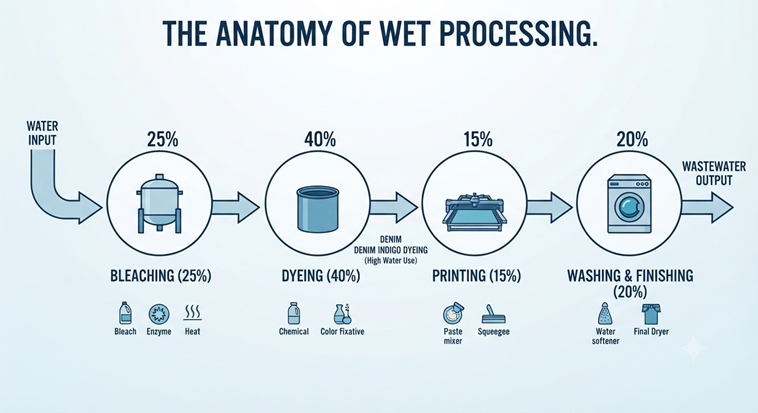
The anatomy of wet processing.