

Texfair 2026 Showcases Future of Textiles
SIMA Texfair 2026 brought together key stakeholders of the textile machinery and accessories sector, highlighting advancements in automation, sustainability and smart manufacturing. The event underscored the industry’s focus on manmade fibres, modernisation and global competitiveness, writes Rakesh Rao.
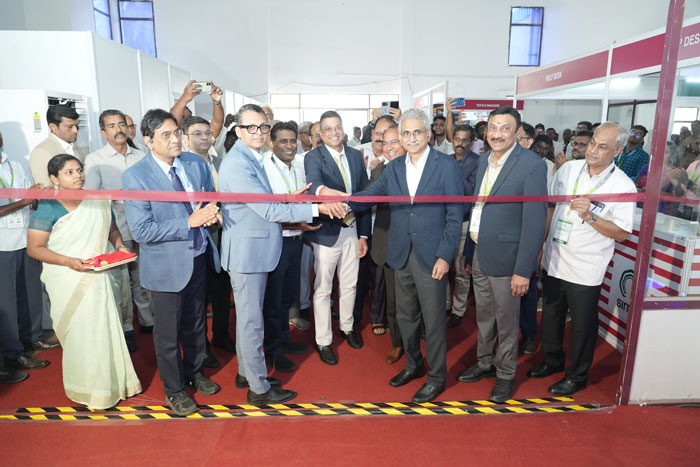
The 15th edition of SIMA Texfair 2026, held from March 6–9 at the CODISSIA Trade Fair Complex, Coimbatore, brought together the textile machinery, accessories and spares ecosystem with a strong focus on automation, innovation and cost efficiency. The exhibition was inaugurated by P R Venketrama Raja, Chairman, Ramco Group, in the presence of key industry leaders including Ashwin Chandran, Chairman, Confederation of Indian Textile Industry (CITI); Shaleen Toshniwal, Chairman, Manmade and Technical Textile Export Promotion Council (MATEXIL); Prashant Agarwal, Joint Managing Director, Wazir Advisors; Suresh Babuji, Director, MSME Development and Facilitation Office; and Durai Palanisamy, Chairman, The Southern India Mills Association (SIMA).
Featuring around 240 exhibitors, the event showcased a wide range of solutions spanning machinery, components and smart manufacturing technologies. Sustainability, automation and the growing dominance of manmade fibres (MMF) emerged as key themes, alongside the expanding scope of technical textiles in India. Industry discussions also highlighted the importance of modernisation, digitisation and leveraging global opportunities, particularly through free trade agreements.
The exhibition served as a vital platform for industry interaction, enabling stakeholders to explore practical solutions and innovations. The Indian Textile Journal (ITJ) engaged with key exhibitors to gain insights into their latest product developments and strategic directions.
VXL Group unveils Fine Blend for precise blending
VXL Group – a manufacturer of textile engineering solutions including rings and travellers, waste collection systems and humidification systems – has introduced its new Fine Blend machine, designed to deliver absolute homogeneity and precise blending of fibres for high-quality yarn production. The company showcased the new solution at SIMA Texfair, highlighting its focus on improving process efficiency and yarn quality for modern spinning mills. The Fine Blend machine is engineered to handle multiple fibre inputs through configurable chambers, allowing mills to achieve highly controlled blending ratios.
“Fine Blend is designed to deliver absolute homogeneity in fibre blending, which is essential for producing consistent and high-quality yarns. The system allows mills to operate with two, three or more blending chambers while maintaining precise control through an intuitive software interface,” said R Govindaraju, Managing Director, VXL Group.
According to the company, the machine integrates advanced software controls that simplify operations while ensuring accuracy in blending. The platform has already been supplied to several mills and is currently operating in commercial production environments. “We have invested significant effort in developing a user-friendly software architecture so that mills can manage blending operations efficiently while maintaining precision,” said N Damodharan, Managing Director, VXL Group.
Beyond blending technology, VXL Group continues to expand its engineering portfolio with the introduction of its HydroAir humidification system, designed to improve environmental control in spinning mills. The system incorporates high-efficiency airflow fans and optimised air distribution to maintain consistent humidity levels, which are critical for stable spinning operations. “Humidification plays a crucial role in spinning performance, and our HydroAir system has been designed to deliver high efficiency and reliable airflow management,” said Govindaraju.
The company also continues to strengthen its presence in waste collection systems, a segment in which it has operated for over three decades. VXL has installed more than 5,000 filtration systems across the country and focuses on designing customised solutions tailored to individual mill requirements. “Our strength lies in working closely with customers to understand their operational needs and designing systems that integrate with their existing machinery. Every spinning mill operates differently, so customisation becomes critical to delivering efficient solutions,” said Damodharan.
VXLRT, the group’s division for ring travellers, also attracted significant attention at the exhibition. The company displayed its extensive product range, including Alpha, Ultimate, Ultimate+, Ulti-Fein, Startech, Ace Jet, Astra and the Plus Series. “In the ring traveller segment, we have introduced several process improvements,” Govindaraju said. “We have made significant changes in the microstructure of the rings, taking their performance to the next level.
Loepfe’s PRISMA Clever Yarn Clearing in spotlight at SIMA Texfair
Loepfe India, the Indian subsidiary of the global manufacturer of electronic online yarn quality assurance systems, showcased its latest PRISMA Clever Yarn Clearing technology at SIMA Texfair, reinforcing its focus on improving yarn quality and contamination detection for spinning mills. The company highlighted a range of product enhancements aimed at helping mills address increasing quality requirements as global buyers place greater emphasis on contamination control and consistent yarn performance.
Hariharan R, GM – Operations, Loepfe India, explained, “We participate regularly at SIMA Texfair as it provides an important platform to engage with spinning mills and industry stakeholders. This year we have showcased our latest innovation, PRISMA Clever Yarn Clearing, along with several improvements in our existing product range.”
According to him, the company has observed a positive shift in industry sentiment, with enquiry levels improving in recent months. The company noted that customer demand is increasingly centred on quality enhancement, particularly in addressing contamination issues in yarn production. Spinning mills are actively seeking reliable systems capable of identifying and removing contaminants with greater accuracy.
Hariharan said, “The primary focus among customers today is on quality, particularly in addressing contamination-related challenges in yarn production. Over the past few years, we have significantly enhanced our systems to improve contamination detection and cleaning efficiency.”
As international textile buyers expand sourcing from India, quality requirements for yarn production are becoming more stringent, placing greater emphasis on advanced quality monitoring systems. “Demand from customers is gradually improving, and the outlook for 2026 appears more positive compared to 2025,” he said. “As global buyers increasingly source from India, the importance of reliable quality monitoring solutions becomes even more critical.”
Loepfe India works closely with spinning mills across a range of applications, including speciality yarns and conventional yarns, where contamination control and consistent yarn quality are essential for downstream textile processing. Looking ahead, the company continues to focus on product innovation and technological advancements, although specific developments for upcoming exhibitions are yet to be announced.
Unitech Texmech displays advanced spinning rings at SIMA Texfair
Unitech Texmech Pvt Ltd, a Pune-based manufacturer of textile spinning rings and accessories, showcased its latest UNI K1-BLK spinning rings at SIMA Texfair, highlighting its focus on improving performance, durability and efficiency in spinning operations. The company, which is celebrating nearly five decades of presence in the textile industry, has developed the UNI K1-BLK rings to deliver enhanced spindle speeds and longer operational life for spinning mills. “At SIMA Texfair we are showcasing our UNI K1-BLK rings, which are designed to deliver improved performance and longer life compared with conventional rings,” said Vrunda Bapat, CEO, Unitech Texmech Pvt Ltd.
According to the company, the newly developed rings can provide 15–20 per cent longer service life than standard products available in the market. The rings are also designed to operate at higher spindle speeds and allow mills to start production quickly without requiring a running-in process. “The ring allows a quick start and does not require a running-in period, enabling mills to reach higher speeds more efficiently,” said Bapat. “We have received encouraging feedback wherever the product has been demonstrated.”
Unitech Texmech noted that spinning mills are increasingly demanding components that improve productivity while maintaining consistent yarn quality. “Customers today are looking for better speeds, better quality and longer lasting rings,” said Bapat. “Our focus is to provide solutions that help mills produce the best possible yarn quality.”
The company’s products are designed to support spinning applications across cotton as well as man-made fibres, reflecting evolving fibre trends in the textile industry. “While man-made fibres offer advantages in terms of consistency and manufacturability, there is also growing interest in natural and sustainable fibres such as bamboo, hemp and pineapple fibre,” she said.
Looking ahead, Unitech Texmech plans to continue strengthening its product portfolio and expand innovation in spinning components. “At present we are focused on promoting our UNI K1 rings and further improving product performance,” said Bapat. “We are also exploring the addition of travellers and other innovations as customer requirements evolve.”
Mariplast expands India presence with Local Production of Dye Tubes
Italy-based Mariplast, a global manufacturer of plastic tubes, cones and carriers for the textile industry, is strengthening its presence in India with local production aimed at serving spinning and dyeing units more efficiently. “Our philosophy has always been to stay close to customers and serve them through local manufacturing wherever possible. Even though we are an international company, producing locally helps us provide better logistics, quicker deliveries and improved technical support,” opined Mauro Romagnoli, Managing Director, Mariplast.
Founded more than 60 years ago in Italy, Mariplast specialises in plastic injection-moulded accessories for the yarn industry, including dye tubes, cones and carriers used in spinning and dyeing processes. The company operates manufacturing facilities across several countries including Italy, the US, Turkey, Spain, Egypt and Central America.
India represents a significant opportunity for the company, which has been supplying products to the market for over three decades through imports from Europe. “Mariplast has been present in the Indian market for around 35 years, but until now we were supplying mainly from Italy. Local production allows us to expand our product range and serve customers more effectively,” Romagnoli said.
The first phase of Mariplast’s India operations will focus on dye tubes, including both single-use and reusable variants suitable for cotton as well as synthetic yarn processing. In subsequent phases, the company plans to expand its offering to include ring spinning accessories such as cones and carriers, catering to the broader spinning sector.
“India is a very important textile market, and we believe local production will enable us to bring more solutions to customers while improving delivery times and cost efficiency,” Romagnoli added.
Currently, the company is working closely with customers to conduct product trials and industrial testing before scaling up volumes. Initial feedback from dyeing and spinning units has been encouraging, though large-scale orders are expected once testing phases are completed. “We are now conducting industrial trials with customers. This process takes time because every mill has different operational requirements and we must ensure the product fits their process perfectly,” he explained.
The company also sees opportunities to introduce single-use dye tubes, which are widely used in international textile markets but less common in India where reusable tubes are still prevalent. “In many international markets, mills increasingly prefer single-use dye tubes because they simplify the process and eliminate additional handling steps such as rewinding,” Romagnoli said.
Looking ahead, Mariplast aims to expand its product portfolio in India in line with its global offering, which includes more than 1,000 products for cotton, wool and synthetic fibre processing. “Our goal is not just to supply products but to help customers solve operational problems through better engineering, higher quality and longer product life,” Romagnoli said.
The company is currently operating with a small team as it builds its India operations but expects to scale up gradually as production expands. With India continuing to modernise its textile manufacturing sector, Mariplast sees strong long-term potential for advanced yarn carriers and dyeing accessories designed to improve efficiency, durability and process reliability.
Pinter Group drives automation in spinning mills
Pinter Group is strengthening its position in India’s textile machinery segment with a focus on automation, digitalisation and value-added yarn solutions. The company, part of the globally established Pinter Group, has been operating in India since 2010 and has steadily expanded its manufacturing capabilities. It currently produces spindle monitoring systems, roving stops and coarse spinning attachments locally, while also reintroducing its compact system, Aerofil, now manufactured in Coimbatore to enhance cost competitiveness. “Local manufacturing has enabled us to offer globally benchmarked solutions at competitive prices for the Indian market,” said R Soundararajan, Director – Operations, Pinter FA.NI Asia Pvt Ltd (Pinter Group).
At SIMA Texfair 2026, the company is highlighting its upcoming Automatic Piecing Robot (APR), designed to automate yarn piecing without human intervention. The product is scheduled for launch in India in August, followed by a larger showcase at India ITME. “We are already seeing strong interest from customers, particularly for automation solutions that address labour shortages,” he noted.
Industry trends are also shaping the company’s strategy, with a clear shift from commodity yarn production to value-added segments. “Customers are increasingly focusing on specialised yarns to improve margins and remain competitive,” Soundararajan explained. Alongside this, digitalisation is gaining momentum as mills look to integrate monitoring systems and adopt Industry 4.0 practices. “Digitalisation is no longer optional—it is becoming essential for operational efficiency,” he added.
The signing of free trade agreements is expected to further boost the sector by opening up new export opportunities. However, Soundararajan pointed out that real benefits will unfold over time. “While the impact of FTAs will take six to twelve months to materialise, customer sentiment is already optimistic, and mills are preparing to meet global demand,” he said.
Automation is emerging as a critical enabler in this transition, particularly in the context of labour shortages. “Today, return on investment is not just about equipment cost—it also includes productivity losses due to labour constraints, which makes automation even more attractive,” he emphasised.
Looking ahead, India remains a key market for the Pinter Group, given its position as one of the largest spinning hubs globally. The company is witnessing strong traction for its monitoring systems and roving stops, with significant market share gains in recent months. “India is a strategic market for us, and we are committed to staying ahead through continuous innovation and advanced technology offerings,” Soundararajan said.
LRT showcases spinning and sustainability solutions at SIMA Texfair
Lakshmi Ring Travellers Coimbatore Pvt Ltd (LRT), a leading manufacturer of ring travellers for spinning mills, showcased a range of solutions spanning yarn technology and environmental management at SIMA Texfair, highlighting the group’s diversified capabilities across the textile value chain. The company presented solutions from its three group entities – Lakshmi Ring Travellers (LRT), Lakshmi Caipo, and Lakshmi Energy and Environment Designs Pvt Ltd (LEED). While LRT demonstrated improved ring traveller products and application tools, Lakshmi Caipo highlighted value-added yarn technologies such as core yarn and slub yarn systems. “At SIMA Texfair we are presenting solutions from all three companies within the group,” said J M Balaji, Vice President of Lakshmi Ring Travellers Coimbatore Pvt Ltd (LRT). “Along with our traveller solutions, we are focusing on value-added yarn technologies such as core and slub yarn systems.”
In the ring traveller segment, the company is focusing on improving product performance to meet evolving customer expectations, particularly in terms of durability and yarn quality. “Customers today expect longer life from travellers and improved operational efficiency,” said Balaji. “Our focus is on better raw materials, improved surface finishes and optimised traveller profiles to reduce friction between the ring and traveller.”
The company also highlighted the role of LEED, its environmental solutions arm, which provides water treatment, wastewater treatment and solid waste management solutions to industries. “We entered the environmental solutions business to provide reliable and credible solutions for industries facing sustainability challenges,” said Balaji. “Our objective is to work with companies that are genuinely committed to environmental responsibility.”
According to the company, Lakshmi Caipo has played a key role in developing the slub yarn segment and has supplied equipment covering nearly four million spindles. “Lakshmi Caipo serves the same spinning industry customer base and has grown into a market leader in slub attachments,” said Balaji. “Over the years, we have helped expand the segment through continuous innovation.”
Discussing broader industry trends, Balaji observed that the spinning sector is witnessing a phase of consolidation, with larger mills expanding their operations while smaller and less efficient units gradually exit the market. “We see consolidation happening faster across the spinning industry,” he said. “Efficient mills that manage energy, manpower and product value addition effectively will continue to grow.”
Looking ahead, LRT aims to further strengthen its global presence and position itself as a preferred solution provider for spinning mills worldwide. “Today we operate in more than 40 countries with a strong distribution network and multiple stock points,” said Balaji. “Our goal is to ensure customers consider us the first choice for spinning solutions.”
The company noted that its extensive distribution network enables it to deliver ring travellers to customers across global markets within 48 hours, reinforcing its commitment to service and reliability in the textile industry.
Automation focus drives MAG Solvics growth
MAG Solvics Pvt Ltd, a Coimbatore-based manufacturer of textile testing and online monitoring system, is strengthening its focus on automation and precision-driven quality control solutions for the evolving textile industry. With a legacy dating back to 1991, the company continues to expand its portfolio across fibre, yarn, fabric, processing and garments testing, alongside advanced online monitoring systems. “At MAG Solvics, our objective has always been to deliver accurate and reliable testing solutions that support quality improvement across the textile value chain. Our technologies are designed to integrate seamlessly with both laboratory and production environments,” explained Chidambaram Dhandayuthapani, MD, MAG Solvics Pvt Ltd.
At SIMA Texfair 2026, the company showcased several advanced solutions, including a fully automatic single yarn strength tester, splice scanner and a movable count analyser. In addition, it presented its spindle monitoring system equipped with optical sensor technology, marking a significant step forward in real-time performance tracking.
“We are introducing three key products at this exhibition, including the splice scanner, which enables precise measurement of yarn strength, RKM (breaking-kilometer that measures yarn strength) and elongation,” Dhandayuthapani explained. “This system can be deployed both in laboratories and directly on the production line.”
Another major highlight is the transition from electromagnetic to optical sensor-based spindle monitoring. “Having already supplied more than five million spindles using electromagnetic systems, we are now moving towards optical sensors to enhance monitoring accuracy and efficiency,” he noted.
The company also showcased its movable count analyser for preparatory departments, designed to improve quality control without material wastage. “This solution allows operators to collect and analyse samples directly from production, ensuring better process control while minimising losses,” he added.
Looking ahead, MAG Solvics is aligning its strategy with emerging trends in manmade fibres and technical textiles. “There is a growing need for advanced solutions in raw material inspection and in-process monitoring, particularly in these segments,” Dhandayuthapani said. “We are upgrading our existing products and developing new systems to meet these requirements.”
The company has outlined an ambitious product development roadmap for the coming years. “We plan to introduce at least five new products over the next three years, including an automatic piecing system integrated with spindle monitoring. This will significantly reduce manpower requirements and improve operational efficiency. We are aiming to increase our overall turnover by more than 50 per cent, driven by new product introductions and enhanced market reach,” Dhandayuthapani added.
Skaat bets on automation and robotics for spinning growth
Skaat Machine Works India Pvt Ltd, a specialist in advanced spinning technologies, showcased its latest automation-driven solutions at SIMA Texfair, with a strong emphasis on robotics and smart manufacturing systems for the textile industry. The company highlighted its expanding portfolio of slub and fancy yarn machines alongside new automation technologies aimed at improving productivity and reducing dependence on manual labour. “At SIMA Texfair, we are showcasing advanced solutions including automated storage and retrieval systems integrated with robotics, along with our established range of spinning machines,” said G Radhakrishnan, MD, Skaat Machine Works India Pvt Ltd.
A key highlight of the showcase was the introduction of an automated storage and retrieval system designed to streamline material handling through robotic integration. The company also presented its linear bale opener with remote operation capabilities, offering enhanced efficiency and customisation for textile mills. “The shortage of skilled labour is a major challenge, and automation is the way forward. We are introducing robotic solutions to address this gap,” Radhakrishnan noted.
Skaat has made significant investments in robotics, establishing a dedicated division and manufacturing facility to develop automation solutions not only for textiles but also for industries such as warehousing, logistics, foundry operations and CNC machining. The company designs customised robotic systems tailored to specific operational requirements. “Our robotic solutions are designed for multiple industries, and we customise them based on customer needs to improve efficiency and productivity,” he added.
The company is also aligning its strategy with broader industry trends, particularly the shift towards automation in traditionally manual processes. This transition is creating new opportunities for technology providers in the textile sector. “There are still many manual processes in textiles, and wherever possible, we are introducing automation systems to enhance performance and reliability,” Radhakrishnan explained.
On the global front, Skaat continues to expand its export footprint across key markets including the US, Spain, Peru, Brazil, Indonesia, Bangladesh and Vietnam. While textile exports to Europe remain limited, the company is supplying medical equipment to select European markets and sees strong growth potential in the Americas and Asia. “We are seeing strong demand from international markets, particularly in the American region, and we expect further growth in the coming years,” he said.
With a focus on automation, robotics and customised solutions, Skaat Machine Works India is positioning itself to meet the evolving needs of the textile industry while capitalising on global opportunities.
ICC displays advanced carding solutions for nonwovent
The Indian Card Clothing Company Ltd (ICC), a long-standing innovator in carding solutions, showcased its advanced product range at SIMA Texfair 2026 exhibition, with a strong focus on high-speed machinery, recycled fibre processing and nonwoven applications. The company highlighted its next-generation cylinder and doffer wires designed to enhance performance across textile and industrial applications. “At the exhibition, we are showcasing our next-generation card clothing solutions for high-speed machines, along with specialised wires for recycled fibre processing,” said Laxmikant Rathi, President – Sales & Marketing, ICC.
The Indian Card Clothing Company is increasingly positioning itself in the nonwoven and technical textiles segments, which are emerging as high-growth areas globally. The company offers a comprehensive range of card clothing solutions for nonwoven machines and has established a strong export presence in Europe and Turkey. “Nonwovens and technical textiles offer significant growth potential, and we are among the few manufacturers providing a complete range of solutions for these applications,” Rathi noted.
With technological expertise supported by its UK-based subsidiary, Garnett Wires, ICC has developed customised solutions for a wide range of fibre types, including specialised applications such as medical textiles. The company’s ability to deliver precision-engineered solutions has strengthened its position in both conventional and advanced textile segments. “We are able to offer highly customised solutions, even for specialised applications such as medical-grade fibres, backed by our global technical know-how,” he added.
Sustainability remains a key focus area for ICC, particularly in fibre recycling. The company is developing solutions that enable efficient processing of recycled fibres, addressing the growing need for circularity in the textile industry. “Recycling of fibres is essential, and we are developing technologies that can process dense and complex materials efficiently to create value-added products,” Rathi explained.
ICC is also investing in digital transformation, integrating AI-driven systems into its manufacturing processes to enhance quality control and operational efficiency. The shift towards real-time monitoring marks a significant move from traditional quality testing methods. “We are implementing AI-based systems for real-time quality monitoring, ensuring consistency and reliability in our products,” he said.
Looking ahead, the company plans to expand its footprint in nonwovens and technical textiles while continuing to strengthen its presence in global markets. With operations in key international regions and growing export demand, ICC is well-positioned to capitalise on emerging opportunities. “We will continue to focus on innovation, diversification and process excellence to remain competitive in a rapidly evolving industry,” Rathi added.
LEDL bets on efficient motor technologies
Lakshmi Electrical Drives Pvt Ltd (LEDL), a leading manufacturer of high-efficiency electric motors, showcased its advanced motor solutions at SIMA Texfair 2026, drawing strong visitor engagement and industry interest. The company highlighted its focus on energy-efficient and smart motor technologies designed for textile machinery and continuous process industries. “We are showcasing our high-efficiency motors, and the response has been very encouraging, with strong footfall from the very first day,” said Dr G M Ramachandran, CEO, Lakshmi Electrical Drives Pvt Ltd.
The company’s participation comes at a time when the industry is witnessing signs of recovery after a period of slowdown. According to Dr Ramachandran, recent months have indicated improving demand, with motors continuing to play a critical role as the core component of industrial machinery. “While there was some slowdown earlier, we are now seeing clear signs of growth, and demand is gradually picking up,” he noted.
LEDL is placing strong emphasis on energy efficiency, particularly through the development of new generation motors which are increasingly becoming standard offerings. These motors are designed to deliver significant power savings, especially in applications where equipment operates continuously. “We are continuously investing in high-efficiency technologies. The new GEN motors not only reduce energy consumption but also offer faster return on investment for customers,” Dr Ramachandran explained.
The company continues to invest in product development, with each advancement in efficiency levels requiring comprehensive redesign and innovation. “Moving from one efficiency level to another is not incremental—it requires complete redesign, effectively creating a new product line,” Dr Ramachandran said.
With a strong focus on efficiency, innovation and digital integration, LEDL is positioning itself to meet the evolving demands of the textile and industrial manufacturing sectors.
Perfect Group advances textile recycling for wearable
Perfect Engineering Corporation (PEC), Ahmedabad, is strengthening its position in textile recycling technology with its proprietary ‘renGen’ process, designed to convert textile waste into high-quality fibres suitable for wearable applications. The company, known for developing indigenous machinery aligned with international standards, is focusing on sustainability-driven innovation to meet evolving global market demands. Perfect Engineering Corporation has been committed to developing recycling solutions that not only reduce waste but also enhance value,” said B Sankar, General Manager (Technical & Development), Perfect Engineering Corporation. “We have worked extensively to ensure our technologies can match, and in many cases outperform, imported alternatives in both performance and cost.”
The company’s renGen process integrates conventional tearing systems with a specialised renGen Carding machine to produce fully opened fibres almost without yarn remnants—an industry limitation that traditionally restricted recycled fibres to low-end applications such as carpets and furnishings. “With our renGen process, recycled fibres can now be used in wearable textiles, which significantly improves their value and usability,” Sankar explained.
This innovation also enables the utilisation of previously underused textile waste, including fine-count fabrics and complex materials that were difficult to process. “Materials that were once considered low-value can now be converted into fibres comparable to virgin cotton, opening up new opportunities for the industry,” he added.
Market demand for such advanced recycling solutions is rising, particularly in export-driven segments. Increasing regulatory pressure in Europe around sustainability, carbon emissions and certifications such as the Global Recycled Standard (GRS) is accelerating adoption. “The push for sustainable manufacturing is no longer optional. It is becoming a requirement, especially for companies looking to access global markets,” noted Sankar.
Beyond recycling, PEC is also expanding into technical and hygiene textiles, with solutions for products such as surgical cotton, cotton rolls and materials used in ear buds manufacturing. The company is further strengthening its capabilities in the nonwoven segment, including developments in spunlace technology and wider-width carding and blending systems. Sankar said, “Technology development in recycling is a long-term process—it has taken us over 15 years to reach this level of confidence and capability. Today, we are well positioned to support the industry with solutions that meet both quality and sustainability expectations.”
Millwright unveils 12-pocket magazine innovation
Millwright Engineering Pvt Ltd, a Coimbatore-based manufacturer of textile machinery spares and service solutions, is advancing indigenous innovation in auto corner systems with a strong focus on automation and efficiency. With over 25 years of industry presence, the company has built capabilities across both mechanical and electrical components for Murata auto corner machines, while also offering conversion and servicing solutions across spinning and open-end applications.
“Our core strength lies in developing indigenous spares and solutions that can match global standards while remaining cost-effective for Indian mills,” said A Srivaradhan, Jt MD, Millwright Engineering Pvt Ltd. “We support the entire ecosystem of auto corner machinery, including both mechanical and electrical systems.”
At SIMA Texfair, the company showcased its latest development—the 12-pocket magazine (MAG 12)—designed to enhance productivity in auto corner operations. Conventional machines typically operate with six or nine pockets; however, this innovation enables the handling of 12 bobbins, significantly improving operational efficiency.
“The 12-pocket magazine has been developed to address labour shortages while improving production output,” Srivaradhan explained. “It reduces manual intervention and helps minimise machine-related alarms, thereby ensuring smoother performance.”
The innovation has received industry recognition, with ITAMMA conferring a Special Award for Patent Recognition (2024–25). This milestone underscores Millwright’s continued focus on product development and technology advancement within the textile machinery segment.
Looking ahead, the company is prioritising automation across the pre- and post-auto corner stages. “Our next phase of development is centred on automation, where both input and output processes can be handled with minimal human intervention,” Srivaradhan noted. “This will help reduce yarn and package defects caused by manual handling, while improving consistency and efficiency.”
Millwright is currently working on two key automation solutions: an automatic bobbin feeding system and an automatic cone packing system. These developments aim to create a more integrated and streamlined workflow within textile mills. “We are targeting the launch of these automation solutions soon,” Srivaradhan added. “Our vision is to enable mills to achieve higher productivity with improved quality through smart and scalable technologies.”
MMF shift drives textile machinery innovation: ITAMMA
The Indian textile machinery sector is entering a phase of transformation, driven by value chain integration and the rising dominance of manmade fibres (MMF). Industry stakeholders are increasingly aligning strategies to capture higher value while adapting to evolving global consumption patterns. “India remains strong in spinning; however, the next phase of growth lies in forward integration into post-spinning segments. Leveraging an established spinning base will help the industry move up the value chain and improve margins,” said ND Mhatre, Director General (Technical), Indian Textile Accessories and Machinery Manufacturers Association (ITAMMA).
A significant shift is underway globally, with MMF accounting for nearly 70 per cent of total fibre consumption. While cotton continues to play a vital role, manmade fibres are no longer confined to technical textiles and are increasingly being adopted in consumer applications. “The industry must now align itself with the growing importance of manmade fibres,” Mhatre noted.
This transition is also placing new demands on machinery and components. Materials such as polyester and rayon exhibit different processing characteristics and tend to cause higher wear and tear. “Machinery manufacturers must innovate with stronger materials and improved surface technologies to ensure durability and consistent performance,” he emphasised.
In response, ITAMMA is actively supporting its members in building capabilities for the MMF value chain. “We are encouraging manufacturers to adopt and innovate in this segment through seminars, knowledge-sharing initiatives and technology support mechanisms,” Mhatre said. “Our role is to guide members towards future-ready solutions that align with global requirements.”
The association is also advising its members to upgrade machinery components to withstand higher abrasion levels associated with MMF processing. This includes the development of enhanced materials and surface treatments to improve equipment life and efficiency.
Beyond technical support, ITAMMA continues to recognise and promote excellence through its annual awards. The ITAMMA Awards (2024–25), presented on March 7, 2026, in Coimbatore, reflect the association’s commitment to fostering innovation and competitiveness within the industry.
LPT focuses on retrofit solutions for mills at SIMA Texfair
Lakshmi Precision Technologies Ltd (LPT), a sister concern of Lakshmi Machine Works (LMW), is strengthening its presence in textile machinery by focusing on cost-effective automation and retrofit solutions for spinning mills. With nearly 70 per cent of its business linked to supplying components and sub-assemblies to LMW, the company has, over the past seven to eight years, expanded into manufacturing textile machinery aimed at improving operational efficiency. “We have increasingly focused on developing solutions that reduce dependency on skilled labour while enhancing productivity,” said Jagadesh TS, GM – Marketing, Lakshmi Precision Technologies Ltd.
At SIMA Texfair 2026, LPT is showcasing a portfolio of solutions including an Overhead Travelling Cleaner, a semi-automatic doffing system, and a magazine feeder for autoconers. These innovations are designed to address labour-intensive processes within spinning mills. “Activities such as doffing and magazine feeding account for a significant portion of labour deployment. Our solutions can reduce labour requirements by nearly 30–35 per cent,” he added.
The semi-automatic doffing system offers a cost-effective alternative to fully automated doffers, particularly for mills operating older or shorter ring frame machines where retrofitting is not viable. Similarly, the magazine feeder automates the process of loading cops into autoconer magazines, reducing manual intervention and improving consistency.
Highlighting current industry challenges, Jagadesh noted that capital constraints and fluctuating market conditions are influencing investment decisions. “Today, mills are cautious about large capital investments. The focus is on sustaining operations with minimal expenditure while improving efficiency,” he explained.
In response, LPT is prioritising retrofit and upgrade solutions. One of its key developments is the conversion of conventional speed frames into advanced systems using servo drives. This upgrade replaces traditional differential gear mechanisms, resulting in improved performance and up to 50 per cent reduction in power consumption. “We are enabling mills to achieve near-new machine performance using existing equipment, which significantly improves cost efficiency,” he said.
The company is also aligning its solutions with evolving market trends, particularly the shift towards finer yarn counts in South India. These applications require higher precision and efficiency, which LPT aims to deliver through its upgraded systems. “Our solutions are designed to support the transition towards finer counts while maintaining quality and operational viability,” Jagadesh added.
Reshmi Industries highlights high-tech winding solutions at Texfair
Reshmi Industries India Pvt Ltd, a long-established manufacturer of post-spinning winding machinery, showcased its latest range of automatic winding and assembly solutions at SIMA Texfair, highlighting the industry’s growing shift towards automation and intelligent machine systems. “Automation has become essential for modern textile mills, particularly as manufacturers face increasing shortages of skilled manpower,” said Vishnu Sajan, Jt Managing Director, Reshmi Industries India Pvt Ltd.
At Texfair, the company presented a portfolio of automatic winding machines, particularly targeting the sewing thread manufacturing segment concentrated around Tiruppur and the southern textile belt. According to Sajan, the company has been focusing on integrating intelligent automation and digital capabilities into its machinery to address operational challenges faced by textile mills. “One of the biggest challenges across textile manufacturing today is the shortage of skilled labour. Our intelligent winding machines are designed so that even operators with minimal training can run them efficiently,” he said.
Reshmi’s machines are equipped with IoT-enabled monitoring systems, which allow mills to track production data, machine performance and operational health in real time. These systems help reduce dependency on highly skilled operators while enabling better maintenance and process control.
The shift towards automation is also being driven by broader workforce trends. With fewer young professionals entering textile manufacturing roles, machinery manufacturers are increasingly focusing on automation-led solutions that reduce manual intervention. “The industry is gradually moving towards autonomous systems, and automation will play a critical role in the future of spinning and post-spinning operations,” Sajan noted.
In addition to new installations, the company is witnessing strong demand from the replacement market, where mills are upgrading older manual winders with modern automatic machines to improve productivity and efficiency. “Many customers are replacing manual winders with automatic systems to increase efficiency and modernise their facilities,” he explained.
Looking ahead, the company expects the textile machinery sector to regain momentum, supported by renewed investments in both domestic and export markets. “We expect the coming year to be promising for the textile industry, but our focus will always remain on sustainable and steady growth rather than rapid expansion,” Sajan added.
Spinnova drives hemp, flax adoption in textiles
Spinnova is strengthening its presence in the textile industry by combining advanced spinning accessories with a growing focus on sustainable fibres such as hemp and flax. With over 15 years in the market, the company operates across three key segments—spinning accessories, ancillary components and fibres. “We have built our portfolio around automation-driven products and specialised accessories that improve efficiency in spinning operations,” said G Venkatesh, CEO, Spinnova.
In recent years, the company has expanded into sustainable fibre solutions, positioning hemp and flax as viable alternatives for the evolving textile landscape. “Sustainability is becoming a key driver for the industry, and fibres like hemp and flax offer long-term value rather than behaving like commodities,” he noted.
Spinnova is actively encouraging mills to diversify their product mix by incorporating sustainable fibres. “Even if mills continue with conventional yarns, allocating 10–20 per cent to sustainable fibres can create differentiation and long-term opportunities,” Venkatesh added.
At SIMA Texfair 2026, the company is showcasing flax fibres as a sustainable and performance-oriented solution, along with a refurbishable top arm locking lever designed to enhance cost efficiency. The component allows mills to refurbish existing parts instead of replacing them, thereby reducing operational costs. “Our focus is on practical solutions that deliver both sustainability and cost benefits to spinning mills,” he said.
Looking ahead, Spinnova is prioritising knowledge-driven solutions to address one of the sector’s most pressing challenges—the shortage of skilled technicians. “The gap in technical expertise is becoming more evident, and traditional knowledge transfer is not keeping pace,” Venkatesh said.
To address this, the company is developing a data-driven support system that will enable mills to access operational guidance and improve decision-making with reduced reliance on skilled manpower. “Our vision is to create systems where knowledge is embedded and easily accessible, helping mills operate efficiently,” he added.
B-Tex India eyes growth by expanding spinning spares portfolio
B-Tex India, a leading manufacturer and supplier of textile machinery spares, is reinforcing its market presence through continuous product development and a growing export footprint. With over four decades of industry experience, the company caters to major spinning mills across India while steadily expanding into global markets. “At B-Tex India, we have been serving the textile industry for more than 40 years, supplying high-quality spinning spares to leading companies across the country,” said Robbin Babel, CEO, B-Tex India. “Our focus has always been on delivering reliable and performance-driven components.”
At SIMA Texfair, the company showcased its latest innovation—the FSM pressure transducer for carding machines—alongside its established range of card gas springs. “This year, we have introduced the FSM pressure transducer, which is designed to improve efficiency in carding operations,” Babel noted. “We are also one of the major suppliers of card gas springs to spinning mills across India.”
The exhibition has generated positive industry engagement, despite prevailing market challenges. “We are receiving encouraging enquiries at the event, which reflects continued interest from the spinning sector,” he added.
B-Tex India continues to focus on innovation-led growth, working closely with leading textile groups. “We are consistently developing new spare parts to meet the evolving requirements of our customers,” Babel emphasised. “Continuous improvement and product development remain central to our strategy.”
On the export front, the company is steadily expanding its global reach. “We are currently exporting to over 20 countries and are looking to strengthen our presence further,” Babel stated. “Markets such as Indonesia and Vietnam offer strong potential, and we are actively working to expand in these regions.”
Driving innovation and modernisation
Overall, SIMA Texfair 2026 reinforced the industry’s shift towards automation, sustainability and value-added manufacturing. As Indian textile players align with global trends and policy support, the exhibition underscored the sector’s readiness to embrace innovation and strengthen its competitive position in the global market.
