


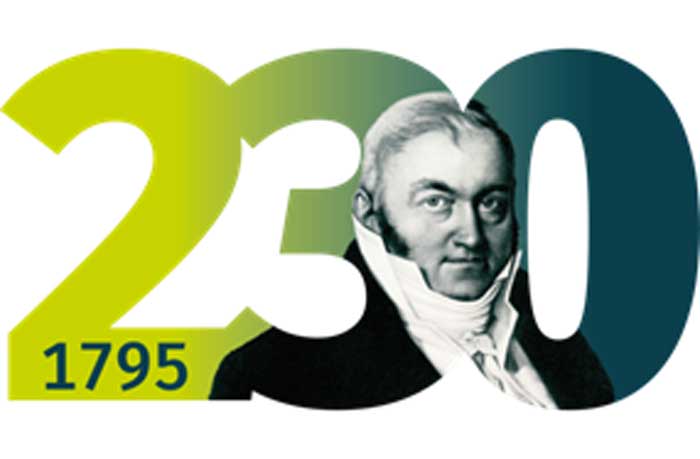
Rieter has stood for pioneering innovation in textile technology for 230 years. Founded in 1795, the company has grown from a trading company to a global technology leader. With a clear focus on automation, digitisation and sustainability, Rieter is shaping the future of yarn production and continues to set standards in the industry.
Rieter, the world leader in developing and manufacturing systems for yarn production with staple fibres, is celebrating its 230th anniversary this year – a history characterised by change, innovation and growth.
The Rieter success story began on April 15, 1795, when Johann Jacob Rieter founded the company JJ Rieter & Cie in Winterthur, Switzerland. Rieter started as a trading company for exotic spices and cotton, and on April 23, 1795, the first cotton bale had already arrived at the Waaghaus trading house on Marktgasse in Winterthur.
Initially involved in spinning mills and textile manufacturing, Rieter continued to develop over the 19 century and shifted its focus to building industrial machinery. Acquiring the buildings of the former Töss Abbey in Winterthur in 1833 was an important step. In addition to spinning mill machines, the company’s product line also included machines for winding, knitting, and weaving.
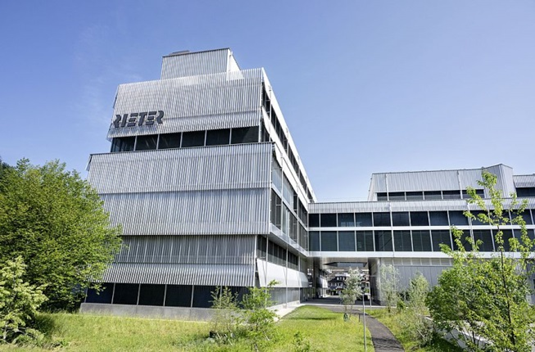
The campus houses the Rieter innovation and technology centre, the most modern of its kind.
In 1891, Rieter converted into a stock company, which was a significant milestone in the company’s history. In the decades that followed, Rieter set new technological standards again and again. For example, the company was the first machine factory in Switzerland with electronic data processing and Rieter set up a modern laboratory for testing materials. It was joined by prototype workshops, a textile laboratory, and a test spinning mill to support further innovation.
Despite economic challenges, Rieter has always used times of crisis as an opportunity to increase its efficiency and hone its strategic focus. Along with its subsidiaries Accotex, Bräcker, Graf, Novibra, Suessen, SSM, and Temco, today Rieter is distinctive and well-known in the market. The company is a leader in spinning mill technology and contributes to sustainability in the textile value chain with state-of- the-art machines, systems, and components.
Rieter’s success is based not only on technological excellence, but above all on the people who drive the company forward. The approximately 4 800 employees worldwide are the company’s greatest asset. With their expertise, innovative spirit, and passion, they set new standards every day and play an active role in shaping Rieter’s future.
From Rieter’s perspective, the future of spinning mills is automated, digital, and intelligent. Research and development activities are being intensified – in both the areas of autonomous transport systems and collaborative robotics, as well as for ESSENTIAL, Rieter’s digital spinning mill platform. The goal is to fully automate the value creation process of spinning mills by 2027. This will enable spinning mills to reduce their yarn manufacturing costs and maximise their returns. Customers can then concentrate fully on their yarn business and rely on Rieter’s technology and know-how for their operations.
With 230 years of experience, strong innovative power, sustainable solutions and a global sales and service organisation, Rieter is perfectly positioned as the market leader and looks to the future with confidence.
About Rieter
Rieter is the world’s leading supplier of systems for manufacturing yarn from staple fibers in spinning mills. Based in Winterthur (Switzerland), the company develops and manufactures machinery, systems and components used to convert natural and man- made fibers and their blends into yarns in the most cost-efficient manner. Cutting- edge spinning technology from Rieter contributes to sustainability in the textile value chain by minimising the use of resources. Rieter has been in business for 230 years, has 18 production locations in ten countries and employs a global workforce of around 4 790, about 16 per cent of whom are based in Switzerland.