


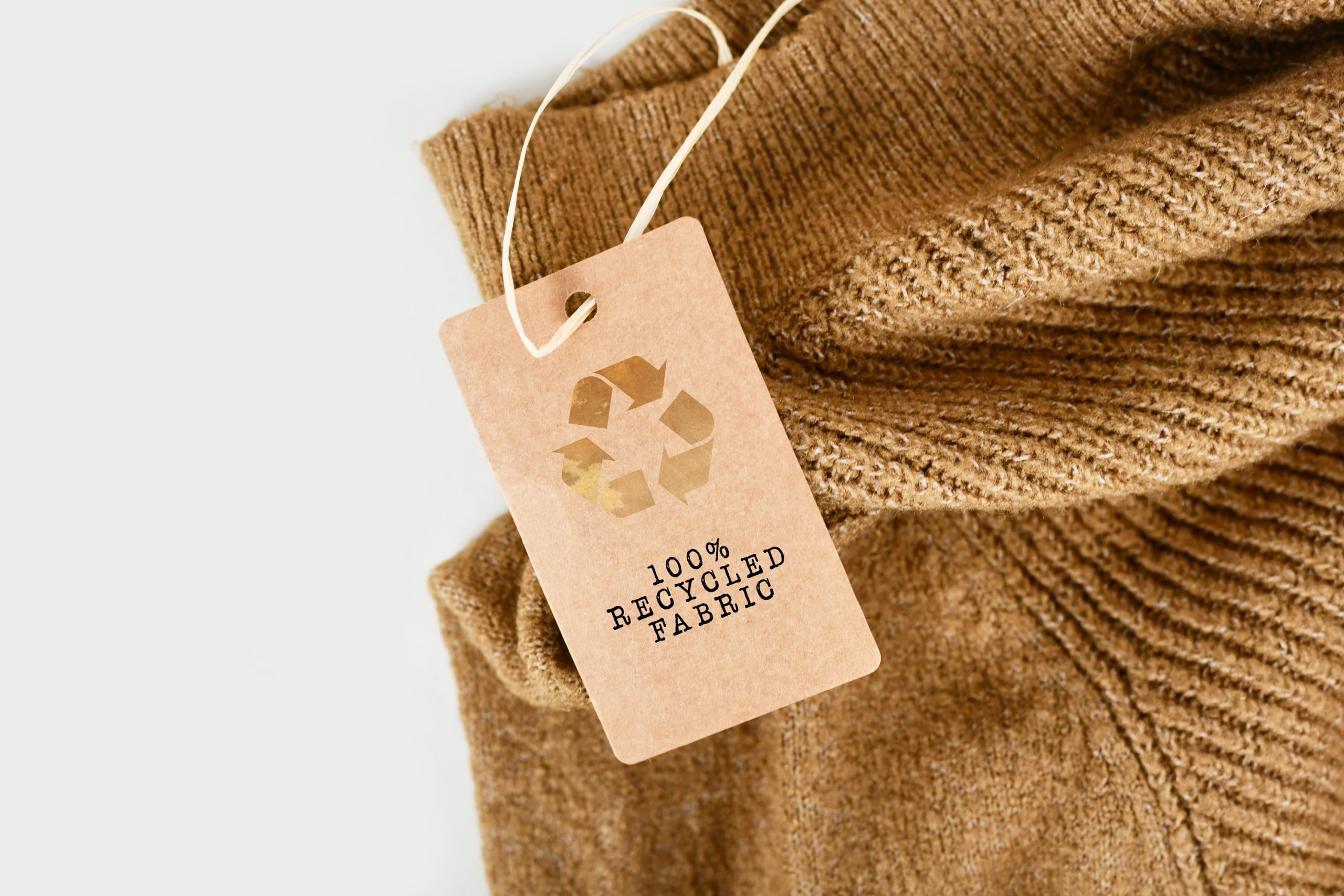
Swiss manufacturers offer perfect matches for circularity.
Many end-users now expect recycled materials to be in textile products they purchase – and this is definitely driving innovation throughout the industry. However, there are still many technical and economic issues facing yarn and fabric producers using recycled resources. Members of the Swiss Textile Machinery Association offer some effective solutions to these challenges.
Synthetic recycled materials such as PET can usually be treated similarly to new yarn, but there are additional complexities where natural fibres like wool and cotton are involved. Today, there’s a trend towards mechanically recycled wool and cotton fibres. Thanks to companies like Rieter, Autefa, Steiger and Uster Technologies, such materials can now be processed. Machinery and services from these firms support further processing of recycled fibres to meet required quality standards. Swiss Textile Machinery member Stäubli also demonstrates what it means to fully embrace circularity concepts.
Spinning recycled cotton
The use of mechanically recycled fibres in spinning brings specific quality considerations: they have higher levels of short fibres and neps – and may often be coloured, particularly if post-consumer material is used. It’s also true that recycled yarns have limitations in terms of fineness. The Uster Statistics 2023 edition features an extended range of fibre data, supporting sustainability goals, including benchmarks for blends of virgin and recycled cotton.
In general, short fibres such as those in recycled material can easily be handled by rotor spinning machines. For ring spinning, the shorter the fibres, the more difficult it is to guide them through the drafting zone to integrate them into the yarn body. Still, for wider yarn counts and higher yarn quality, the focus is now shifting to ring spinning. The presence of short fibres is a challenge, but Rieter offers solutions to address this issue.
Knitting recycled wool
For recycling, wool fibres undergo mechanical procedures such as shredding, cutting, and re-spinning, influencing the quality and characteristics of the resulting yarn. These operations remove the natural scales and variations in fibre length of the wool, causing a decrease in the overall strength and durability of the recycled yarn. This makes the yarn more prone to breakage, especially under the tension exerted during knitting.
Adapting to process recycled materials often requires adjustments to existing machinery. Knitting machines must be equipped with positive yarn suppliers to control fibre tension. Steiger engages in continuous testing of new yarns on the market, to check their suitability for processing on knitting machines. For satisfactory quality, the challenges intensify, with natural yarns requiring careful consideration and adaptation in the knitting processes.
From fibres to nonwovens
Nonwovens technology was born partly from the idea of recycling to reduce manufacturing costs and to process textile waste and previously unusable materials into fabric structures. Nonwovens production lines, where fibre webs are bonded mechanically, thermally or chemically, can easily process almost all mechanically and chemically recycled fibres.
Autefa Solutions offers nonwovens lines from a single source, enabling products such as liners, wipes, wadding and insulation to be produced in a true closed loop. Fibres are often used up to four times for one product.
Recycling: total strategy
Great services, technology and machines from members of Swiss Textile Machinery support the efforts of the circular economy to process recycled fibres. The machines incorporate the know-how of several decades, with the innovative power and quality standards in production and materials.
Stäubli’s global ESG (environmental, social & governance) strategy defines KPIs in the context of energy consumption, machine longevity and the recycling capacity in production units worldwide, as well in terms of machinery recyclability. The machine recyclability of automatic drawing in machines, weaving systems and jacquard machines ranges from 96 to 99 per cent.