


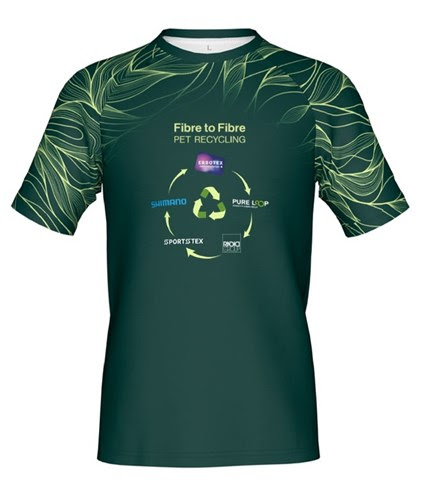
From upstream to downstream, circularity in textiles is feasible. With no compromise on the quality and technical performance of the products.
This is an ambitious research & development project, built step by step, which demonstrates the feasibility of polyester “fibre to fibre” recycling. It started with Sportstex, a company specialised in the production of sportswear, and RadiciGroup, a Group with many years of experience in circular economy, wishing to collaborate for the recovery of polyester textile waste such as uniforms for football, volleyball and other sports. The involvement of Pure Loop, a company specialised in recovery machinery, was immediate, with the aim of identifying the best available technology to obtain a new textile fibre. To reach this goal, the R&D teams of the three companies carried out various tests to achieve a recycled textile product with high technical features. An initial result was obtained using a mixed recovery technique, “dosing” variable percentages of granules from recycled bottles (a more than consolidated practice at RadiciGroup) together with polyester granules from recycled fabrics. This experience allowed to gradually fine-tune the processes and to achieve, at the end, a yarn 100 per cent derived from the recovery of textile waste.
Once scaled-up, this virtuous circularity system will make it possible to easily produce recycled polyester garments that, at the end of their life, can be recovered again. Shimano was the first company to embrace this sustainability project branding the first jersey coming from this supply chain collaboration. A cycling jersey made with this process will be on display for the first time at ITMA, the most important international trade fair for textile and clothing technology, scheduled in Milan from 8 to 14 June 2023, in the booth of one of project partner companies (Booth Pure Loop H9/D304).Â
The research project has highlighted a new recycling way, which allows to obtain quality polyester fibres starting, for example, from pre-owned clothes, for a textile “Closed Loop”.
Moreover, Erdotex, a company specialised in the sorting of used garments, will support the project. Thanks to specific “sorting” procedures, Erdotex will make it possible to feed this innovative recycling process, with the ambition of developing a real industrial process.
Achieving increasingly sustainable textiles is at the heart of the strategy of Radici InNova, the RadiciGroup company focused on innovation for circularity – underlines Gianni Todaro, R&D Specialist Apparel and Technical, RadiciGroup Advanced Textile Solutions – For some time now, we have been designing innovative solutions with high technical performance that respect the environment, working in synergy with our customers and suppliers and sharing our knowledge in the recovery of textile waste.