


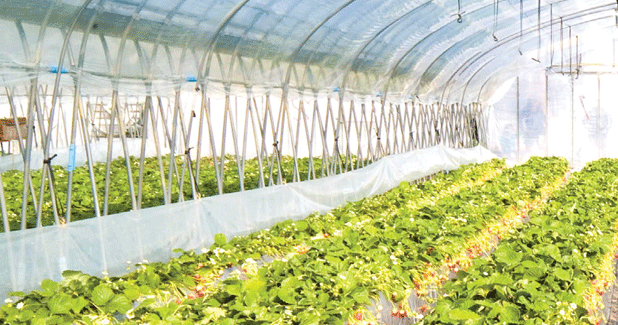
Nonwoven crop covers can also be used again and again, and by increasing the production and limiting damage to agricultural crops, nonwovens ensure that what is grown in the field counts.
Nonwovens are used effectively for optimising the productivity of crops, gardens and greenhouses. Their protective nature means that the need for pesticides is reduced and manual labour is kept to a minimum.
The use of nonwoven crop covers on the land increases yields and improves the quality of the crops. Very light, flexible sheets are laid over seed beds, which create a microclimate in which the heat and humidity are controlled. The growth of the plants is accelerated and they are protected from adverse weather conditions and vermin. Additionally, nonwovens can mean a big difference to the amount of food produced, or prevent spoilage once a crop has been harvested. For example, when growing strawberries, a farmer only has to save two per cent of the value of their crop to make using nonwoven covers worthwhile. This can mean a saving of 25 million Euros per year of strawberries that wouldn´t otherwise have made it to market.
Nonwoven crop covers can also be used again and again, and by increasing the production and limiting damage to agricultural crops, nonwovens ensure that what is grown in the field counts. In capillary mat applications, nonwovens promote the healthy growth of flowers and vegetables in greenhouses by using soil-less growing methods.
Some examples of where nonwovens are used
- Crop covers
- Plant protection
- Seed blankets
- Weed control fabrics
- Greenhouse shading
- Root control bags
- Biodegradable plant pots
- Capillary matting
- Landscape fabric The advantages of using nonwovens
- Fabrics with high strength, durability and elasticity
- Frost and insect protection
- Exceptional permeability
- Weed control
- Apertures between the intersecting fibres of nonwoven sheets which are big enough to allow air and water to reach the crop but small enough to keep out insects.
- The protection allows plants and crops to grow without the use of pesticides and herbicides
- An earlier development and harvest of the crop, improved yield and a growing year which can be extended at both ends
Technologies used are bonding and formation.
Bonding
Webs, other than spunlaid, have little strength in their unbonded form. The web must therefore be consolidated in some way. This is effected by bonding, a vital step in the production of nonwovens. The choice of method is at least as important to ultimate functional properties as the type of fibre in the web.
There are three basic types of bonding:
- Chemical
- Thermal
- Mechanical
Chemical bonding (adhesion bonding): Chemical bonding mainly refers to the application of a liquid based bonding agent to the web. Three groups of materials are commonly used as binders-acrylate polymers and copolymers, styrene-butadiene copolymers and vinyl acetate ethylene copolymers. Water based binder systems are the most widely used but powdered adhesives, foam and in some cases organic solvent solutions are also found. There are many ways of applying the binder. It can be applied uniformly by impregnating, coating or spraying or intermittently, as in print bonding. Print bonding is used when specific patterns are required and where it is necessary to have the majority of fibres free of binder for functional reasons.
Thermal bonding (cohesion bonding): This method uses the thermoplastic properties of certain synthetic fibres to form bonds under controlled heating. In some cases the web fibre itself can be used, but more often a low melt fibre or bicomponent fibre is introduced at the web formation stage t