


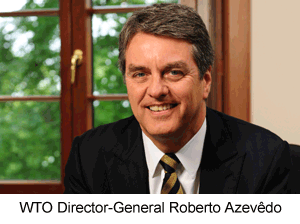
The World Trade Organisation (WTO) has played a key role in helping countries adjust to four recent trends that have considerably altered the relationship between trade and development, according to the latest edition of the WTO?s flagship publication released recently in Geneva. Director-General Roberto Azevêdo, in marking the launch of the report, said that ?the emerging trends highlighted in this report suggest that trade will be a major force for development in the 21st century?.
The World Trade Report 2014 identifies these four trends as:
- the rise of the developing world;
- the expansion of global value chains;
- the higher prices of commodities; and
- the increasingly global nature of macroeconomic shocks.
Incomes in developing countries have been converging with those of rich countries. Since 2000, GDP per capita of developing countries has grown by 4.7 per cent, with developing country G-20 members performing particularly strongly. Meanwhile developed countries only grew by 0.9 per cent. As a result, developing countries now account for more than half of world output (in purchasing power parity terms).
Higher GDP per capita helps to achieve other societal objectives, such as reducing poverty and protecting the environment. Given that more trade is associated with faster growth, trade can make it easier to achieve these goals.
Expanding trade underpinned these gains in income. The share of developing countries in global trade rose from 33 per cent to 48 per cent since 2000.
Over the last couple of decades, developing countries as a whole have reduced MFN tariffs, enabling this trade expansion. Average reductions of MFN tariffs have been greater in G-20 developing countries.
Increasing participation of developing countries in global value chains
Developing countries are increasingly involved in international production networks, including through services exports. More than half of their total exports in value-added terms are now related to global value chains (GVCs). South-South global value chain linkages are becoming more important with the share of GVC-based trade between developing countries quadrupling over the last 25 years.
GVCs offer an opportunity to integrate in the world economy at lower costs. GVC participation can lead to productivity enhancements through technology and knowledge transfers. Countries with high greater GVC participation have experienced higher growth rates.
But gains from GVC participation are not automatic. Many developing countries join GVCs by performing low-skill tasks where value capture is low and achieving upgrading to higher value tasks can be challenging.
Countries with a favourable business environment and low tariffs participate to a greater extent in GVCs. In addition, GVCs are associated with ?deep integration? agreements: more than 40 per cent of free trade agreements in force today include provisions related to competition policy, investment, standards and intellectual property rights.
Obstacles for developing countries seeking to participate in GVCs include infrastructure and customs barriers. Directing Aid for Trade resources toward these objectives should therefore remain a priority.