


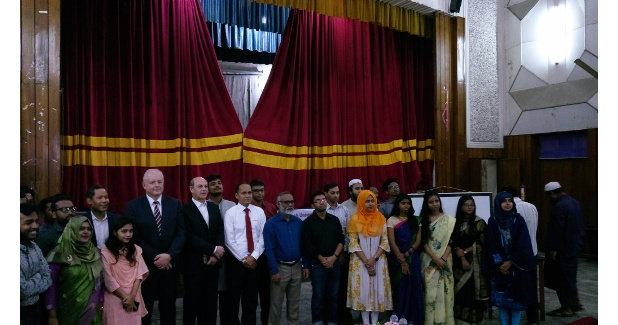
As guest speakers at lectures at the Bangladesh University of Textiles (BUTEX) and the Northern University Bangladesh, representatives of the German mechanical engineering company Mahlo GmbH introduced the students to the requirements and solutions of modern textile production. In the future, the connection to one of the most important textile markets in the world is to be further strengthened.
“No excuse for warped fabric†was the striking title of the lecture prepared for the students by Head of Sales Thomas Höpfl and Area Sales Manager Adnan Andac. At BUTEX, Prof. Md. Abdul Kashem, Vice Chancellor, and Prof. Dr. Shaik Md. Mominul Alam, Head of the Department of Textile Machinery Design & Maintenance welcomed them. At the Northern University the experts from Germany were joined by Vice-Chancellor Prof. Anwar Hossein, Prof. A. Y. M. Abdullah, Chairman of the Northern University Bangladesh Trust and Prof. Dr. Engr. Md. Humaun Kabir, Dean of the Faculty of Science & Engineering.
Together, they showed the 300 or so future leaders how modular process control can be the answer to current challenges in the industry, such as rising costs for raw materials and personnel. "In the age of Industry 4.0, data-based production is indispensable," was Höpfl’s central message. Mahlo has therefore developed the mSmart digitalization concept. Höpfl and his colleague Andac explained the principle in a practice-oriented way, using the production steps around the stenter as an example: "Without measurement and control systems, textile finishing is like a black box. The user is solely dependent on his experience. However, if he uses suitable sensor technology, the processes become transparent and can be controlled effectively". Mahlo uses its automatic straightening system to eliminate residual distortion. The yarn density sensor Famacont PMC regulates yarn density and basis weight to minimize residual shrinkage values. Process control systems such as the Permaset VMT measure the fabric temperature and thus regulate the dwell time. If the producer still monitors residual and exhaust air moisture, he prevents the fabric from overdrying, for example, and thus saves a considerable amount of energy.
“Since all Mahlo machines are networked in the mSmart environment, the user receives all the essential data at a glance, anytime and anywhere,†says Adnan Andac. This enables a quick reaction based on the latest values. Process control thus not only helps to save resources, but also to make the machinery easier to handle. “And those responsible have more time to concentrate on other projects.†The interested questions and discussions at the end of the lecture showed that the topic had hit the nerve of the students.
The over 5,000 students at BUTEX and the Faculty of Textile Engineering at the Northern University of Bangladesh are part of the most important industry in their country. "The large number of students alone shows the importance of the textile sector", Höpfl knows. This is why the company was very pleased about the opportunity to get in touch with young professionals of such an important market. The Mahlo representatives therefore expressed their great thanks to Tun H. Kyaw, CEO of their long-standing service partner Tootal Quality Resources Ltd, who had established the connection, as well as to the responsible persons of the two universities.