


Zero-duty access to boost India’s competitiveness in EU market.
Indian textile and apparel exporters are set to gain a major competitive advantage in the European market following the India–EU Free Trade Agreement (FTA), which will eliminate import duties and place Indian shipments on par with key competitors such as Bangladesh and Vietnam, according to a report by ICRA.
The agreement is expected to reduce EU import duties on Indian textiles to zero, removing a long-standing tariff disadvantage that had constrained India’s pricing competitiveness in the region. ICRA noted that preferential trade access and lower tariffs had earlier enabled competing countries to secure stronger positions in the EU market, while Indian exporters faced structural cost pressures.
The report highlighted that the EU’s import dependence on India has historically remained below 5 per cent, with China, Bangladesh, Turkey and Vietnam dominating supplies to the region. Preferential access enjoyed by these countries had limited India’s ability to scale exports to Europe prior to the agreement.
India’s apparel exports are estimated at over $16 billion in calendar year 2025, with nearly one-third destined for the US and around 23 per cent for the EU, making Europe one of the sector’s largest markets. However, exports to the EU have remained largely flat in recent years due to subdued retail demand, inflationary pressures and diversification of sourcing by global buyers.
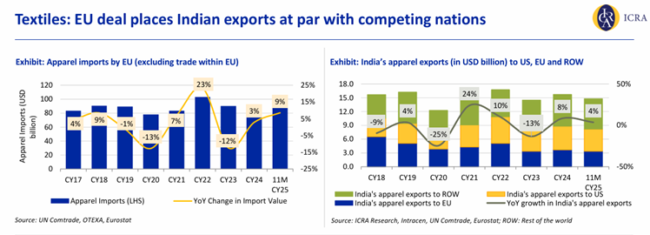
According to ICRA, the India–EU FTA is expected to provide a significant boost to apparel and home textile segments, which stand to benefit most from tariff-free access. Duty elimination is likely to improve price competitiveness, expand sourcing opportunities with European retailers and strengthen India’s integration into European supply chains. The agreement is also seen as a structural catalyst for export growth, improved competitiveness and long-term investments across the textile value chain.
Beyond textiles, the broader trade pact offers preferential zero-tariff access on 97 per cent of EU tariff lines, covering 99.5 per cent of India’s export value, with a substantial portion of duties expected to be eliminated immediately upon enforcement. This wide-ranging access is expected to support labour-intensive sectors and deepen India’s participation in global value chains.
Improved market access could enable Indian exporters, including MSMEs, to expand sourcing relationships with European buyers and attract investments in capacity expansion, technology upgrades and product diversification. Over the medium term, the level playing field created by the agreement is expected to reinforce India’s position as a reliable and competitive sourcing destination for the EU market.