


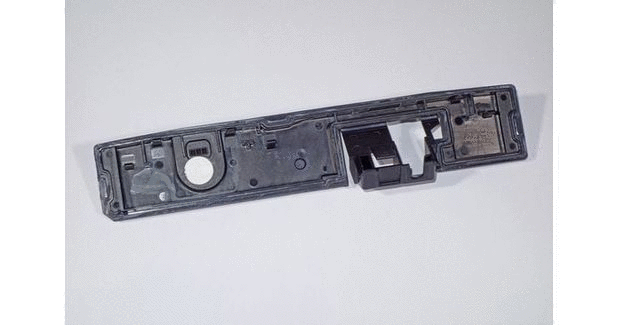
Laser transmission welding is becoming increasingly established in the series production of complex shaped plastic parts for the automotive, electrical/electronic, IT, and consumer industries. LANXESS is, therefore, expanding its range of laser-transparent polyamide 6 and polyamide 66 as well as PBT compounds (polybutylene terephthalate) for this forward-looking technology.
“With these new products, we are primarily targeting the growing demand for housings for sensors, control units, and display systems, for example, which are needed for electrification of vehicle drives and for applications in driver assistance systems through to autonomous driving,†explains Frank Krause, welding technology expert in the High Performance Materials (HPM) business unit at LANXESS. All new compounds are characterized by a high degree of transparency for the light from the near infrared range that is commonly used in laser transmission welding.
In the procedure, a laser beam is sent through a laser-transparent component and absorbed by a second, often black-pigmented component below. This generates heat that melts the surface of the second component. The surface of the first component also melts through heat conduction, so that a material-joining in the form of a weld is created between the two components. The process has several advantages: Thus, it is easy to automate and, compared to vibration, ultrasonic, and infrared welding it is thermally and mechanically less stressing. It allows the joining of 3D contours and hard/soft material combinations. Depending on the size of the component, the cycle times are considerably less than 30 seconds, and the welding flash is – if at all – extremely low. In addition, welding seams are created without lint. This means, for example, that welded liquid containers do not have to be washed out for cleaning after production.
One highlight among the new compounds from LANXESS is the halogen-free flame-retardant Durethan AKV30FN04LT. The light transmission for this polyamide 66 is comparatively high in the wavelength range usual for laser welding at wall thicknesses of up to 1.5 mm. “The heat input at the boundary layer is thus fast, so that the joining area also melts quickly, which makes economical production possible,†says Krause. The compound shows a very high tracking resistance and achieves the best classification of V-0 (0.4 mm) in flammability testing pursuant to the United States’ UL 94 (Underwriter Laboratories Inc.) standard.