



Sulakshana Rao, Ashok Gulati and Rohit Kansal edited a book named “Stitching India’s Apparel Export Strategy: From Farm to Foreign.”
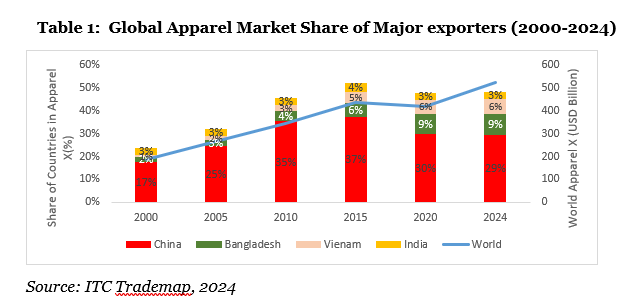
The textile and apparel (T&A) sector has historically served as a cornerstone of industrialisation across developing economies. As one of the most labour-intensive manufacturing activities, it has played a pivotal role in enabling structural transformation absorbing surplus labour from agriculture and generating employment, particularly for women. For India, the sector is the second-largest employer after agriculture. And yet, a country with a full fibre to fashion value chain, abundant labour and centuries of craft heritage holds around 3 per cent of global apparel exports, since last two decades. Competitors Bangladesh and Vietnam moved from 2.2 per cent and 1 per cent respectively in 2000, to 9 per cent and 6 per cent by 2024. This book raises a very pertinent question: why has India not been able to fully capture the ‘China+1’ opportunity in global sourcing, even as far narrower economies seized it?
Stitching India’s Apparel Export Strategy: From Farm to Foreign, co-edited by Sulakshana Rao, Ashok Gulati and Rohit Kansal, examines this question across the entire value chain, beginning at the farm, where indecision on next generation cotton technology and under-investment in public research converted India from the world’s leading cotton exporter into a net importer. The book then moves through the fibre to fabric conversion gap, the processing and MMF deficit, the structural fragmentation of garment manufacturing and the capital, skilling and institutional constraints that have collectively affected export competitiveness. The book also draws on India’s own success stories, enterprises and clusters that have built globally competitive businesses to demonstrate that scale, compliance and innovation are not aspirations but achievable realities, and that the ingredients for global T&A leadership exist within India. India already possesses the essential building blocks for global leadership in T&A; what is needed is a coherent, integrated ecosystem that connects these strengths across the entire value chain and enables them to operate at scale.
The book also examines India’s evolving textile policy architecture and the shift towards a more integrated, value chain-based approach to sectoral development. It highlights the Integrated Programme for Textiles as an important step towards bringing together flagship initiatives such as the Textile Expansion and Employment (TEEM) Scheme and the Tex Eco Initiative under a common strategic framework to strengthen scale, productivity, sustainability and export competitiveness. Drawing lessons from China, Bangladesh and Vietnam, the book argues that the long-term success of these initiatives will depend on stable policy frameworks, coordinated implementation and institutional mechanisms that provide businesses the confidence to invest, innovate and scale.
The central contribution of the book is its comparative policy analysis of China, Bangladesh and Vietnam, examined through five pillars of competitiveness: scale and ecosystem; capital and financial architecture; labour, technology and skills; cluster governance and institutional mechanisms; and market access and trade facilitation. Lessons from China is one of ecosystem approach: vertically integrated clusters, concessional finance and institutional governance that transformed China as the largest apparel exporter. Bangladesh, had the LDC preference and tariff edge primarily, supported by financial architecture designed around apparel cash flows the back-to-back letter of credit, bonded warehousing and factory-gate regulatory services. Vietnam’s rise illustrates the transformative potential of aligning FDI attraction, FTA utilisation and investor-ready industrial infrastructure into a single, demand-responsive system. The book provides a clear short, medium and long-term agenda to reform India’s T&A sector.
It is inarguably evident that India is now at an opportune moment. The recently concluded India UK CETA and India EU FTA places Indian exporters on tariff-equivalent terms with competitors, bridging a long-standing tariff disadvantage. However, the authors argue that export competitiveness goes well beyond tariff gains. The book provides a comprehensive reform agenda across all five pillars of competitiveness operationalising PM MITRA parks as genuine fibre to fashion ecosystem, deepening financial access for MSMEs, upgrading skills and technology, streamlining trade facilitation and embedding sustainability in the future. The sequenced and actionable reform roadmap set out in the book outlines a practical pathway for repositioning India as a scale-driven, fibre-diverse, digitally enabled and women-inclusive global apparel sourcing hub.