


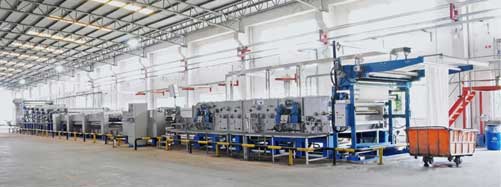
Open width knit mercerisation is expected to be an integral part of the sequence of knitted fabric processing soon.
Mercerising is a treatment that adds value to cellulosic fabrics. It is a process of treatment of cotton fabric with highly concentrated caustic soda, under tension. Mercerisation is possible for both woven as well as knitted cellulosic fabrics and improves the dye ability of such fabrics and imparts dimensional stability and tensile strength to these fabrics. The lustre which is obtained through mercerisation stays permanently with the fabric. Additionally, this treatment gives a ‘cooling’ feel to the fabric, thus providing greater comfort to the end users. With the emphasis on comfortable clothing growing every year, mercerised knitted fabrics are in great demand for making garments for international high-end fashion brands.
Indian knit processors have realised the immense benefits of switching over from tubular to open width processing for knit fabrics. Several processors in the country have already converted their knit process houses to open width bleaching, cold pad batch dyeing, and washing.
The knit mercerisation uptrend has been prevalent since over 15 years. However, the growth in knit mercerisation was constrained as so far it was applicable only for tubular fabrics. Tubular mercerisation has its own limitations – it creates visible marks on the edges of the fabric, and it also causes a lot of effluent treatment issues due to the high chemical oxygen demand load per unit of fabric treated. This is where the development of the open width knit mercerisation process has helped considerably, as this process not only mitigates the issues faced with tubular mercerisation, but also improves the quality of fabric in terms of feel and comfort. It also has higher savings in dyeing related processing costs as compared to unmercerised cotton knits. Open width knit mercerisation is expected to be an integral part of the sequence of knitted fabric processing soon.
Benefits of Goller open width knit merceriser:
- Saves up to 15-20 per cent of dyes when compared to unmercerised varieties
- Excellent dimensional stability
- Improvement in tensile strength of the fabric
- Achieving excellent colour depth, especially in medium dark or dark-shaded printed fabric
- Excellent permanent lustre
- Less pilling
- Less shrinkage of finished fabric in domestic washing
- Higher quality compared to tubular knit mercerisation
- Lower utility consumption per unit of fabric as compared to tubular knit mercerisation
Technical and utility data of Goller knit mercerisation:
Process: Dry on wet/wet on wet, room mercerising (hot/cold optional)
Fabric quality: 100 per cent cotton, cotton/viscose blends at lower caustic strengths
Production speed: 20-30 or 30-40 metres per minute configuration available
Chemicals: Caustic soda, acetic acid
Caustic consumption: Approx. 140 g/kg of fabric @ 25 Be
Water consumption: Approx. 5 – 6 L/kg of fabric
Steam consumption: Approx. 0.5 – 0.6 kg/kg of fabric
| Cold mercerising | Room mercerising | Hot mercerising | |
| Temperature | 25°C | 40-45°C | 60°C |
| Time | 50 – 60 s | 40 s | 25 s |
| Lye (NaOH) | 25 – 30 Be | ||
| Lye penetration | Slow | Medium | Fast |
| Application | Yarn dye/Dye fabric | Grey fabric | Grey fabric |
About Goller
Goller is a pioneer and a global market leader in the manufacturing of open width textile processing ranges, including those for knit mercerisation. Goller was founded in Germany in 1948 and became a member of the CHTC Fong’s Group in 2006. The integration of Goller into the CHTC Fong’s Group helped it develop and spread its highly engineered textile wet finishing ranges at a tremendous pace..