


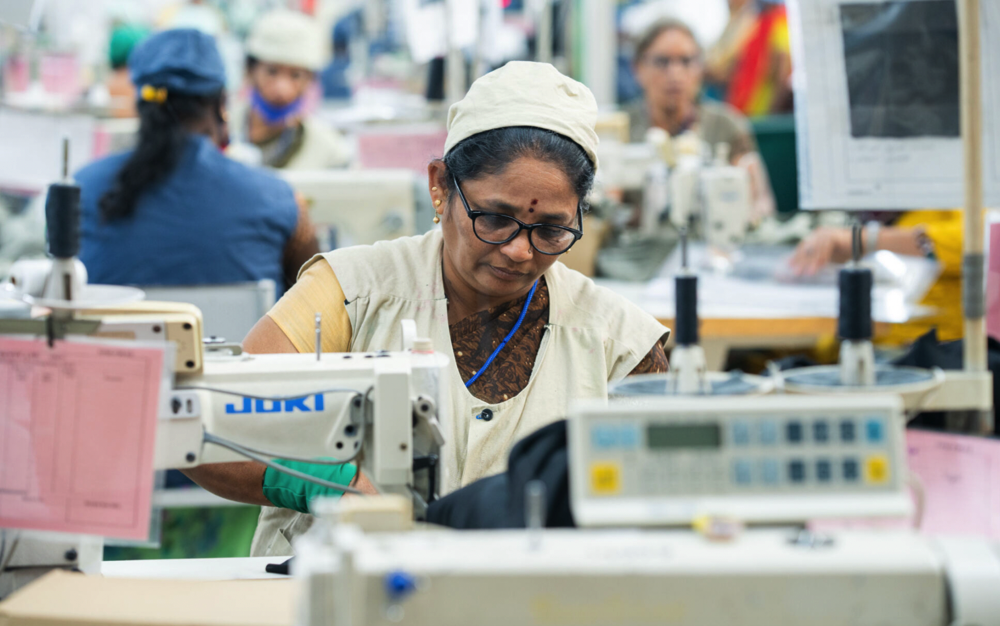
One in four sewing machine operators found to have uncorrected vision impairments.
According to a new randomised controlled trial (RCT) at Shahi Exports, conducted by Good Business Lab (GBL), and published in the British Journal of Ophthalmology, correcting the near vision of garment factory workers with glasses improved their productivity by 6 per cent.
The RCT undertaken across shopfloors of Karnataka-based factories operated by Shahi Exports provided free glasses to 344 sewing machine operators. These workers were experiencing Presbyopia, an age-related decline in near vision, affecting their work on the factory floor and their quality of daily life. This condition affects 1 in 4 sewing machine operators in the selected factories.
Implemented by VisionSpring, the intervention provided vision screening and free glasses at under
Rs 1,000 per worker. Factories saw a net benefit of Rs 4,000 per worker in just six weeks, with a projected return of Rs 15,000 over a year. The findings point to a clear business case: a modest, one-time investment in worker wellbeing delivered measurable gains in factory performance within weeks. Shahi Exports, India’s largest textile manufacturer, is committed to expanding vision correction programmes beyond presbyopia across its operations, with a target to reach 100,000 workers.
Workers also reported measurable benefits of improved vision, demonstrating significantly better visual function scores within 12 weeks of receiving glasses. Furthermore, adherence to wearing glasses increased significantly, from 41 per cent in week 4 to 65 per cent in week 12. This suggests that workers who experienced benefits were more likely to continue using the glasses consistently. Clearer vision also has direct quality-of-life effects: the ability to read a mobile phone, help a child with schoolwork, or manage daily tasks independently.
Achyuta Adhvaryu, Co-Founder, Good Business Lab,noted, “When employers invest in something as fundamental as a worker’s ability to see, the returns flow in both directions, to the worker and the business. This study demonstrates that simple, low-cost intervention such as providing vision correction glasses can yield productivity results comparable to other proven, but significantly more expensive, performance-linked incentives, or training initiatives. I am truly excited that Shahi Exports has decided to scale this program, and I hope other firms recognize that addressing such a basic physiological barrier is a powerful, yet often overlooked, way to drive both worker well-being and long-term business growth.”
Anant Ahuja, Director of ESG and Sustainability at Shahi Exports, added, “Eye health is an imperative life function. The findings of the study are promising and signal a growing belief that strategic investment in worker wellbeing not only improves workers’ lives but also strengthens the business. We are now expanding the reach of this benefit to all workers across our factories.”
If scaled across the estimated 53 million garment workers in India, Bangladesh, Vietnam, and Cambodia, universal vision correction could add tens of billions of dollars in annual output while directly improving workers’ quality of life. Globally, the study estimates a potential $27 billion annual productivity gain for the textile and garment sector.
The size and importance of the garment industry, especially in low- and middle-income countries where access to eye care is limited, means that a productivity improvement on this scale could be felt across entire economies. The garment industry is also an important source of employment for women, especially in South Asia. At under Rs 1000 per worker, vision correction is among the lowest-cost, highest-return investments an employer in this sector can make.