


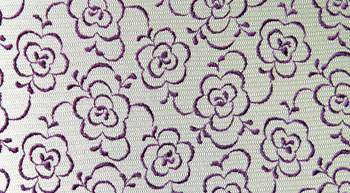
Delicate embroidery grounds continue to be in vogue. Fabric producers are selling transparent, extremely fine, tulle fabrics in the global clothing and lingerie sectors and are constantly demanding new creations in order to stimulate demand even more. Companies that want to operate successfully on the market can no longer rely on conventional three-stitch hexagonal tulle.
The results of the latest development work to produce patterned embroidery grounds were just one of the things on show in the trends section of the Interfilière show, held between July 4-6 in Paris. The beautiful fabrics featured dense, filet-like constructions made from extremely fine yarns, as well as loose, irregular meshes with an organic look. Alongside these were various honeycomb designs, as well as austere, geometrical tulle constructions, Spotnet fabrics and embroidery grounds featuring Multibar designs. The wide variety of grounds may have a simplistic look with no additional decoration, or else they may be used to create additional design elements, or may appear as shadow effects of the embroidered motifs.
The impetus for the new, fine embroidery grounds is not only coming from the manufacturers, but also from KARL MAYER, the company that makes the machines. Since the end of 2013, the textile developers in this innovative company have been designing delicate fabrics that will enable its customers to break new ground. The new embroidery grounds are produced in a gauge of E 32 instead of the normal E 28, and an HKS 3-M machine is used to produce them. This high-speed warp knitting machine with three guide bars can reach speeds of 2,000 to 2,500 min-1 and, therefore, offers a much greater level of productivity than the raschel machines normally used to produce embroidery grounds. A working width of 210†enables manufacturers to achieve an even greater level of productivity.
Stretch, embroidered honeycomb tulle
The development work carried out at KARL MAYER has resulted in the development of embroidery grounds whose completely new, open tulle constructions are particularly striking, thanks to a clever feature of the lapping. The key element of this clever patterning technology is the close linking of adjacent pillar stitch wales by two counter-notation weft links. This firm coupling makes the paired yarn pieces look identical and solves one of the patterning limitations of high-speed tricot machines when producing tulle: the length of the holes in the pore structure is restricted by the technology. With the two-in-one, pillar-stitch wale construction, stretch honeycomb patterns can be worked, as can patterns having asymmetrical waffle constructions, holes of different size and intermittent connecting pieces, as well as a combination of all of these.
The new and varied tulle constructions developed by KARL MAYER were then embroidered. A ground made from polyamide monofilaments of 20 den was used to create attractive decorative patterns using pattern yarns. The stable yarn enables delicate textiles to be embroidered without any problems, despite their filigree construction, and even dense motifs can be embroidered. This was confirmed by KARL MAYER’s partners, Surbhi Industries Limited and Bischoff Textil GmbH, who were responsible for embroidering the tulle.
For further information: www.karlmayer.com