

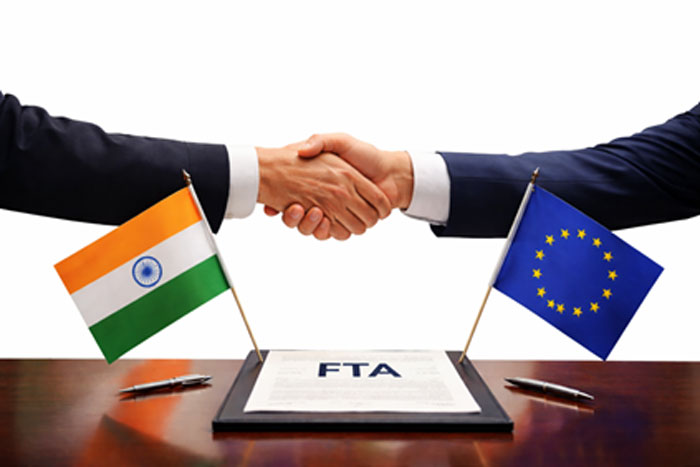
European FTA… unstoppable India!
“Let us celebrate,” says Avinash Mayekar, expressing hope that these positive developments will serve as a powerful catalyst to boost the share of India’s textiles and apparel industry once the India–EU FTA is signed.
India is really unstoppable. Whenever any hurdles have come our way, we have always found a better solution to improve India’s well-being. We have managed this exceptionally under the leadership of our Prime Minister, along with his entire cabinet ministers, who are more than a match in front of each other and showing their visionary plans to boost the morale of India and mainly help our country shine with new glitter by using innovative tools.
Till now, India has not been given much preference at the global platform; in fact, we have faced many challenges as a developing country. Now, with new leadership and innovative thought process we are showing our growth in multi-folds on many fronts including signing of FTA’s and MoU’s with promising countries and as it is rightly said this FTA with European Union (EU) is mother of all FTA’s which will take care of a huge sum of percentage of total GDP, to be precise India-EU Free Trade Agreement—linking the world’s 4th and 2nd largest economies, together accounting for 25 per cent of global GDP
Let us take a deep dive into the textile and apparel industry to understand its impact.
As on date, China is the largest supplier of textiles and apparel to the EU in 2025, maintaining its lead with competitive pricing followed by Bangladesh for Ready Made Garments, Turkey enjoys the trade benefits of proximity to European Countries, Vietnam major supplier of knitwear, sportswear and garments is currently benefitting from the EU-Vietnam Free Trade Agreement (EVFTA) and Pakistan major supplier of cotton textiles, bed linen and apparel. Cambodia, Morocco, and Tunisia also are key suppliers benefitting from geographical proximity. Although India is a partner in trade for textiles and Apparels the share is not very high but the mother of all trade can totally change the dynamics. The average MFN duty in per cent of EU for the various category of textiles. The FTA with EU is likely to eliminate all the below tariffs.
| Category | Average MFN |
| Fibre | 2.43 |
| Yarn | 3.98 |
| Fabric | 7.61 |
| Carpet | 7.55 |
| Apparel | 11.57 |
| Made-ups | 9.95 |
| Silk | 5.18 |
| Wool | 3.75 |
| Cotton | 6.36 |
| Other veg textiles (Jute, hemp, etc) | 3.39 |
| MMF | 6.20 |
Moreover, our textile industry will be getting European technology at a much cheaper rate, which was our major limitation till date. I am sure it will also showcase our willingness to get associated with the European textile machinery manufacturing sector, which is looking for an open-door policy to enter India and show a better payback period with innovative and efficient machinery supply compared to other countries like China.
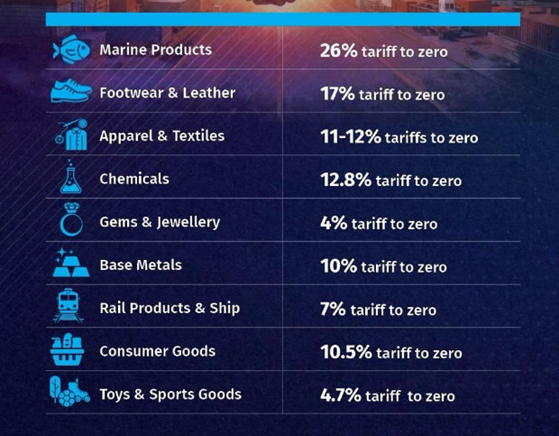
Therefore, it is a win-win situation for both parties, with perhaps some concerns for a few small sectors. But certainly, it will be a great booster to the Indian textile industry for selling their finished products in European markets and also for importing European technology, providing higher productivity, excellent quality & durability of main plant & machinery, ultimately lowering their operating costs.
Conclusion
Let us welcome this bold step taken by the Government of India for the nation’s overall development. For the textile industry, this initiative comes as a significant boost although a bit prolonged and delayed decision. Let us hope for all the positives to turn into an excellent rocket launcher for increasing the share of India’s textiles and apparel industry once India-EU FTA is signed.
With the government’s focused initiatives to support the textiles and apparel industry, we are confident that the agreement will open doors to substantial investments that have been largely absent since the COVID era. This FTA once in motion will give boost to major segments like apparel, carpets, other home textiles & textile machinery in the European market. The Indian textiles and apparel industry will be well-positioned to capture a significantly larger share of the market following the signing of the agreement.
About the author
Avinash Mayekar is the Managing Director of SUVIN Expo LLP. He has over 35 years of experience working in consulting firms and various reputed textile companies of India. His main specialisation lies in strategy building, business process re-engineering and technical textiles. Working with a reputed global consulting firm, Mayekar has worked on large spinning projects in India and gained huge overseas experience.
