Close Menu
Indian Textile Journal
  • Home
  • Textile Machinery
    • Allied Equipment and Accessories
    • Automation
    • Dyeing, Processing & Finishing
    • Knitting
    • Printing
    • Spinning
    • Weaving
  • Tech Textiles
  • Sustainability
  • Resources
    • Trade Fair
    • Events
    • Videos
  • Interview & Opinion
  • Subscribe Now
  • Advertise
  • Digital
  • Apparels & Garments
  • Fibres & Raw Materials
  • Home Textiles
  • Industry Update
Facebook X (Twitter) YouTube LinkedIn
Indian Textile Journal
Epson
  • Home
  • Textile Machinery
    • Allied Equipment and Accessories
    • Automation
    • Dyeing, Processing & Finishing
    • Knitting
    • Printing
    • Spinning
    • Weaving
  • Tech Textiles
  • Sustainability
  • Resources
    • Trade Fair
    • Events
    • Videos
  • Interview & Opinion
  • Subscribe Now
  • Advertise
  • Digital
  • Apparels & Garments
  • Fibres & Raw Materials
  • Home Textiles
  • Industry Update
Indian Textile Journal
Home » E-textiles to control home appliances
Spinning

E-textiles to control home appliances

By June 27, 20181 Min Read
Share Facebook Twitter LinkedIn WhatsApp Copy Link

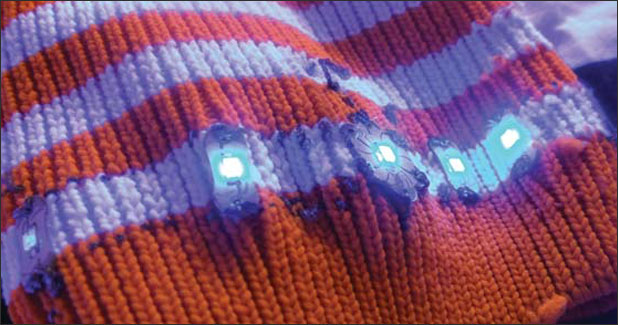
Are you feeling lazy to get up and switch off TV or fans? A new invention by Chinese researchers has a way out. Just swipe your finger on your wristband made from a new type of electronic textile (e-textile), according to a report in the “ACS Nano” journal published by the American Chemical Society (ACS).

Jiaona Wang, at the School of Materials Science & Engineering in Beijing and co-workers have developed the new type of e-textile that allows a person to control household appliances or computers from a distance simply by touching a wristband or other item of clothing, “something that could be particularly helpful for those with limited mobility”, the report says.

E-textiles are not new, but most existing versions have poor air permeability, can’t be laundered or are too costly or complex to mass-produce, ACS said in a press release.

“The self-powered E-textile developed by the researchers overcomes all of these limitations, is washable and highly sensitive to human touch.”

Previous ArticleOnline visitor registration for ITMA ASIA + CITME 2018 opens
Next Article India, Bangladesh to remove non-tariff barriers

Related Posts

Seven years of proven performance: Consistent effluent quality, stable flux & permeability, and exceptional operational reliability

June 25, 2026

From Waste Fabric to New Yarn: Why Material Origin Matters in Textile Recycling   

June 23, 2026

Zagis Strengthens Competitiveness with Rieter Spinning System

June 22, 2026
Recent Posts
  • Union Minister of State for Textiles Pabitra Margherita honors winners at CITI Awards 2026
  • Giriraj Singh launches CMAI and GATS’ the ‘India Textiles & Apparel CXO Blueprint 2030’
  • LMW receives strong response at Bharat Tex 2026
  • D.BADAMI debuts high-end collection at Bharat Tex 2026
  • DC Handlooms opens ‘Weave The Future 4.0’ at Dilli Haat
  • GHCL Textiles unveils premium yarn and fabric portfolio at Bharat Tex 2026
  • eVent Fabrics and PELLIOT partner to advance eco-conscious outdoor solutions
  • Trident Group accelerates growth at Bharat Tex 2026 through innovation and significant R&D commitment
Facebook X (Twitter) YouTube LinkedIn
  • About us
  • Contact us
  • Privacy Policy
  • Terms and Conditions

SISTER PUBLICATIONS

Construction World Equipment India Industrial Product Finder Infrastructure Today

© 2026 Indian Textile Journal. All Rights Reserved.

Type above and press Enter to search. Press Esc to cancel.