


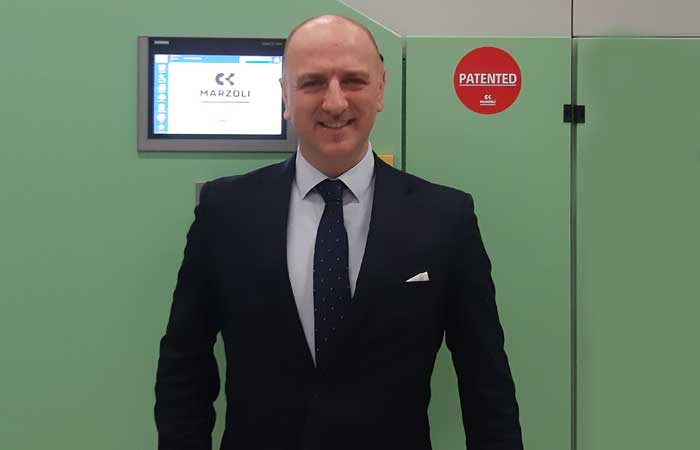
Marzoli positions itself as a textile engineering company supporting the entire spinning value chain with integrated solutions. With 175 years of expertise, it combines advanced machinery, digital technologies, and services to help customers improve yarn and fabric quality, boost efficiency, and enable sustainable production models. Its offerings include spinning and non-woven machinery, retrofitting and plant upgrades, and digital monitoring and optimisation tools, serving premium segments like luxury fashion, denim, and technical textiles. Cristian Locatelli, General Manager, Marzoli, shares the company’s offerings and future plans.
How is Marzoli serving and supporting the global textile industry today?
Marzoli today positions itself not simply as a machinery manufacturer, but as a true textile engineering company, capable of supporting the entire spinning value chain with integrated, high-value solutions. With 175 years of experience, we combine advanced machinery, digital technologies, and innovative services to address the evolving needs of the textile industry.
Marzoli supports global players by focusing on key industry challenges: ensuring quality and durability of yarns and fabrics, improving production efficiency and cost competitiveness, enabling new revenue streams, and facilitating sustainable and circular production models.
This is achieved through a comprehensive offering that includes spinning and non-woven machinery, retrofitting and plant upgrades, and digital tools for monitoring and optimisation. In addition, we provide advanced services, allowing customers to move beyond traditional production and become active players in innovation and sustainability.
Through this approach, we act as a strategic partner for high-end segments such as luxury fashion, denim, and technical textiles, helping customers strengthen their market positioning and respond to increasingly demanding end consumers.
What are the latest innovations or new technologies Marzoli has introduced recently?
Our recent innovation efforts are strongly centered around Technology Accelerator Center (TAC), a hub dedicated to developing advanced solutions for performance, sustainability, and product innovation.
One of the most significant innovations is Refiber technology, which enables the regeneration of textile waste and unsold garments into high-quality fibres. Unlike traditional recycling, this process allows to obtain material with technical characteristics close to virgin fiber and allowing higher recycled content in yarns.
Another breakthrough is Marzoli’s yarn functionalisation technology, through addition of nanofibres, that gives the yarn new advanced properties, while maintaining the natural feel and softness of the original material. This represents a major step forward in combining performance with comfort and sustainability.
Can you describe Marzoli’s current operations and presence in the Indian market?
India is a key strategic market for Marzoli and plays a central role in the global textile landscape, both in terms of production capacity and future growth potential. We are present in the country with our Marzoli India branch, which enables us to operate with a strong local footprint while maintaining global technological standards.
The company’s operations in India are structured to provide not only advanced spinning technologies, but also end-to-end support across the entire project lifecycle, from plant design and machinery supply to installation, training, and ongoing technical assistance. This allows us to act as a long-term partner for Indian textile manufacturers rather than just an equipment supplier.
In addition, we have strengthened our role in India through dedicated initiatives in digitalisation and advanced services, including remote support through the Digi4spin centre based in Marzoli India. These capabilities are designed to help Indian manufacturers improve productivity, reduce downtime, and transition toward more data-driven production models.
What strategies is Marzoli using to strengthen and grow its relationship with Indian textile manufacturers?
Our strategy in India is built on a strong local presence combined with advanced technological expertise, enabling us to develop long-term partnerships with textile manufacturers.
A key pillar is our “glocal” approach, through which we combine Italian engineering excellence with local industrial capabilities. With our facility in Coimbatore, we ensure local assembly, a structured supply chain, and the availability of spare parts, supported by skilled engineers who provide continuous technical assistance, from installation to plant optimisation. This proximity allows us to respond quickly and to better understand the specific needs of Indian customers.
Another important strategy is our focus on customised engineering and co-development. We work closely with customers and technology partners to design tailored solutions that address specific production challenges and emerging trends. This collaborative approach helps our customers differentiate their products and strengthen their competitiveness.
Finally, we encourage relationships by promoting innovation and sustainability projects, particularly in circular economy and fibre regeneration. By enabling our customers to recover value from waste and develop new business opportunities, we position ourselves as a partner that contributes directly to both operational performance and long-term strategic growth.
What are Marzoli’s key growth plans and priorities globally and in India for the next few years?
Globally, Marzoli’s growth strategy is centered on strengthening its positioning as a high-end, innovation-driven partner for selected segments, in particular: luxury & fashion, denim, and technical textiles.
We aim to expand our presence across the entire value chain, engaging not only with spinners but also with downstream players such as weavers and garment manufacturers. This broader approach allow us to influence product quality, sustainability, and traceability at every stage.
In India, growth priorities include:
- Increasing penetration in premium and specialised textile segments
- Supporting the modernisation of existing plants through retrofitting and digitalisation
- Promote the nonwoven technologies for the production of disposable products, wipes, medical and surgical products
- Developing partnerships for circular economy initiatives, particularly in fiber recycling and waste management
How is Marzoli addressing sustainability and digitalisation trends in its products and solutions?
At Marzoli, we see sustainability and digitalisation as two fundamental pillars to turn advanced solution into strategic advantages: we design to impact on textile industry of the future
On the sustainability side, we focus on enabling a concrete transition toward circular and responsible production models. Through our proprietary Refiber technology, we are able to regenerate textile waste and unsold garments into high-quality fibres, creating a true circular loop within the value chain. This allows our customers to transform a cost – the waste – into a valuable resource, while also addressing increasing regulatory and market pressures on traceability and environmental impact.
At the same time, sustainability also means reducing consumption and improving efficiency. Our machinery is designed with energy-saving components, optimised mechanical stability, and advanced automation systems that reduce waste, limit downtime, and minimise operator intervention. Retrofitting solutions play a key role, allowing customers to upgrade existing plants, extend machine lifetime, and significantly reduce energy consumption without the need for full investment.
When it comes to digitalisation, our focus is creating connected and data-driven spinning mills. With our solutions we enable real-time monitoring, advanced analytics, and predictive maintenance, allowing customers to continuously optimise performance and improve decision-making. Solutions such as YarNet, MRM, and Brainbox transform production into a dynamic system that adapts to changing conditions, increasing efficiency, stability, and productivity.