



The by-invitation conclave brought together over 250+ key decision makers from the textile and apparel value chain, including leading brands, manufacturers, exporters, policymakers, international buying houses, startups and innovators.
The Clothing Manufacturers Association of India (CMAI), in collaboration with SU.RE, successfully hosted the first edition of the ECO-STITCH Sustainability Conclave on April 3, 2026, at the Bombay Exhibition Centre, Mumbai, alongside FAB Show 2026.
The conclave was inaugurated by Vrunda Desai, Textile Commissioner – Ministry of Textiles, Government of India. Speaking at the inauguration, she expressed, “I am really very happy that we have a day -long conclave, where all industry leaders and stakeholders would be putting in ideas of how to make strides for a more sustainable and ecological environment and how to make India more Atmanirbhar. Internationally – circularity and sustainability are the buzzwords and if we have to make good use of the FTAs and promote our exports, we will have to integrate sustainability as a core business strategy.”
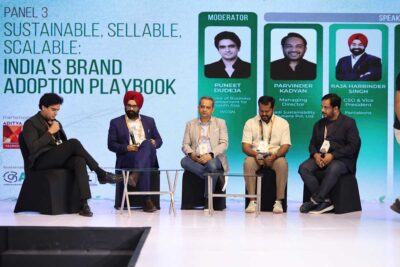
The by-invitation conclave brought together over 250+ key decision makers from the textile and apparel value chain, including leading brands, manufacturers, exporters, policymakers, international buying houses, Startups and Innovators. ECO-STITCH Sustainability Conclave was supported by Global Alliance For Textile Sustainability Council (GATS), Brands & Sourcing Leaders Association, and UNIDO. The event marked a significant step forward in advancing industry-wide alignment on embedding sustainability into core business strategies.
Speaking on the success of the conclave, Santosh Katariya, President, CMAI, said:
“The ECO-STITCH Conclave has reaffirmed that the industry is ready to move from intent to implementation. The quality of discussions, combined with the strong participation across stakeholders, reflects a collective commitment to embedding sustainability at the core of how we design, source and manufacture. This is the beginning of a long-term movement to build a more responsible and globally competitive Indian apparel ecosystem.”
Naveen Sainani, General Secretary & Chairman, ESG Committee, CMAI, noted, “What sets ECO-STITCH apart is its focus on actionable pathways. The exchange of real experiences, solutions and business-led approaches has created a strong foundation for accelerating sustainability adoption across the industry.”
A key highlight of the conclave was its experiential 3R Zones—Reuse, Repurpose, Recycle, which showcased real-world applications of circularity. From upcycled collections to integrated waste-to-wardrobe supply chains, the installations offered tangible demonstrations of how sustainability can be operationalised across production systems. The event also featured a dedicated Automation and AI Showcase, underlining the growing role of technology in enabling responsible manufacturing, improving efficiency, and driving traceability across the fashion value chain.
Designed as an action-oriented platform, ECO-STITCH moved beyond dialogue to focus on practical, scalable solutions. Through a mix of leadership panels, speakers engaged in discussions on topics like Future Ready India: Competing in a Sustainable Global Economy; Leading the Shift: CEOs Building India’s Most Trusted Supply Chains; Sustainable, Sellable, Scalable: India’s Brand Adoption Playbook; UNIDO & India Programs: One UN + Cluster Exchange Mechanism; Scaling Brands Globally: The Sustainability Imperative; Green Finance & Social Inclusion; AI & Tech in Fashion, among others.
Participating in panel discussions were sustainability leaders such as Roop Rashi – Khadi & Village Inds. Comm., Dr Naresh Tyagi – ABFRL, Subir Mukherjee – Bhaskar Denim, Abhishek Raj – Lacoste, Vineet Gautam – 91 Brands, Puneet Dudeja – WGSN, Dr Tapan K Rout – (Director – Textile Committee, Ministry of Textiles), Parvinder Kadyan, GATS, T. Jayaraman – Classic Polo, Dr Pankaj Kumar – UNIDO, Tanmeet Thukral – World Bank Group, Sunder Belani – Ramsons, Sanjay Shukla & Tapan Bansal – BSL, Dr Smita Honade Bait – ZDHC, Darshana Gajare – Reliance Brands/SU.RE, Raja Harbinder Singh – Pantaloon, Vinod Sharma – Country Manager, OVS, Manmohan Singh – Grasim, Anand Muthuswamy – Tirupur Exporters Association, Kritika Chouhan – Shahi Exports, Naveen Sainani, Hon. General Secretary & Chairman, ESG Committee, CMAI among many others.
Roop Rashi, CEO, Khadi and Village Industries Commission, said, “Khadi by default is among the most resource-efficient systems as it uses much less water and energy. So, the question is: how do we bring in the new-gen factor and new-gen aspiration for Khadi? We need to create a demand pull, and design is the most important element in drawing the new generation towards Khadi. We have created a Centre of Excellence for Khadi, and launched “Navu Khadi” initiative last year.” Dr Pankaj Kumar, National Project Coordinator, UNIDO, highlighted, “UNIDO has developed a technology innovation roadmap, which has one common platform to see all the information available, and enables connect to the Textile Committee as well as the UNIDO for whatever support anyone needs, whether technical or financial. Textile is the only sector where we need to think about energy, environment, UN empowerment, and land improvement. So the idea is support for clusters through a clustered approach.”
Dr Naresh Tyagi, Chief Sustainability Officer, ABFRL, said, “India as a country matters immensely because, as we move towards becoming the third-largest economy after the US and China, textiles will be one of the key contributors. In this context, adopting sustainability in textile and apparel manufacturing processes becomes even more imperative. Therefore, this is a significant moment for us to participate and scale our efforts in a larger, more impactful way.” Speaking about circularity, Kritika Chauhan of Shahi Exports, expressed, “We often think that circularity is something that comes at the grave stage, at the end of the life cycle. However, circularity starts when your material is actually very simple in the beginning.”
A major milestone at the conclave was the debut of the CMAI SU.RE Sustainability Awards, recognising excellence across the industry value chain.
The Jury for the awards included stalwarts like Dr. Naresh Tyagi, CSO, ABFRL; Sanjay Rastogi, Business Head, Trent Ltd.; Radhika Kaul, Chief of Staff, UN RCO India; Manohar Samuel, SU.RE; Parvinder Kadyan, Chairman, GATS; Naveen Sainani, Hon. Gen. Secretary & Chairman, ESG at CMAI; Ankur Gadia, Vice President, CMAI; Darshana Gajare, Head of Sustainability, Lakmé Fashion Week, SU.RE, Circular Design Challenge; and Prof. (Dr.) Meenakshi Tomar, Vice Dean, Jindal Global Business School.
Further elevating the event was a Grand Sustainable Fashion Showcase, featuring 8 curated sequences that brought together AI-driven design, sustainable fabrics, and Indian craft traditions. The showcase saw participation from leading fashion institutes including NIFT Bengaluru, JD Institute of Fashion Technology, SOFT Pune, and IDT Surat, highlighting the role of emerging talent in shaping the future of responsible fashion.
By convening stakeholders across the ecosystem—from MSMEs to large exporters, brands, designers, and technology providers—the ECO-STITCH Conclave has laid the groundwork for sustained collaboration and measurable progress, positioning sustainability as a shared industry mandate rather than a standalone initiative.