Close Menu
Indian Textile Journal
  • Home
  • Textile Machinery
    • Allied Equipment and Accessories
    • Automation
    • Dyeing, Processing & Finishing
    • Knitting
    • Printing
    • Spinning
    • Weaving
  • Tech Textiles
  • Sustainability
  • Resources
    • Trade Fair
    • Events
    • Videos
  • Interview & Opinion
  • Subscribe Now
  • Advertise
  • Digital
  • Apparels & Garments
  • Fibres & Raw Materials
  • Home Textiles
  • Industry Update
Facebook X (Twitter) YouTube LinkedIn
Indian Textile Journal
Epson
  • Home
  • Textile Machinery
    • Allied Equipment and Accessories
    • Automation
    • Dyeing, Processing & Finishing
    • Knitting
    • Printing
    • Spinning
    • Weaving
  • Tech Textiles
  • Sustainability
  • Resources
    • Trade Fair
    • Events
    • Videos
  • Interview & Opinion
  • Subscribe Now
  • Advertise
  • Digital
  • Apparels & Garments
  • Fibres & Raw Materials
  • Home Textiles
  • Industry Update
Indian Textile Journal
Home » Avoiding Moiré Effect in open-end spinning
Spinning

Avoiding Moiré Effect in open-end spinning

By October 1, 20152 Mins Read
Share Facebook Twitter LinkedIn WhatsApp Copy Link

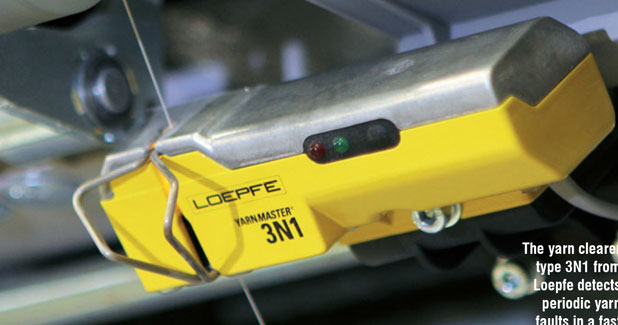
Loepfe´s 3N1 offers an additional detector for foreign matter and a triboelectric sensor for detection of synthetic foreign matter.
Open-end spinning has the advantage of high production output. As winding is not necessary, a yarn clearer is often not applied. On the other hand, periodic yarn faults can have a huge impact on the final product: the so-called Moiré effect. Yarn clearers of type 3N1 and 1N1 from Loepfe offer a fast and safe possibility, to detect these faults during open-end spinning process, resulting in a higher quality of the produced yarn.

Periodical occurring faults in open-end spun yarns can cause quality defects in the woven end product. Due to the periodicity, even small variations in yarn thickness are visible in the woven fabric the so-called Moiré effect.

The solution to avoid this effect is the installation of optical yarn clearers in open-end spinning machines. The yarn clearers 3N1 and 1N1 from Loepfe utilise an optical sensing technology and are able to detect yarn faults in a very reliable way.

Optical yarn clearers in open-end spinning
Loepfe´s optical yarn clearers cover open-end yarn counts from Nec 3 to Nec 60 at a maximum spinning speed up to 400 m/min with one sensing head. The type 3N1 offers´compared to type 1N1´an additional detector for foreign matter and a triboelectric sensor for detection of synthetic foreign matter.

The optical sensing technology is non-sensitive against changing humidity, which can occur quite often in spinning mills. Other environmental conditions like changing temperatures show no effect on the sensor either. The central unit provides and analyses all quality and production related data on its large touch screen. Periodical faults, which could result in Moiré effect and which cannot be detected during subsequent laboratory quality control, are visualised as well.

In general the use of a yarn clearer eliminates the need for laboratory quality controls of the spun yarn. The user has the advantage of 100 per cent quality control and the possibility of fast reaction times.

Previous ArticleSANMIT Card Clothing completes 5 years
Next Article Core yarn

Related Posts

LMW: Complete Technology | Seamless Possibilities

November 19, 2026

Building on Success: Suessen’s Next-Generation Compact Spinning Systems

November 17, 2026

Engineering Versatile Operations: Shreedhar Spinners Scales with LMW

November 4, 2026
Recent Posts
  • Role of textiles in molecular medicine
  • Managing the 5x Surge: Supply Chain Resilience for India’s Textile & D2C Fashion Brands
  • LMW: Complete Technology | Seamless Possibilities
  • Makarand Kulkarni: Demand for recycled polyester is rising across all segments
  • Thies appoints Rossari Biotech as sales agent in India
  • Reimagining Machinery at ITME 2026
  • The Next Generation of Denim: Innovation in Comfort, Stretch, Versatile Textures and Performance Fabrics
  • Mihir V Shah: Circularity must also consider the end-of-life stage of fabrics
Facebook X (Twitter) YouTube LinkedIn
  • About us
  • Contact us
  • Privacy Policy
  • Terms and Conditions

SISTER PUBLICATIONS

Construction World Equipment India Industrial Product Finder Infrastructure Today

© 2026 Indian Textile Journal. All Rights Reserved.

Type above and press Enter to search. Press Esc to cancel.