


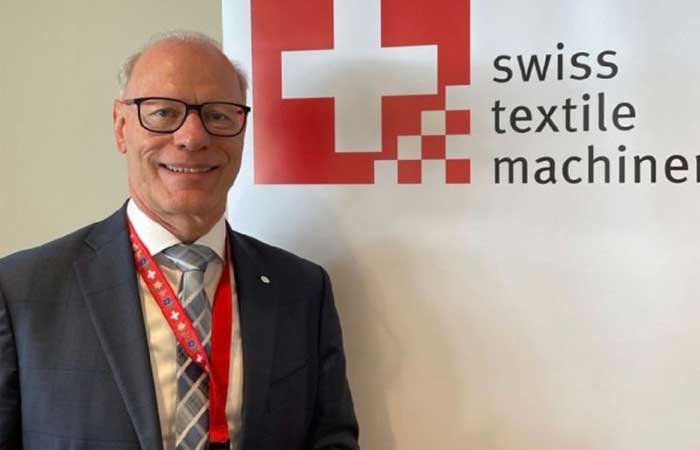
Stäubli is a global industrial and mechatronic solution provider with four dedicated divisions; textiles, electrical connectors, fluid connectors and robotics and, serving customers who aim to increase their productivity in many industrial sectors. Stäubli currently operates in 28 countries, with agents in 50 countries on four continents. Fritz Legler, Textile Marketing Officer, Stäubli, shares how automation is transforming the industry to Divya Shetty.
Given the current uncertainty of the Indian textile industry and global industry in general, how can automation help mitigate this challenge?
Automation lends itself to support textile manufacturers to achieve quick turnarounds thus becoming very responsive to market requirements within the supply-chain. Repetitive work is very well suited for automation offering high quality, timely supplies year in, year out. Stäubli is very active with automation solutions in India – leading weaving companies use our automatic drawing-in machines SAFIR in warp preparation. Mitigation also comes from improved economics in weaving since perfect warp beams without any running-in, running-out or crossed ends improve weaving efficiency and productivity by several percentage points, and this on top of vast labour savings. Another area of useful automation is material handling by AGVs or robotic creel feeding of yarn bobbins on creels.
How does automation help in increasing the productivity and reducing the losses? How is your company benefitting with the automation?
Typical areas of productivity gains are the reduction of unnecessary machine stops through perfect quality of warp harnesses (warp beams, drop wires, heddles and reeds drawn-in) being fed to weaving machines applying QSC – quick-style-change systems in conjunction with automatic drawing-in machines. Sources for errors coming from manual labour are eliminated; resp. labour can be upgraded to levels where automation does not render positive results. Automation is actually a panacea for lack of skilled labor becoming more and more a burden within our industry.
Stäubli delivers many automatic drawing-in machines to India on a yearly basis as well as robotic solutions to many industries in your country.
What challenges exist in integrating automation into textile manufacturing?
Implementation challenges can be mitigated through proper planning and interface management. Stäubli provides the necessary support through our local company set up with local engineers. Stäubli also works with professional integrators thus facilitating industrialisation of automation solutions.
How is Industry 4.0 changing the landscape of textile manufacturing?
Partnerships with our end-users of Stäubli technology – be it shed-forming technologies, warp preparation solutions or carpet weaving – will further intensify through on-line and remote diagnostics and support via a secure and protected Stäubli cloud, coupled with our local service teams. Instantaneous data and performance checks will again improve productivity of equipment employed from Stäubli.
Lastly, what are the future trends in automation in textile industry?
In the ever-evolving textile industry, several promising trends are shaping the future such as
Advanced apparel manufacturing: Automation is revolutionising textile production, such as being widely used in India for cotton and filament applications – Stäubli Automatic drawing-in machines.
AI and data analytics: Machine learning algorithms analyse vast amounts of data to optimise production processes, predict trends, and improve supply chain management. AI-driven insights enhance decision-making across the textile value chain. Stäubli MyStäubli customer portal offers our customers data driven insights in order to quickly adapt to market demands.