


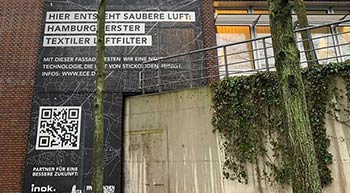
The RWTH Aachen University has opened the first innovative anti-NOX textile facade on an office building of the company ECE Europa Bau- und Projektmanagement in Hamburg, Germany. The textile facade system is a light and transparent textile facade developed by the university, in co-operation with the German companies that include ECE and INOK, Willich.
The researchers achieved the reduction of harmful nitrogen oxides (NO and NO2) by means of an innovative facade coating. The coating acts as a catalyst and binds the harmful nitrogen oxides from the city air directly to the facade surface under UV light. Oxidation processes convert the pollutants into small quantities of harmless salts. When it rains, rainfall removes the salt residues from the façade surface. The rainwater is then returned to the cycle of nature. It can seep away or be used as fertiliser for plants. In the project, samples of the rainwater are taken in order to scientifically prove the environmental compatibility, according to a press release by the university.
In addition to the contribution to health protection made by air purification, the facade does even more. As a second building envelope, it lends the building a novel, futuristic appearance and also serves as an external sun protection. Studies have already proven that the new building envelope can reduce the solar cooling load of buildings in summer by up to 78 per cent.
The facade system can be used for new buildings as well as for the subsequent energy-efficient renovation of existing buildings, thus contributing to climate protection. The new materials are 100 per cent recyclable.
In addition, the research team has
just presented a variant in which the textile is made from recycled plastic bottles. The researchers are also working on integrating micro solar cells into the textile.
In the future, the facade is to be made available to ITA as a research laboratory in the field of sustainable building technology and contribute to testing prototypes under real conditions. The project is accompanied by the Institut für Textiltechnik Aachen of RWTH Aachen University (ITA), and is part of a research project of architect Jan Serode, ITA, which started in 2016 and is carried out in close cooperation with industrial partners and various RWTH research institutes. An elaborate measurement procedure with digital measurement technology on the facade enables live monitoring. The study results should provide information about the contribution of the facade to improving air quality.
“Without the great cooperation and financial support of our partners ECE and INOK, we would not have been able to carry out the project in this way. Very special thanks also go to the company Hillebrandt Stahl- und Behälterbau from Greven, Germany, which has helped us a lot in the last twelve months to realise the facade. The company, Schüco International, with its practical experience in the field of façade technology was also helpful to us,†architect at ITA, Jan Serode said.
The researchers achieved the reduction of harmful nitrogen oxides (NO and NO2) by means of an innovative facade coating. The coating acts as a catalyst and binds the harmful nitrogen oxides from the city air directly to the facade surface under UV light. Oxidation processes convert the pollutants into small quantities of harmless salts. When it rains, rainfall removes the salt residues from the façade surface. The rainwater is then returned to the cycle of nature. It can seep away or be used as fertiliser for plants. In the project, samples of the rainwater are taken in order to scientifically prove the environmental compatibility, according to a press release by the university.
In addition to the contribution to health protection made by air purification, the facade does even more. As a second building envelope, it lends the building a novel, futuristic appearance and also serves as an external sun protection. Studies have already proven that the new building envelope can reduce the solar cooling load of buildings in summer by up to 78 per cent.
The facade system can be used for new buildings as well as for the subsequent energy-efficient renovation of existing buildings, thus contributing to climate protection. The new materials are 100 per cent recyclable.
In addition, the research team has
just presented a variant in which the textile is made from recycled plastic bottles. The researchers are also working on integrating micro solar cells into the textile.
In the future, the facade is to be made available to ITA as a research laboratory in the field of sustainable building technology and contribute to testing prototypes under real conditions. The project is accompanied by the Institut für Textiltechnik Aachen of RWTH Aachen University (ITA), and is part of a research project of architect Jan Serode, ITA, which started in 2016 and is carried out in close cooperation with industrial partners and various RWTH research institutes. An elaborate measurement procedure with digital measurement technology on the facade enables live monitoring. The study results should provide information about the contribution of the facade to improving air quality.
“Without the great cooperation and financial support of our partners ECE and INOK, we would not have been able to carry out the project in this way. Very special thanks also go to the company Hillebrandt Stahl- und Behälterbau from Greven, Germany, which has helped us a lot in the last twelve months to realise the facade. The company, Schüco International, with its practical experience in the field of façade technology was also helpful to us,†architect at ITA, Jan Serode said.