


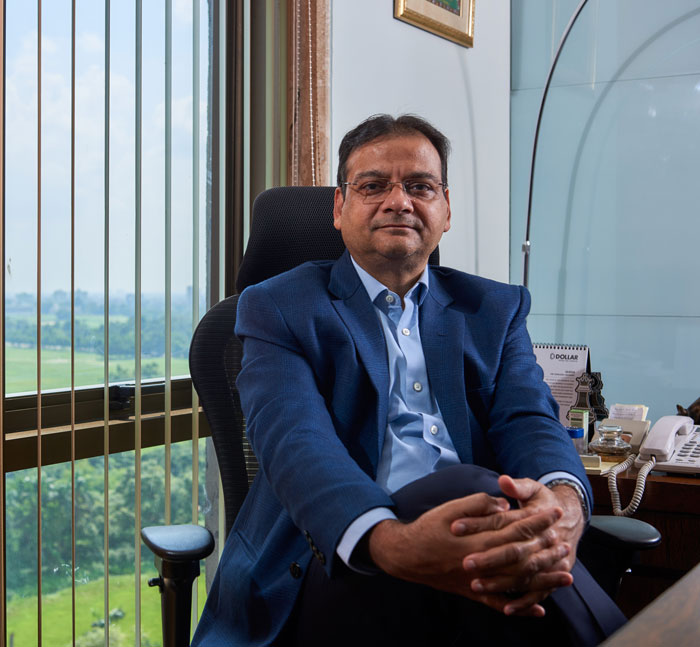
As India’s textile and apparel industry enters a phase of technology-led growth, premiumisation and global supply-chain realignment, Dollar Industries is sharpening its focus on distribution expansion, portfolio diversification and operational efficiency. Vinod Kumar Gupta, Managing Director, Dollar Industries, in an interaction with Divya Shetty, discusses the company’s growth strategy for the next three to five years, the role of Project Lakshya, emerging opportunities across e-commerce and quick commerce, and investments in automation and digitalisation.
Your company has built significant scale and business momentum. What will be the key growth drivers that help you sustain this trajectory over the next three to five years?
Over the next three to five years, we see multiple structural growth drivers that can help Dollar Industries sustain its growth trajectory. First is deeper penetration and productivity of our retail network through Project Lakshya. Having built a strong foundation of retailer mapping, digital enrolment and distributor visibility, the next phase is focused on activating more retailers, improving secondary sales and using data to make our distribution increasingly demand-led. This should help us strengthen our presence in both stronghold and under-penetrated markets.
Second, we see significant opportunity from premiumisation and portfolio expansion. We are strengthening brands such as Force NXT and Dollar Bigboss while expanding categories such as women’s innerwear, athleisure, thermals and Dollar Protect. This allows us to address a wider consumer base, improve our product mix and increase our share of the consumer’s wardrobe.
Third is the rapid scaling of modern trade, e-commerce and quick commerce. These channels are becoming increasingly important for product discovery, premiumisation and convenience. In FY26, our non-traditional channels grew 24.2 per cent, while quick commerce grew 437 per cent year-on-year, giving us confidence that these channels can become meaningful contributors over the medium term.
Fourth, we see opportunities from geographic expansion and stronger market penetration, particularly in under-served territories. Our integrated manufacturing and supply-chain capabilities provide us with the flexibility to respond to changing demand while maintaining quality and cost competitiveness.
Finally, we remain focused on operating leverage, manufacturing productivity and margin discipline. As volumes scale, better capacity utilisation, product mix, sourcing efficiencies and tighter cost management should support profitability alongside revenue growth.
So, our objective for the next three to five years is not growth at any cost. It is to build quality, profitable and cash-generative growth by combining deeper distribution, premiumisation, new-age channels, geographic expansion and operational efficiency. We believe these levers together can enable Dollar to progressively evolve from a strong innerwear brand into a broader, integrated all-wear apparel company.
What opportunities do you see for Indian manufacturers to capture a larger share of international sourcing, and what must the industry do to capitalise on them?
We believe the global diversification of textile and apparel supply chains presents a meaningful opportunity for Indian manufacturers. As international brands look to diversify sourcing and build resilient supply chains, India has several inherent advantages — a large and integrated textile ecosystem, strong cotton and fibre availability, skilled manpower and a sizeable domestic manufacturing base. India’s textile and apparel exports, including handicrafts, reached around $35.5 billion in FY26, while ready-made garments alone contributed about $15.8 billion.
However, capturing a substantially larger share of global sourcing will require the industry to move beyond being primarily a cost-competitive supplier. Scale, speed, consistency and compliance will be critical. We need greater integration across the value chain, higher manufacturing productivity, investment in automation and technology, stronger capabilities in man-made fibres and technical textiles, shorter lead times and the ability to handle large, consistent orders. The Economic Survey has also highlighted fragmentation, dependence on cotton, relatively lower technology adoption and the need to strengthen MMF capabilities as areas requiring attention.
The second important requirement is global-market orientation — developing products specifically for international consumers, strengthening design and R&D capabilities, meeting increasingly stringent sustainability and traceability requirements, and building long-term relationships with global brands rather than competing only on price.
Trade agreements can further improve India’s competitiveness. For example, the India–UK FTA provides duty-free access for 99 per cent of India’s textile exports to the UK, while government initiatives such as PM MITRA, PLI, RoSCTL and RoDTEP are aimed at improving manufacturing and export competitiveness.
So, the opportunity is clearly there, but the next phase should be about moving from “Made in India” to becoming a preferred, reliable and integrated global sourcing partner. If the industry can combine scale, technology, competitive costs, faster execution and globally relevant products, India can capture a larger and more sustainable share of the international textile and apparel value chain.
How are investments in automation, digitalisation, AI and advanced manufacturing technologies changing productivity, quality and cost competitiveness across your operations?
Technology is increasingly becoming an important enabler of productivity, quality and cost competitiveness across our operations. At Dollar Industries, our focus is on progressively automating manufacturing processes, improving machine utilisation and using digital systems to create greater visibility across production, inventory and supply-chain operations. Automation helps us improve consistency and reduce manual intervention, particularly in processes where precision and repeatability are critical.
Digitalisation is also enabling us to make decisions faster and with greater accuracy. Better integration of ERP, production and sales data allows us to monitor demand, inventory, production planning and distributor-level movement more effectively. This is particularly relevant to initiatives such as Project Lakshya, where data and digital tools are helping us improve visibility of secondary sales, retailer activation and distribution productivity.
We see AI and advanced analytics as the next layer of this transformation. The immediate opportunities are in demand forecasting, inventory optimisation, production planning, quality monitoring and identifying inefficiencies across the value chain. Rather than adopting technology simply for the sake of automation, our approach is to focus on areas where it can deliver measurable improvements in throughput, quality, working capital and operating costs.
Over the next three to five years, we expect technology to increasingly help us build a more agile, data-driven and efficient manufacturing and supply-chain ecosystem. The objective is ultimately to achieve higher productivity and consistent quality while supporting scale without a proportional increase in the cost base.
With sustainability increasingly influencing both customer and investor decisions, what major investments are you making in areas such as renewable energy, water management, circularity, sustainable materials and decarbonisation?
Sustainability is increasingly becoming an important part of how we think about the long-term competitiveness of our business. At Dollar Industries, our approach is focused on improving resource efficiency across manufacturing and the supply chain, while progressively reducing the environmental footprint of our operations.
Our key areas of focus include energy efficiency, renewable energy, water conservation, responsible manufacturing and reduction of process waste. We are continuously evaluating opportunities to increase the use of renewable energy and improve energy efficiency across our manufacturing facilities. At the same time, better process controls and water-management practices are helping us optimise consumption and reduce wastage.
On the product side, we are also evaluating greater use of sustainable and recycled materials, wherever they are commercially and technically viable, while maintaining the quality, comfort and performance expected by our consumers. We see circularity as a longer-term opportunity, particularly through better material utilisation, reduction of manufacturing waste and responsible sourcing.
Importantly, our sustainability approach is being integrated with our broader operational-efficiency agenda. Investments that reduce energy, water, raw-material consumption and waste can simultaneously improve our environmental footprint and our cost structure. Going forward, we intend to progressively strengthen our measurement and reporting of sustainability parameters and identify opportunities for further decarbonisation across our operations and value chain.
Ultimately, our objective is to build a more resource-efficient and resilient business, where sustainability supports both our environmental responsibilities and long-term shareholder value.
What are your major capacity expansion, product diversification or value-added manufacturing plans, and which markets or product segments do you expect to contribute most strongly to the next phase of growth?
Our next phase of growth will be driven by a combination of better utilisation of our existing manufacturing capabilities, selective capacity augmentation, portfolio diversification and deeper market penetration. We have an integrated manufacturing platform with four facilities and backward integration across key processes, which gives us the flexibility to scale volumes while maintaining quality and cost competitiveness. Our immediate focus is therefore to improve capacity utilisation and productivity, while adding capacity selectively in line with demand rather than pursuing capacity expansion for its own sake.
On the product side, we are consciously moving beyond our traditional core hosiery portfolio towards a broader all-wear apparel proposition. Premium and value-added categories such as Force NXT, Dollar Bigboss, Dollar Woman, athleisure, thermals and Dollar Protect are important parts of this strategy. Force NXT delivered 16.5 per cent value growth and 26.2 per cent volume growth in FY26, while Dollar Protect delivered 18 per cent volume growth, demonstrating the potential of these categories.
We also see meaningful headroom in women’s wear, kidswear, athleisure and functional/seasonal categories. The objective is to increase the contribution of these categories while continuing to strengthen our core men’s and everyday portfolio.
From a market perspective, deeper penetration in our existing strongholds and expansion into under-served geographies will be key. Project Lakshya Phase 2 is focused on increasing active retailers in stronghold markets and developing market-specific strategies for non-dominant territories. Alongside this, e-commerce, modern trade and particularly quick commerce are becoming increasingly important routes to consumers.
So, the growth model is essentially scale plus premiumisation plus distribution productivity. We want to increase volumes through stronger retail penetration, improve the product mix through higher-value categories, and use our manufacturing and supply-chain capabilities to support profitable growth. Over the medium term, we expect this combination to strengthen Dollar’s evolution from a primarily innerwear-led company into a broader, integrated all-wear apparel business.
Looking towards 2030, what do you believe will differentiate India’s leading textile companies from the rest — scale, technology, innovation, sustainability, brand building or global market presence — and where is your company placing its biggest bets?
Looking towards 2030, we believe the leading textile and apparel companies will be differentiated not by any single factor, but by their ability to combine scale, technology, innovation, brands, distribution and sustainability into one integrated business model.
Scale will remain important because it provides purchasing power, manufacturing efficiency and the ability to invest continuously in technology and brands. However, scale by itself will not be sufficient. Companies will need to be increasingly data-driven and technology-enabled, with greater automation, better demand forecasting, supply-chain visibility and faster response to changing consumer preferences.
We also believe premiumisation and brand building will become increasingly important. The Indian consumer is becoming more quality-conscious and is willing to spend more for better products, functionality, design and comfort. This creates an opportunity for established Indian brands to move up the value curve rather than compete purely on price.
For Dollar Industries, our biggest bets are therefore around distribution expansion, brand premiumisation, product diversification and technology-led operational efficiency. Project Lakshya is aimed at improving the productivity and depth of our retail network, while brands such as Force NXT and Dollar Bigboss provide platforms for premium and value-added growth. We are also expanding into categories such as women’s innerwear, athleisure, thermals and functional products, thereby broadening our addressable market.
At the same time, we see e-commerce, modern trade and quick commerce becoming increasingly important in reaching younger consumers and creating new consumption occasions. Our manufacturing capabilities and backward integration provide a foundation to support this expansion while maintaining quality and cost competitiveness.
Finally, sustainability will increasingly move from being a compliance requirement to becoming an important element of operational efficiency and brand credibility. Energy efficiency, responsible sourcing, resource conservation and reduction of waste will therefore remain areas of focus.
So, as we look towards 2030, our ambition is to build Dollar as a scaled, technology-enabled, multi-category and increasingly premium Indian apparel brand, with a strong distribution ecosystem and the capabilities to participate more meaningfully in both domestic and international markets.